


Holding up portraits of detained Chinese democracy activists and lighting candles, hundreds of people gathered in Liberty Square in Taipei — where thousands had rallied in support of students and others protesting in Beijing’s Tiananmen Square 25 years ago — to mark the 25th anniversary of the Tiananmen Square Massacre.
“Free prisoners of conscience! Let human rights reign,” the participants chanted, while holding small candles in their hands to show their support for democracy in China as they remembered the tragedy in 1989.
“I would like to thank Taiwanese for standing on the same side as Chinese democracy activists,” exiled Chinese dissident Wuer Kaixi, one of the Tiananmen student leaders, told the rally. “We have not succeeded in our quest for democracy, and I would like to urge all Taiwanese to continue standing with us.”
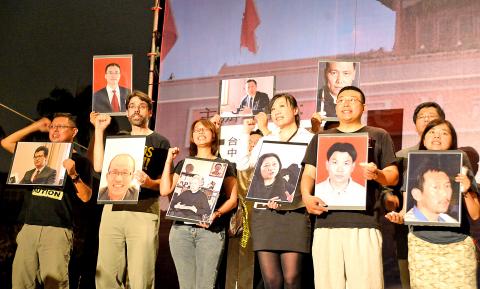
Photo: Wang Yi-sung, Taipei Times
It is unimaginable that the dictatorship of the Chinese Communist Party still stands, he said.
“I sometimes lament the fact that, since the Chinese students fired the first shot in 1989, we have not been able to succeed in 25 years,” the Uighur activist said.
However, Wuer Kaixi said he has never lost hope, because over the course of the past century, several fascist and communist regimes elsewhere in the world have fallen.
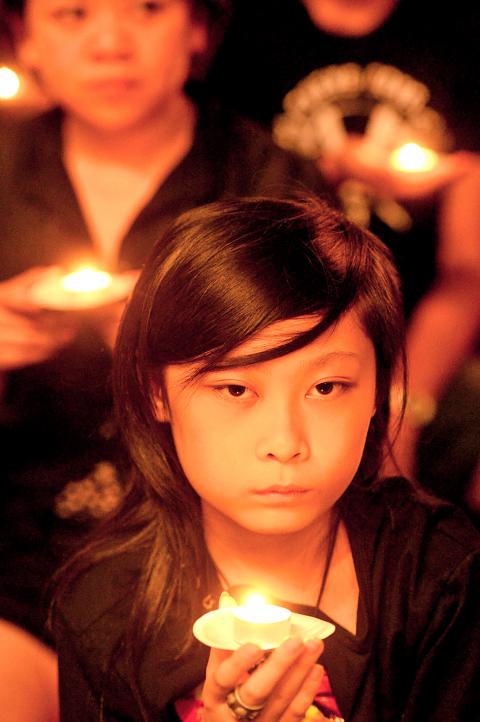
Photo: Wang Yi-sung, Taipei Times
During the recent Sunflower movement protests in Taiwan, “some may have been surprised to realize how easily freedom could be lost, even when we are a strait away” from China, he said, urging the crowd to stand in line with Chinese democracy activists in the fight against dictatorship.
Long-time human rights advocate and attorney Wellington Koo (顧立雄) made a similar appeal.
“Having been through what we have been through together, we may feel that what happened in Tiananmen Square 25 years ago is no longer so distant,” Koo said.
“Remembering Tiananmen is not only about remembering what happened there 25 years ago, or those Chinese student activists on the square, it is also about showing our insistence on maintaining our way of life and our democracy,” he said.
“Let’s all join the campaign together, to make sure our way of life would stay on forever,” Koo added.
Exiled Chinese dissident writer Yu Jie (余杰) said the Tiananmen Square Massacre had been a wake-up call for him, leading him to the realization that he should lead a life to uphold certain values when, as a 16-year-old sitting in his home in a small town in China’s Sichuan Province, he heard gunshots over the radio from far away in Beijing.
“Eight years ago, I was in China, my friends and I — a total of six people — gathered to remember the massacre,” he said. “I could never imagine that, eight years later, I would be in Taipei, remembering the tragedy with hundreds of people.”
To help Taiwanese better understand the meaning of Tiananmen Square Massacre, “I would call it China’s 228 Massacre,” he said.
Later in the rally, people remembered the tragedy by singing, reciting poetry and saying prayers in the hope that democracy and freedom would reign over China soon.

The Tourism Administration yesterday announced that it would reward repeat international visitors with incentives of up to NT$8,000 to boost inbound tourism. The incentives are available to all international tourists, it said, adding that repeat visitors would be rewarded with NT$5,000 and would receive an additional NT$3,000 if they bring travel companions. The nation received 2,990,657 inbound visitors during the first quarter, marking a 3.8 percent increase from the same period last year, agency data showed. Japanese nationals are among groups visiting Taiwan the most. About 1.48 million Japanese tourists arrived last year, a year-on-year increase of more than 12
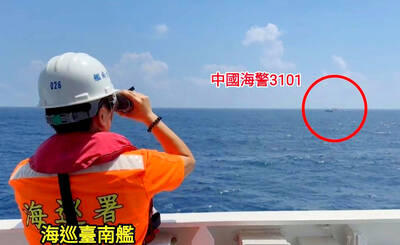
‘BRAZEN’: The holiday did not stop China from activities that infringe on Taiwan’s maritime jurisdiction, but the CGA is ready to defend the nation, Kuan Bi-ling said Beijing is intensifying maritime pressure on Taiwan, but the nation will never yield, Ocean Affairs Council Deputy Minister Sung Chen-en (宋承恩) said. The Coast Guard Administration (CGA) has adopted a “shadowing and monitoring” approach to avoid falling into a Chinese trap to escalate tensions and deepen the conflict, Sung said in an interview published yesterday in the Chinese-language Liberty Times (the Taipei Times’ sister newspaper). China Coast Guard formations patrolling waters east of Taiwan, as well as official Chinese vessels entering areas around Itu Aba Island (Taiping Island, 太平島) and Pratas Islands (Dongsha Islands, 東沙群島) show Beijing’s attempts to significantly step up
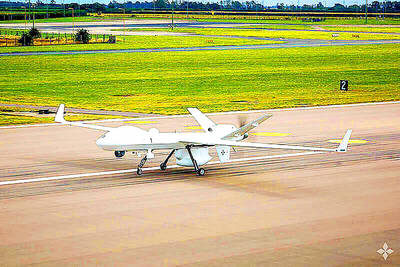
BOOST: By operating the same advanced systems as the US military, Taiwan would be better positioned to share and integrate intelligence with partners, an expert said The first batch of MQ-9B SkyGuardian drones has arrived in Taiwan, and is being assembled and tested by drone manufacturer General Atomics and the military ahead of flight trials as part of the air force’s acquisition to bolster its aerial surveillance capabilities, a source said yesterday. The air force allocated a budget of NT$21.7 billion (US$687 million) from 2022 to 2029 to procure four MQ-9B uncrewed aerial vehicles (UAVs) manufactured by General Atomics along with associated equipment such as ground control stations. The US has agreed to deliver the four MQ-9Bs to Taiwan in two batches this year and next

Taiwanese firms’ China investments have dwindled to less than 1 percent of their total foreign investments, putting China-based investments on track for a record low this year, Ministry of Economic Affairs data showed. Taiwan’s investments abroad in the first five months of this year reached US$35.92 billion, Department of Investment Review data showed. Investments outside China totaled US$35.61 billion, up 133.94 percent year-on-year, while investments in China totaled US$310.3 million, down 32.3 percent and about 0.86 percent of the total, data showed. Major overseas projects included Taiwan Semiconductor Manufacturing Co’s (TSMC, 台積電) US$30 billion capital injection into an overseas subsidiary,


 RSS
RSS