


Taiwan has made significant progress in the past 30 years in terms of human rights protection, Amnesty International (AI) secretary-general Salil Shetty said yesterday.
However, he said there is still room for improvement — especially when it comes to police brutality and the use of torture against peaceful demonstrators.
On his first visit to Taiwan, Shetty said it does not feel like an unfamiliar country, because AI, along with other global human rights organizations, have worked with Taiwan before, including efforts to rescue political prisoners during the Martial Law era.
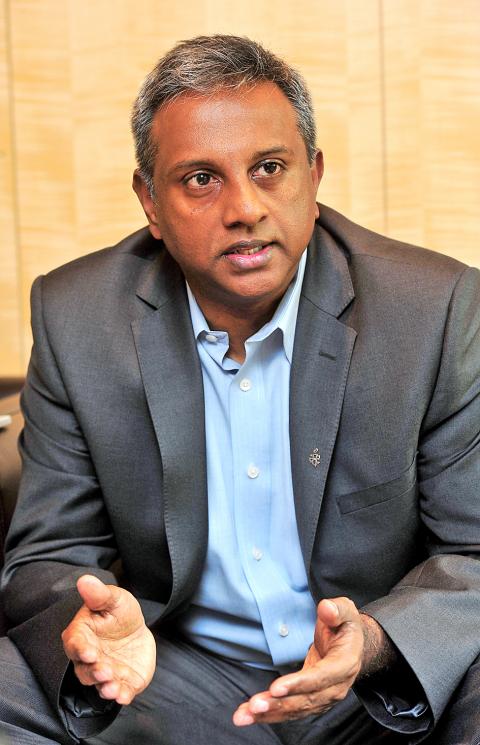
Photo: Chien Jung-fong, Taipei Times
After several days in the country, which has included traveling down to Greater Kaohsiung, Shetty said he has enjoyed Taiwan’s landscape and people’s dynamism and energy, especially when it comes to human rights issues.
“I believe events in the past two or three months, such as the Sunflower movement, have been helpful in raising public awareness and increasing involvement in human rights campaigns,” Shetty said in an interview with the Taipei Times yesterday.
However, when it comes to how the government responded to those demonstrations, Shetty shakes his head.
“We haven’t made detailed research, but from all the assessments we’ve made so far, there have been several cases in which the police have used excessive force in crowd control, especially when facing peaceful, sitting demonstrators,” he said. “In a democratic society, peaceful assembly is a fundamental right of the people — it is also stated in the Taiwanese Constitution — and it is the government’s responsibility to protect it.”
“The use of public spaces for public protests is a legitimate use, as long as it’s for peaceful demonstration,” he added.
Shetty said that, for instance, the use of water cannons against peaceful demonstrators is in violation of international human rights standards. “There is a set of UN guidelines for police handling of public protests, which especially stresses the point that all measures must be ‘necessary’ and ‘proportional,’” he said.
Shetty said he brought up the issue in a meeting with Vice President Wu Den-yih (吳敦義) on Friday and called on the government to take immediate action on allegations and complaints of excessive use of force by the police, as well as provide better training for police crowd control and revise the Assembly and Parade Act (集會遊行法), which falls outside of international standards.
Speaking about the death of late army corporal Hung Chung-chiu (洪仲丘) and the cases of death-row inmates Cheng Hsing-tse (鄭性澤) and Chiu Ho-shun (邱和順), Shetty said the three cases show that — long after Martial Law was lifted in 1987 — torture still exists in the nation, since Hung died of torture, while Cheng and Chiu have both said that they were tortured to extract the confessions that led to their death sentence.
“Besides the issue of torture, reforms should be made in giving prisoners proper medical treatment — for instance, your former president Chen Shui-bian [陳水扁] is suffering because he has not received proper treatment,” Shetty said.
“Overcrowding in most prisons is also not good for prisoners’ health,” he added.
Shetty said that although Wu listened to him closely and expressed agreement, he remains skeptical about whether the vice president is serious about making changes.
“In AI, we go by actions, not words,” he added.
Asked about recent public calls for capital punishment for Cheng Chieh (鄭捷), the suspect in the deaths of four people in a knife attack that also wounded 24 on Taipei’s Mass Rapid Transit system last month, Shetty said that while AI members would stand in sympathy and solidarity with victims and their families, “we do not support the death penalty.”
“When we started the anti-death-penalty campaign three decades ago, there were only 30 countries without the death penalty. Now, there are only about 30 countries that still have it,” he said. “Research shows that the death penalty has nothing to do with the crime rate. In fact, the crime rate has fallen in many countries where the death penalty was abolished.”
“The question to ask is why the government is unable to prevent the crime in the first place,” he added.
Shetty also urged Taiwanese to show more concern about human rights violations in China.
“Taiwan has geographical proximity to China, which has grown economically, but does not respect human rights,” he said. “Taiwan shows the contrast: You have economic growth with human rights protection.”
“However, if you want to sustain economic growth and social stability, you need to have more freedom,” Shetty said.
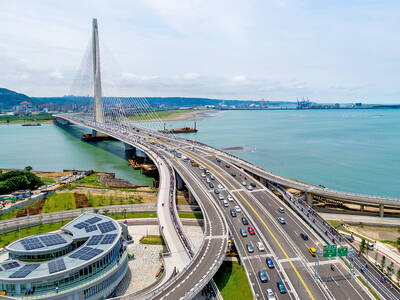
The Ministry of Transportation and Communications yesterday inaugurated the Danjiang Bridge across the Tamsui River in New Taipei City, saying that the structure would be an architectural icon and traffic artery for Taiwan. Feted as a major engineering achievement, the Danjiang Bridge is 920m long, 211m tall at the top of its pylon, and is the longest single-pylon asymmetric cable-stayed bridge in the world, the government’s Web site for the structure said. It was designed by late Iraqi-British architect Zaha Hadid. The structure, with a maximum deck of 70m, accommodates road and light rail traffic, and affords a 200m navigation channel for boats,
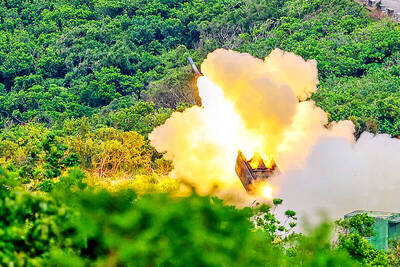
PRECISION STRIKES: The most significant reason to deploy HIMARS to outlying islands is to establish a ‘dead zone’ that the PLA would not dare enter, a source said A High Mobility Artillery Rocket System (HIMARS) would be deployed to Penghu County and Dongyin Island (東引) in Lienchiang County (Matsu) to force the Chinese military to retreat at least 100km from the coastline, a military source said yesterday. Taiwan has been procuring HIMARS and Army Tactical Missile Systems (ATACMS) from the US in batches. Once all batches have been delivered, Taiwan would possess 111 HIMARS units and 504 ATACMS, which have a range of 300km. Considering that “offense is the best defense,” the military plans to forward-deploy the systems to outlying islands such as Penghu and Dongyin so that
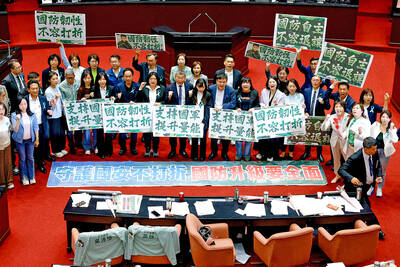
WHAT WAS ALL THAT FOR? Jaw Shaw-kong said that Cheng Li-wen had pushed for more drastic cuts and attacked him, just for the outcome to be nearly identical to his bill The legislature yesterday passed a supplementary budget bill to fund the purchase of separate packages of US military equipment, with the combined amount of spending capped at NT$780 billion (US$24.8 billion). The Chinese Nationalist Party (KMT) and Taiwan People’s Party (TPP) used their legislative majority to pass the bill, which runs until 2033 and has two main funding provisions. One was for NT$300 billion of arms sales already approved by the US for Taiwan on Dec. 17 last year, the other was for NT$480 billion for another arms package expected to be announced by Washington. The bill, which fell short of the NT$1.25

‘CLEAR MESSAGE’: The bill would set up an interagency ‘tiger team’ to review sanctions tools and other economic options to help deter any Chinese aggression toward Taiwan US Representative Young Kim has introduced a bill to deter Chinese aggression against Taiwan, calling for an interagency “tiger team” to preplan coordinated sanctions and economic measures in response to possible Chinese military or political action against Taiwan. “[Chinese President] Xi Jinping [習近平] has directed the People’s Liberation Army to be ready to invade Taiwan by 2027. China has a plan. America should have one too,” Kim said in a news release on Thursday last week. She introduced the “Deter PRC [People’s Republic of China] aggression against Taiwan act” to “ensure the US has a coordinated sanctions strategy ready should


 RSS
RSS