


The Taipei District Prosecutors’ Office yesterday appealed a ruling to release Farglory Land Development Co (遠雄建設) chairman Chao Teng-hsiung (趙藤雄) on bail of NT$5 million (US$166,000) and Wei Chun-hsiung (魏春雄) — a company executive — on NT$1 million bail, in a corruption case.
Prosecutors lodged their appeal against Chao’s release immediately after the court’s announcement, fearing that the suspects might conspire to pervert the course of justice if left out on bail.
Chao was banned from leaving the country and released on condition that he report to the Taipei District Court daily, the court ruling said yesterday morning.
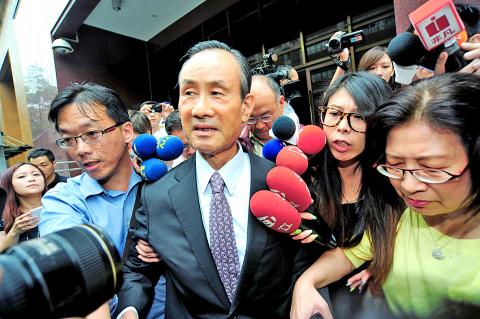
Photo: Lo Pei-der, Taipei Times
Following the hearing at 6:30am yesterday, the Taipei District Court decided not to rule in favor of the prosecutors’ request to detain Yeh and Tsai on suspicion of corruption.
Chao has been accused of offering bribes to former Taoyuan County deputy commissioner Yeh Shih-wen (葉世文) through middleman Tsai Jen-hui (蔡仁惠) — a retired professor — regarding a bid that the company had secured earlier last month for a government housing project.
In raids since early Friday morning, prosecutors and officials from the Ministry of Justice’s Agency Against Corruption have seized NT$17 million in cash from Yeh’s home in Taipei and about NT$1.12 million in cash from his office in the county government, while 18 people were summoned for questioning throughout the day.
According to unnamed sources, Tsai allegedly picked up the money from a Farglory office in Taipei under instruction from Chao and Wei and was told that the money must be delivered to Yeh before the Dragon Boat Festival holiday tomorrow.
After allegedly picking up the money, Tsai left the office with a wheeled suitcase and on Thursday night met Yeh at a Japanese restaurant near the SOGO department store on Zhongxiao E Road in Taipei where he gave the case to Yeh, the sources said.
The sources said that prosecutors had been trailing Yeh at the time that Tsai reportedly gave him the suitcase.
They followed Yeh home and stayed outside his apartment overnight to ensure that he did not leave with the bag.
The next day when the prosecutors searched his home, they found the suitcase, which weighed 17kg and contained the NT$17 million, in cash, the sources said.
Yeh maintained his innocence during questioning, saying that he borrowed the money from Chao and did not take a bribe, the sources said.
Chao also denied involvement in any bribery, the sources added.
Tsai said that two Farglory employees, Hsu Tzu-chiang (許自強) and Chou Ming-hung (周銘弘), gave him the money and he then delivered the money to Yeh.
Hsu and Chou both confirmed Tsai’s account.
Farglory secured the affordable housing project in Bade City (八德) with a bid of NT$1.3 billion and on May 8 signed a contract with the government.
Meanwhile, prosecutors said yesterday that they are also investigating another case of suspected corruption allegedly involving Yeh.
Investigators said that during questioning, Tsai accused Chao of bribing Yeh to obtain another government housing project in New Taipei City’s Linkou (林口) in 2012, when Yeh was director-general of the Ministry of the Interior’s Construction and Planning Agency.
Additional reporting by CNA
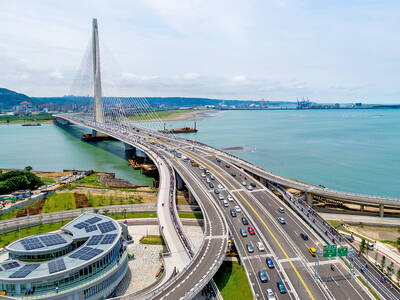
The Ministry of Transportation and Communications yesterday inaugurated the Danjiang Bridge across the Tamsui River in New Taipei City, saying that the structure would be an architectural icon and traffic artery for Taiwan. Feted as a major engineering achievement, the Danjiang Bridge is 920m long, 211m tall at the top of its pylon, and is the longest single-pylon asymmetric cable-stayed bridge in the world, the government’s Web site for the structure said. It was designed by late Iraqi-British architect Zaha Hadid. The structure, with a maximum deck of 70m, accommodates road and light rail traffic, and affords a 200m navigation channel for boats,
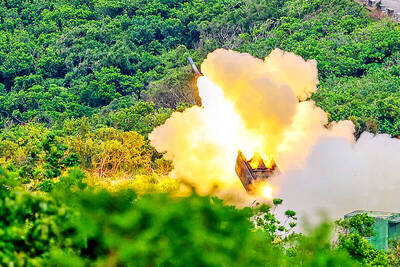
PRECISION STRIKES: The most significant reason to deploy HIMARS to outlying islands is to establish a ‘dead zone’ that the PLA would not dare enter, a source said A High Mobility Artillery Rocket System (HIMARS) would be deployed to Penghu County and Dongyin Island (東引) in Lienchiang County (Matsu) to force the Chinese military to retreat at least 100km from the coastline, a military source said yesterday. Taiwan has been procuring HIMARS and Army Tactical Missile Systems (ATACMS) from the US in batches. Once all batches have been delivered, Taiwan would possess 111 HIMARS units and 504 ATACMS, which have a range of 300km. Considering that “offense is the best defense,” the military plans to forward-deploy the systems to outlying islands such as Penghu and Dongyin so that
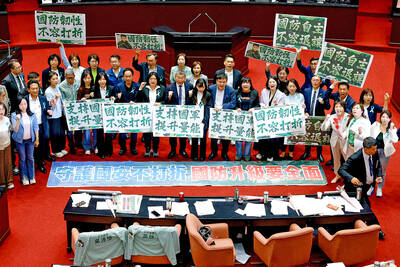
WHAT WAS ALL THAT FOR? Jaw Shaw-kong said that Cheng Li-wen had pushed for more drastic cuts and attacked him, just for the outcome to be nearly identical to his bill The legislature yesterday passed a supplementary budget bill to fund the purchase of separate packages of US military equipment, with the combined amount of spending capped at NT$780 billion (US$24.8 billion). The Chinese Nationalist Party (KMT) and Taiwan People’s Party (TPP) used their legislative majority to pass the bill, which runs until 2033 and has two main funding provisions. One was for NT$300 billion of arms sales already approved by the US for Taiwan on Dec. 17 last year, the other was for NT$480 billion for another arms package expected to be announced by Washington. The bill, which fell short of the NT$1.25
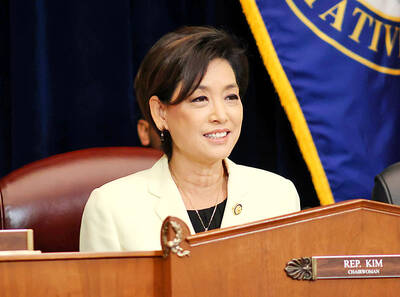
‘CLEAR MESSAGE’: The bill would set up an interagency ‘tiger team’ to review sanctions tools and other economic options to help deter any Chinese aggression toward Taiwan US Representative Young Kim has introduced a bill to deter Chinese aggression against Taiwan, calling for an interagency “tiger team” to preplan coordinated sanctions and economic measures in response to possible Chinese military or political action against Taiwan. “[Chinese President] Xi Jinping [習近平] has directed the People’s Liberation Army to be ready to invade Taiwan by 2027. China has a plan. America should have one too,” Kim said in a news release on Thursday last week. She introduced the “Deter PRC [People’s Republic of China] aggression against Taiwan act” to “ensure the US has a coordinated sanctions strategy ready should


 RSS
RSS