


The Taipei District Court yesterday ruled in favor of the Ministry of National Defense against former minister of national defense Chen Chao-min (陳肇敏) over a miscarriage of justice 18 years ago in which 21-year-old air force serviceman Chiang Kuo-ching (江國慶) was wrongly executed.
According to the ruling, Chen and other military officials responsible for the wrongful conviction of Chiang in 1996 and his execution the following year were liable to compensate the ministry a total of NT$59.55 million (US$1.98 million).
In a posthumous ruling in 2011, Chiang was acquitted of the charges that he sexually abused and murdered a five-year-old girl.
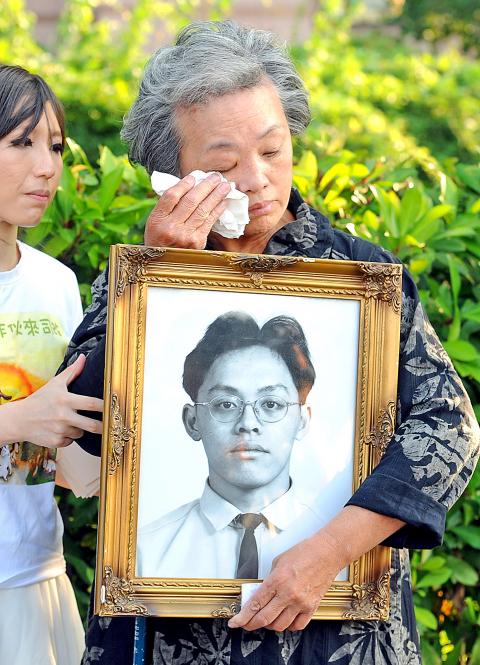
Photo: Liao Chen-huei, Taipei Times
His case was reopened only after the Control Yuan found in 2010 that Chiang had been tortured by military investigators before a speedy trial ordered by Chen, who was then the air force commander-in-chief.
After offering Chiang’s family NT$130 million in 2011 in compensation for his death, the ministry sued Chen and other military officials involved in the wrongful execution in 2012, because they had refused to admit guilt for the case, except for former counterintelligence agent Teng Chun-huan (鄧震環), who had paid the ministry NT$2.8 million.
The ministry demanded that Chen, former air force command legal department director Tsao Chai-sheng (曹嘉生), former military prosecutor Huang Jui-peng (黃瑞鵬) and air force counterintelligence officials Ko Chung-ching (柯仲慶), Ho Tsu-yao (何祖耀) and the heirs of Lee Chih-jen (李植仁), pay the ministry NT$14.74 million each.
The Taipei District Court ordered Chen and Ko to pay the ministry NT$14.74 million each, Tsao and Ho NT$8.59 million each, and Lee’s children NT$12.89 million, while Huang was found not liable for compensation.
The ruling was not a final verdict.
“We will consider whether to appeal the ruling after we read the court’s judgement,” said Yang Tsung-chien (楊從健), head of the Military Northern District Court, which filed the lawsuit on behalf of the ministry.
The ministry respected the ruling, but the amount of compensation imposed on the defendants was short of what the ministry had requested, Yang said.
Judicial Reform Foundation executive director Kao Jung-chih (高榮志) commended the ruling, but said that an investigation by prosecutors at the Taipei District Prosecutors’ Office should quicken its pace and the military officials involved should be held criminally accountable.
“It’s been a year and a half since the Taipei District Prosecutors’ Office’s decision not to indict Chen and the others involved was rejected by the Taiwan High Prosecutors’ Office. The Taipei District Prosecutors’ Office could be abusing its power by not prosecuting the military officials involved,” Kao said.
Chen could not be reached for comment yesterday.
Ho complained about the ruling to reporters last night.
He said he did not intend to have Chiang falsely convicted, adding that he only did what he was told to do.
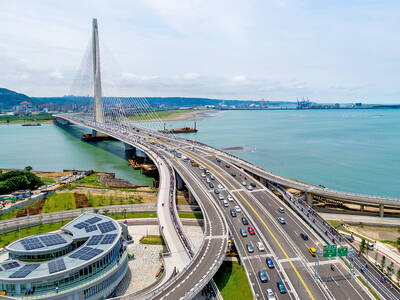
The Ministry of Transportation and Communications yesterday inaugurated the Danjiang Bridge across the Tamsui River in New Taipei City, saying that the structure would be an architectural icon and traffic artery for Taiwan. Feted as a major engineering achievement, the Danjiang Bridge is 920m long, 211m tall at the top of its pylon, and is the longest single-pylon asymmetric cable-stayed bridge in the world, the government’s Web site for the structure said. It was designed by late Iraqi-British architect Zaha Hadid. The structure, with a maximum deck of 70m, accommodates road and light rail traffic, and affords a 200m navigation channel for boats,
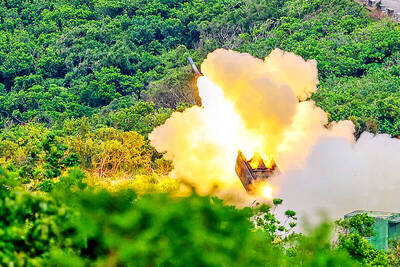
PRECISION STRIKES: The most significant reason to deploy HIMARS to outlying islands is to establish a ‘dead zone’ that the PLA would not dare enter, a source said A High Mobility Artillery Rocket System (HIMARS) would be deployed to Penghu County and Dongyin Island (東引) in Lienchiang County (Matsu) to force the Chinese military to retreat at least 100km from the coastline, a military source said yesterday. Taiwan has been procuring HIMARS and Army Tactical Missile Systems (ATACMS) from the US in batches. Once all batches have been delivered, Taiwan would possess 111 HIMARS units and 504 ATACMS, which have a range of 300km. Considering that “offense is the best defense,” the military plans to forward-deploy the systems to outlying islands such as Penghu and Dongyin so that

WHAT WAS ALL THAT FOR? Jaw Shaw-kong said that Cheng Li-wen had pushed for more drastic cuts and attacked him, just for the outcome to be nearly identical to his bill The legislature yesterday passed a supplementary budget bill to fund the purchase of separate packages of US military equipment, with the combined amount of spending capped at NT$780 billion (US$24.8 billion). The Chinese Nationalist Party (KMT) and Taiwan People’s Party (TPP) used their legislative majority to pass the bill, which runs until 2033 and has two main funding provisions. One was for NT$300 billion of arms sales already approved by the US for Taiwan on Dec. 17 last year, the other was for NT$480 billion for another arms package expected to be announced by Washington. The bill, which fell short of the NT$1.25

‘CLEAR MESSAGE’: The bill would set up an interagency ‘tiger team’ to review sanctions tools and other economic options to help deter any Chinese aggression toward Taiwan US Representative Young Kim has introduced a bill to deter Chinese aggression against Taiwan, calling for an interagency “tiger team” to preplan coordinated sanctions and economic measures in response to possible Chinese military or political action against Taiwan. “[Chinese President] Xi Jinping [習近平] has directed the People’s Liberation Army to be ready to invade Taiwan by 2027. China has a plan. America should have one too,” Kim said in a news release on Thursday last week. She introduced the “Deter PRC [People’s Republic of China] aggression against Taiwan act” to “ensure the US has a coordinated sanctions strategy ready should


 RSS
RSS