


More than a dozen groups yesterday protested outside the Straits Exchange Foundation’s (SEF) headquarters in Taipei’s Dazhi (大直) area against a visit by Chen Yunlin (陳雲林), a former chairman of China’s Association for Relations Across the Taiwan Straits (ARATS).
Chen arrived on Monday for a “cultural exchange” visit, leading a group called ARATS Chinese Arts Exchange, but the protesters said Beijing should release dissident artists before talking about exchanges in the arts.
The Chinese group yesterday attended a conference at the foundation’s headquarters about cross-strait cultural communication that featured artists from the two nations.
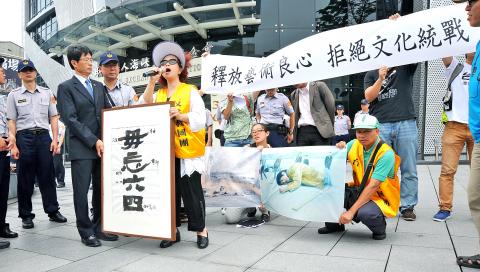
Photo: Liu Hsin-de, Taipei Times
Also at the conference was Mainland Affairs Council Deputy Minister Chang Hsien-yao (張顯耀), who also serves as vice chairman of the foundation, and former premier Liu Chao-shiuan (劉兆玄), who is president of the General Association of Chinese Culture.
The protesters held up banners that read: “Release the conscience of the arts; [we] refuse political efforts aimed at unification in the name of culture,” as well as two paintings by Chinese artist Chen Guang (陳光).
The groups said that while Chen Yunlin and his delegation were taking part in an cultural exchange, many Chinese activists, such as Chen Guang, have been detained ahead of the 25th anniversary of the Tiananmen Square Massacre on June 4.
“Chen Guang is a soldier turned artist. He was one of the ones who had to clear the square in those days and has been creating art using that experience as inspiration,” New School for Democracy secretary-general Wang Hsing-chung (王興中) said.
“Many believe Chen Guang was detained because of a performance art piece that he staged privately in his studio,” Wang said.
“As a democratic country with human rights as one of its key values, Taiwan will not tolerate the Chinese Communist government’s double-faced tactics: Throwing artists into prison without hesitation [in China] on the one hand, while trumpeting its ‘one Chinese nation’ stance [in Taipei] in the name of arts on the other,” the alliance said.
Representatives of Taiwan Friends of Uighurs (TFU) and Students for a Free Tibet Taiwan (SFT) were among the protesters, with TFU chairman Paul Lin (林保華) and SFT chairman Fong Jyun-shan (奉君山) both raising concerns about the Chinese government’s efforts to marginalize and eventually eradicate minority groups’ cultures.
Art cannot bloom where fear abounds, and “fear is a ruler’s most powerful tool,” Fong said.
He criticized the announcement by Taiwan’s government that it would compile a list of people or groups with “the highest potential to commit crimes.”
“This is the blacklist of our age. The authorities could easily detain people who hold different political views, excusing such actions by evoking public fear, just like they are doing with pre-emptive detentions,” Fong said.
Pro-independence group Flanc Radical, which is largely made up of young people, said Chen Yunlin’s claim to be on a “purely cultural exchange visit” was not believable.
They criticized his framing of the exchange as one among members of the “Chinese nation” — a term the group said was “racial-political” — and his ignoring that Taiwan and China are two nations with different histories, cultural progression and political-economic systems.
The groups left a piece of calligraphy by Taiwanese calligrapher Chen Shih-hsien (陳世憲) — which reads “Remembering Tiananmen. Without Freedom, No Art” — as a gift for Chen Yunlin.
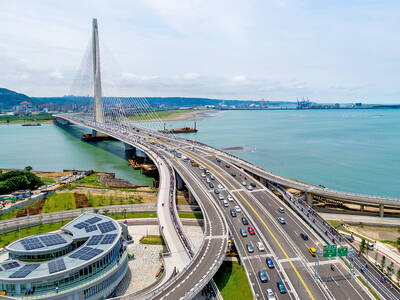
The Ministry of Transportation and Communications yesterday inaugurated the Danjiang Bridge across the Tamsui River in New Taipei City, saying that the structure would be an architectural icon and traffic artery for Taiwan. Feted as a major engineering achievement, the Danjiang Bridge is 920m long, 211m tall at the top of its pylon, and is the longest single-pylon asymmetric cable-stayed bridge in the world, the government’s Web site for the structure said. It was designed by late Iraqi-British architect Zaha Hadid. The structure, with a maximum deck of 70m, accommodates road and light rail traffic, and affords a 200m navigation channel for boats,
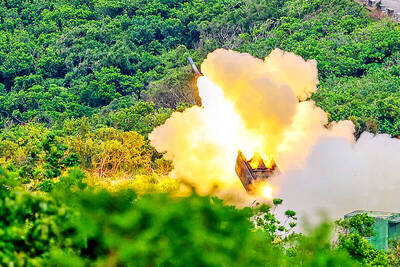
PRECISION STRIKES: The most significant reason to deploy HIMARS to outlying islands is to establish a ‘dead zone’ that the PLA would not dare enter, a source said A High Mobility Artillery Rocket System (HIMARS) would be deployed to Penghu County and Dongyin Island (東引) in Lienchiang County (Matsu) to force the Chinese military to retreat at least 100km from the coastline, a military source said yesterday. Taiwan has been procuring HIMARS and Army Tactical Missile Systems (ATACMS) from the US in batches. Once all batches have been delivered, Taiwan would possess 111 HIMARS units and 504 ATACMS, which have a range of 300km. Considering that “offense is the best defense,” the military plans to forward-deploy the systems to outlying islands such as Penghu and Dongyin so that
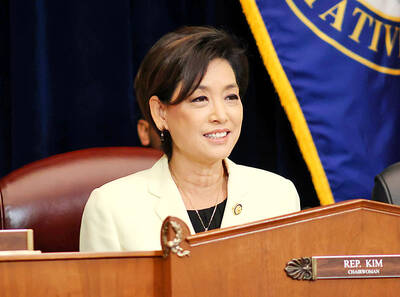
‘CLEAR MESSAGE’: The bill would set up an interagency ‘tiger team’ to review sanctions tools and other economic options to help deter any Chinese aggression toward Taiwan US Representative Young Kim has introduced a bill to deter Chinese aggression against Taiwan, calling for an interagency “tiger team” to preplan coordinated sanctions and economic measures in response to possible Chinese military or political action against Taiwan. “[Chinese President] Xi Jinping [習近平] has directed the People’s Liberation Army to be ready to invade Taiwan by 2027. China has a plan. America should have one too,” Kim said in a news release on Thursday last week. She introduced the “Deter PRC [People’s Republic of China] aggression against Taiwan act” to “ensure the US has a coordinated sanctions strategy ready should
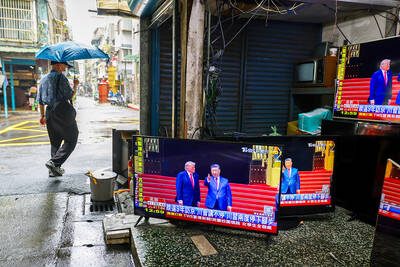
TAIWAN ISSUE: US treasury secretary Scott Bessent said on the first day of meetings that ‘it wouldn’t be a US-China summit without the Taiwan issue coming up’ There were no surprises on the first day of the summit between US President Donald Trump and Chinese President Xi Jinping (習近平), the Mainland Affairs Council (MAC) said yesterday, as the government reiterated that cross-strait stability is crucial to the Asia-Pacific region, as well as the world. As the two presidents met for a highly anticipated summit yesterday, Chinese state media reported that Xi warned Trump that missteps regarding Taiwan could push their two countries into “conflict.” Trump arrived in China with accolades for his host, calling Xi a “great leader” and “friend,” and extending an invitation to visit the White House


 RSS
RSS