


A 21-year-old student allegedly killed four people and injured 22 yesterday in a random killing spree on a train of the Taipei Mass Rapid Transit (MRT) system’s Bannan Line.
The four victims were a 47-year-old woman, a 62-year-old woman and two men aged 20 and 30. They had reportedly lost all vital signs before they were rushed to the New Taipei City Hospital’s Banciao Branch, the Taipei Hospital and the Far Eastern Memorial Hospital respectively.
It was the first deadly attack on an MRT train since the Taipei commuter rail system went into commercial service in 1996.
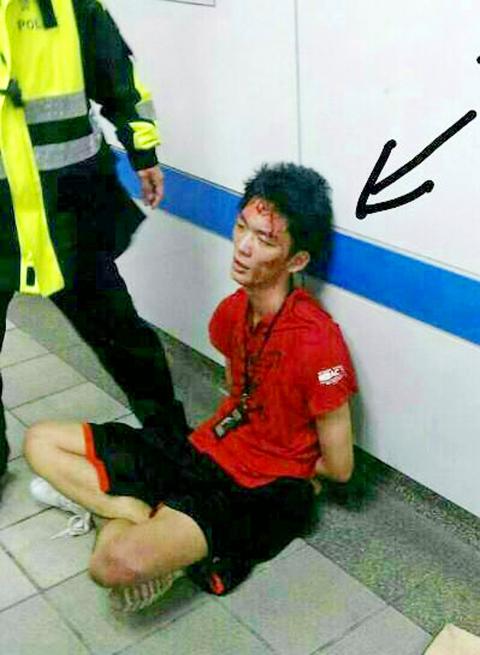
Photo: CNA
The suspect, who has been identified as Cheng Chieh (鄭捷) from Greater Taichung’s Tunghai University, allegedly started attacking passengers around him with a 30cm-long fruit knife while the train was traveling between the Longshan Temple Station and the Jiangzicui Station at approximately 4:26pm.
He was apprehended by security guards, police officers and other passengers shortly after the train stopped at the Jiangzicui Station, from where he was taken to the Jiangzicui police station for questioning.
According to New Taipei City Police Department Director-General Chen Kuo-en (陳國恩), Cheng boarded an MRT train heading to the Taipei Nangang Exhibition Center at the Jiangzicui Station earlier in the afternoon and alighted at the Sun Yat-sen Memorial Hall Station.
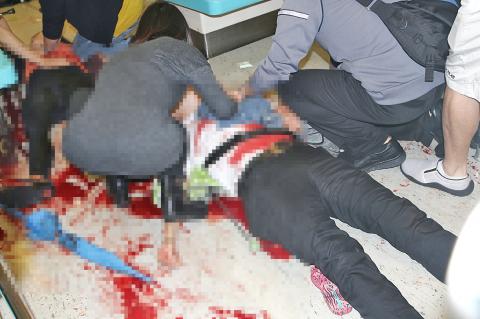
Photo: Wu Jen-chieh, Taipei Times
He subsequently hopped on the ill-fated train heading to the Banciao Station before carrying out the killing spree, Chen added.
“The suspect told us that he had since elementary school wanted to ‘do something big’ and that he had shared the idea with some of his high-school and college classmates,” Chen said.
Chen said Cheng originally planned to execute the idea after he graduated from university, but decided to move it forward to yesterday after giving it some thought last week.
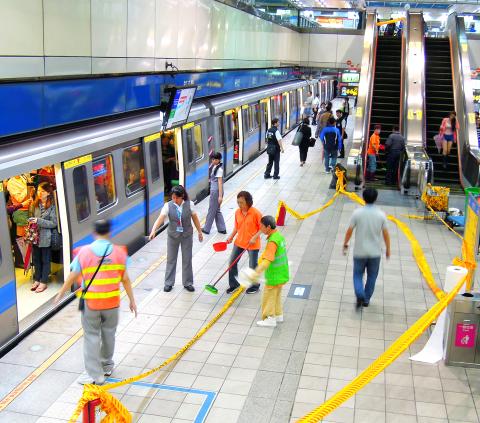
Photo: EPA
“He bought two fruit knives of different sizes from a supermarket before he boarded the trains… His blood-alcohol content registered 0.04mg/L and he has no medical records of mental illness,” Chen said.
“He showed no signs of remorse during questioning,” Chen added.
Taipei Mayor Hau Lung-bin (郝龍斌) said that for the next two weeks, the city government planned to deploy 80 special police officers to MRT stations to conduct routine patrols, to assist the 143 MRT police officers.
“Our priority is to restore order and security at MRT stations to make sure that our passengers do not feel afraid when taking the metro,” Hau said.
New Taipei City Deputy Mayor Hou You-yi (侯友宜) said the city government had instructed all available police officers to patrol the areas surrounding the city’s 34 MRT stations shortly after the incident, in an effort to tighten security.
Taipei Rapid Transit Corp (台北捷運公司) general manager Tan Gwa-guang (譚國光) said the company would give NT$4 million (US$132,000) in compensation to the families of the victims and would take care of all medical expenses incurred by the injured passengers.
Additional reporting by Liu Ching-ho

PROVOCATIVE: Chinese Deputy Ambassador to the UN Sun Lei accused Japan of sending military vessels to deliberately provoke tensions in the Taiwan Strait China denounced remarks by Japan and the EU about the South China Sea at a UN Security Council meeting on Monday, and accused Tokyo of provocative behavior in the Taiwan Strait and planning military expansion. Ayano Kunimitsu, a Japanese vice foreign minister, told the Council meeting on maritime security that Tokyo was seriously concerned about the situation in the East China and South China seas, and reiterated Japan’s opposition to any attempt to change the “status quo” by force, and obstruction of freedom of navigation and overflight. Stavros Lambrinidis, head of the EU delegation to the UN, also highlighted South China Sea
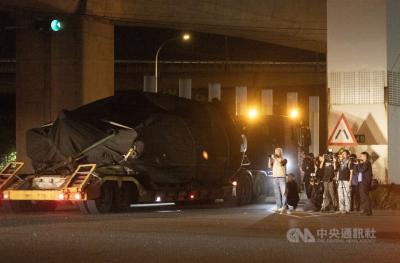
The final batch of 28 M1A2T Abrams tanks purchased from the US arrived at Taipei Port last night and were transported to the Armor Training Command in Hsinchu County’s Hukou Township (湖口), completing the military’s multi-year procurement of 108 of the tanks. Starting at 12:10am today, reporters observed more than a dozen civilian flatbed trailers departing from Taipei Port, each carrying an M1A2T tank covered with black waterproof tarps. Escorted by military vehicles, the convoy traveled via the West Coast Expressway to the Armor Training Command, with police implementing traffic control. The army operates about 1,000 tanks, including CM-11 Brave Tiger
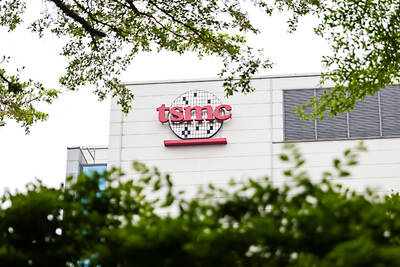
Taiwan Semiconductor Manufacturing Co (TSMC, 台積電), the world’s largest contract chipmaker, said it expects its 2-nanometer (2nm) chip capacity to grow at a compound annual rate of 70 percent from this year to 2028. The projection comes as five fabs begin volume production of 2-nanometer chips this year — two in Hsinchu and three in Kaohsiung — TSMC senior vice president and deputy cochief operating officer Cliff Hou (侯永清) said at the company’s annual technology symposium in Silicon Valley, California, last week. Output in the first year of 2-nanometer production, which began in the fourth quarter of last year, is expected to

Taiwan’s drone exports surged past US$100 million in the first quarter, exceeding last year’s full-year total, with the Czech Republic emerging as the largest buyer, the Ministry of Economic Affairs said. Exports of complete drones reached US$115.85 million in the period, about 1.2 times the total recorded for all of last year, the ministry said in a report. Exports to the Czech Republic accounted for about US$100 million, far outpacing other markets. Poland, last year’s top destination, recorded about US$11.75 million in the first quarter. Taiwan’s drone exports have expanded rapidly in the past few years, with last year’s total


 RSS
RSS