


Student activists occupying the legislative chamber yesterday rejected the Cabinet’s proposal for legislation to monitor cross-strait agreements, calling it an empty, insincere proposal aimed at deceiving the public.
“The Cabinet proposal is rather superficial, especially when [the premier] rejects our demand to apply the law to the review of the cross-strait service trade agreement,” student leader Chen Wei-ting (陳為廷) told a news conference at the Legislative Yuan.
“The proposal is empty, insincere and deceptive, and ignores the demands raised by the 500,000 people who took part in Sunday’s demonstration [in Taipei],” he said.
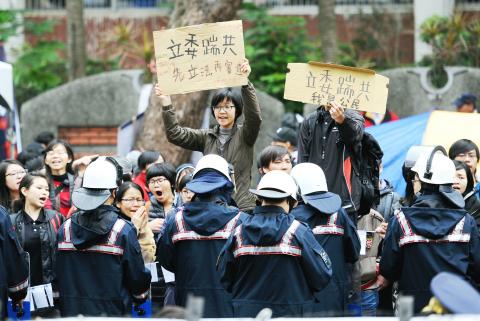
Photo: Chang Chia-ming, Taipei Times
None of the protesters’ five major demands were included: the public’s participation in the reviews of cross-strait pacts, making all information public, stipulating the government’s responsibilities, human rights protection and granting the legislature the actual power to review cross-strait agreements.
“We hereby declare that the Executive Yuan has flunked class, because it failed to respond positively to the public’s demands,” Chen said.
Academia Sinica associate research law fellow Huang Kuo-chang (黃國昌) said that he agreed with Chen.
“In the proposal for the legislation to monitor cross-strait agreements raised by non-governmental organizations [NGOs], the legislature is given full power to review any cross-strait agreements, and the government would be required to report to the legislature on plans to sign an agreement with China prior to the beginning of negotiations for such a pact,” Huang said.
These mechanisms are absent from the Cabinet’s version, he said.
Human rights protection is an important element for many countries when signing free-trade agreements (FTA) with other nations, he said.
“In many FTAs, there are clauses concerning human rights protection, such as stipulating a suspension of the agreement when human rights are violated, or providing a way to appeal for those who feel that their rights have been compromised by the agreement,” Huang said.
“Unfortunately, such a mechanism does not exist in the Cabinet’s proposal,” he said.
Huang said the NGOs’ draft proposal also stipulates that if the government negotiates an agreement with China that involves a change in the political “status quo,” the agreement would have to be voted on by the public in a referendum before being ratified, but that was not mentioned in the Cabinet’s version either.
Attorney Lai Chung-chiang (賴中強) said that according to the NGOs’ draft proposal, the government not only has to report to the legislature before negotiating an agreement with China, but it also has to hold public hearings in advance.
The Cabinet’s proposal that only national security agencies would need to review a cross-strait pact before it was signed was not enough, the attorney said.
“One of the controversies concerning the cross-strait service trade pact is that the government only held public hearings after the pact was signed,” Lai said.

A signaling system malfunction disrupted high-speed rail (HSR) services beginning at 8am today, with trains temporarily reduced to three northbound and three southbound trains per hour as authorities conduct inspections. The malfunction occurred on a section of track in Miaoli County during pre-operation checks early this morning, forcing northbound and southbound trains to use a single track, the HSR operator said. The regular schedule has been replaced with three hourly trains offering only nonreserved seating in each direction, stopping at every station, it said, adding that business class cars would still have reserved seating. Departures from terminal stations are scheduled at the top

Taiwan is still in the process of assessing the possibility of recruiting workers from Eswatini, the Ministry of Foreign Affairs said yesterday, adding that its goal is to help Eswatini upgrade its vocational training centers. If there are plans to recruit workers from Eswatini, safeguarding national security, protecting public health and ensuring the employment rights of Taiwanese would be prerequisites, Department of West Asian and African Affairs Director-General Yen Chia-liang (顏嘉良) told a news conference. Key considerations would also include filling labor shortages in specific industries, and fostering bilateral professional and technical exchanges, he said. Yen was asked about the progress of labor

A US uncrewed surface vessel (USV) encountered multiple Chinese warships during an autonomous transit of the Taiwan Strait, US defense company Seasats said in a statement on Wednesday. Seasats announced that a Lightfish USV had completed the first autonomous transit of the Taiwan Strait. Over five days, the USV traversed the entire length of the Strait while constantly monitoring surface vessel traffic, the company said. The Lightfish encountered multiple Chinese warships, one of which was a Chinese People’s Liberation Army Navy (PLAN) Type 056 corvette, it said. The Chinese vessels were operating “well within Taiwan’s exclusive economic zone without transmitting their identity via the

VERBOSE VESSELS: A CGA cutter and a China Coast Guard exchanged verbal barbs for more than a day in Taiwanese-controlled waters before the Chinese vessel left The Taiwanese and Chinese coast guards had a standoff near the strategically located Pratas Islands (Dongsha Islands, 東沙群島) in the north of the South China Sea, the Coast Guard Administration (CGA) said yesterday. The two sides engaged in intense radio exchanges over sovereignty claims during the 33-hour standoff. China Coast Guard vessel 3501 eventually left the restricted waters, 26.6 nautical miles (49.2km) west of the Pratas Islands, at 5pm yesterday, the CGA said. Lying approximately between southern Taiwan and Hong Kong, the Taiwan-controlled Pratas are seen by some security experts as vulnerable to Chinese attack due to their distance — more than


 RSS
RSS