


The Executive Yuan yesterday approved a draft bill that would establish a mechanism to monitor agreements between Taiwan and China, but showed no signs of giving in to student activists’ demand that the legislative review of the controversial cross-strait service trade agreement be suspended until the oversight mechanism is institutionalized.
The bill proposed by the Mainland Affairs Council (MAC) was adopted at a Cabinet meeting yesterday and would allow the Legislative Yuan to revise cross-strait agreements and solicit their renegotiation.
Asked by reporters whether the bill, if enacted, would apply to the pact at the center of the Sunflower movement, MAC Minister Wang Yu-chi (王郁琦) gave only vague answers.

Photo: Chang Chia-ming, Taipei Times
The movement refers to an ongoing student-led siege and occupation of the Legislative Yuan to protest the service trade agreement.
Wang said that if the oversight bill clears the legislature while the cross-strait service trade agreement is still pending review, the pact would be subject to the provisions under the bill regarding the ratification of agreements with China.
Nevertheless, Wang said: “[The bill] would not make any difference to the pact.”
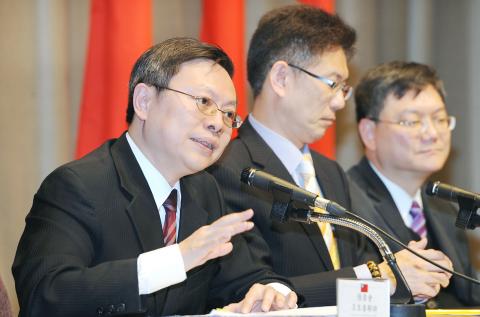
Photo: Liao Chen-huei, Taipei Times
The government “respects” the right of the legislature to decide whether to review the draft bill first and then the service trade agreement, or vice versa, Wang said.
“However, from my perspective, the result in each case would be the same,” he added.
Wang declined to elaborate on why the cross-strait service trade pact would be unaffected if lawmakers were given a mandate to revise agreements.
“Let’s talk about this next time,” he said.
The draft bill suggests that a cross-strait agreement would automatically go into effect if the legislature fails to complete its review within three months, which could be extended once for another three months.
Asked whether the service trade agreement would be considered already ratified if the oversight bill is passed by the legislature, given that it has been more than nine months since the agreement was sent to the legislature for review, Wang gave no answer.
Wang said he could not answer the question because the government had agreed to a resolution reached among lawmakers in June last year that the service trade agreement would not become effective without being reviewed and voted on item-by-item.
“If the legislature adopts the draft bill, we still need to figure out how much bearing the June resolution would have on a newly enacted law,” Wang said.
The bill calls for the Executive Yuan to communicate better with the Legislative Yuan and the public on cross-strait negotiations before, during and after such agreements are signed, and to establish a screening mechanism to examine how deals would affect the country from a national security perspective.
Several main points in the oversight mechanism proposed by the Democratic Front Against Cross-Strait Trade in Services Agreement — one of the groups leading the ongoing legislative siege — highlighting the role of the public and the legislature in cross-strait negotiations were not accepted by the government in its version.
These include a demand that the government present a report to the legislature detailing its plan to ink a deal with China and give the legislature 90 days to consider the plan before it decides whether to allow the government to begin negotiations.
Under the civic group’s version, the government is also required to allow civic groups to assess a proposed agreement within 180 days after completion of negotiations and prior to signing the deal, while the legislature is mandated to demand renegotiation when their conclusions differ significantly from those reached by the government.
Wang said that the government highly disapproved of the ideas because the Republic of China Constitution gives the executive branch exclusive power over trade activities with foreign countries, “not the legislative branch,” as opposed to Article 1, Section 8 of the US Constitution, which he said the civic groups had consulted.
“The ideas run counter to the system of the separation of power in our Constitution,” he said.
The processes the government would be required to abide by would be tantamount to asking the government to “reveal to Mainland China our bottom line,” Wang said.
“In that case, we would lose any negotiation before it begins,” he added.
If the version proposed by the civic group were to pass the legislature, it would make it impossible to sign any cross-strait agreement, Wang said.
Democratic Progressive Party spokesperson Lin Chun-hsien (林俊憲) said that the Executive Yuan proposal would create “a monitoring mechanism in name only,” under which the legislature would not have the required powers to effectively supervise cross-strait negotiations and agreements.


RESILIENCE: Taiwan plays a key role in semiconductors, energy, information infrastructure and advanced manufacturing, AIT Director Raymond Greene said Taiwan’s continued investment in deterrence and resilience remains vital, especially in uncrewed systems and other emerging technologies, American Institute in Taiwan (AIT) Director Raymond Greene said yesterday. Greene made the remarks at the annual National Strategic Summit on Supply Chain Resilience held by the Research Institute for Democracy, Society and Emerging Technology (DSET), a government-backed think tank. As Taiwan last year became the US’ fourth-largest trading partner and supply chain security is becoming more important, cooperation in emerging technologies continues to deepen between the two countries, he said. The US is committed to accelerating innovation, building key infrastructure, strengthening cooperation

The National Chungshan Institute of Science and Technology yesterday showcased its locally developed variants of the Vision 60 robotic patrol dog, which it plans to deploy on the nation’s outlying territories in the South China Sea. The variants were produced under the Joint Lab project — created by the institute and domestic companies — and assembled with domestically produced motors, lenses and artificial intelligence (AI) systems alongside licensed tech from the US, Missile and Rocket Systems Research Division deputy director Jen Kuo-kang (任國光) told the media event at a military base in Taipei’s Dazhi (大直) area. Taiwan has built up its strengths

RIGHT DIRECTION: Taiwan’s efforts to prevent forced labor include a proposal to ‘fully prohibit’ employers from withholding workers’ documents, an official said Taiwan is to establish a mechanism to restrict imports of goods linked to forced labor, the Executive Yuan said yesterday, after the US proposed imposing additional tariffs on Taiwanese goods over labor concerns. “The Ministry of Labor and the Ministry of Economic Affairs are to establish an interministerial review procedure,” Executive Yuan spokesperson Michelle Lee (李慧芝) said at a news briefing in Taipei. “The government is to use the Foreign Trade Act [貿易法] as the legal basis to restrict imports of goods produced with forced labor” and bring its supply chain governance more in line with international standards on human rights, resilience
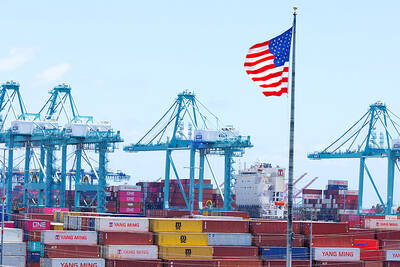
NOT IMMEDIATE: Taiwan has a chance to appeal the proposed 10 percent tariff before it starts, while other countries face a 12.5 percent tariff from the trade office Taiwan is among 60 economies determined by the US to have failed to impose or enforce a ban on the importation of goods produced with forced labor, according to a notice released on Tuesday by the Office of the US Trade Representative (USTR), which proposed imposing an additional 10 percent or more tariff on them. The USTR in a statement said that following an investigation, it had determined under Section 301 of the Trade Act of 1974 that the failure of the 60 economies to impose and effectively enforce a prohibition on the importation of goods produced with forced labor is


 RSS
RSS