

Alumni of National Taiwan University’s (NTU) Department of Political Science yesterday reprimanded former NTU professor Premier Jiang Yi-huah (江宜樺) for employing violent measures in a crackdown on student protesters earlier this week and called on him to resign.
Department alumna Fu Yu-ju (傅鈺如) said at the main entrance to the university’s College of Social Sciences yesterday morning that she and several others had initiated a petition for alumni against Jiang’s decision after the bloody eviction on Monday morning of protesters from in and around the Executive Yuan building.
The online petition, which started on 4:50pm on Monday and ended at 3:50pm on Tuesday, gained more than 700 signatures from the department’s alumni and students, she said.
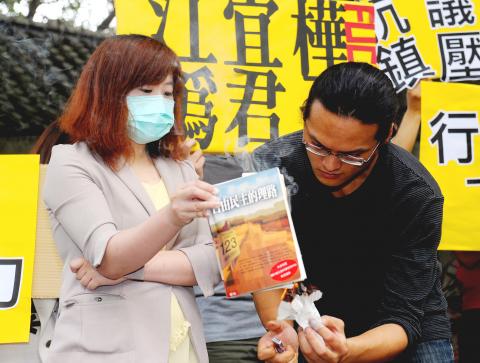
Photo: CNA
She said Jiang was a teacher who was greatly admired by many students in the past, and many said they were inspired by his teaching on the value of democracy, so they feel particularly disappointed that Jiang is now going back on his words and using state violence against unarmed protesters.
Chang Di-hao (張迪皓), an alumnus and musician in a band that has often supported labor movements in recent years, said he was at the site when riot police used violence against the protesters on Monday.
“We showed self-control that night, by sticking to our principles. We would not move if the police did not move, we stopped those that wanted to confront the police and we urged everyone not to throw water bottles at the police,” he said. “But later, we heard people say that the police were hitting people.”
Lee Ming-chih (李明芝), an alumna and now a lawyer who represented a group in Dapu Borough (大埔), Miaoli County, in their struggle against a forced demolition of four houses, said Jiang had taught them that “if a system claims itself to be democratic, but refuses to respond to protesters, then it is ‘numb and bereft of all feeling.’”
“I think Jiang should step down from his post as an apology for his poor decision to violently evict the protestors and also for publicly lying that the police only ‘patted the protesters’ shoulders and asked them to leave,’” Lee said.
In their open letter to Jiang, they also said that Jiang “took the lead in betraying democracy and allowed the government to have its own way, while claiming he was only acting according to the law,” and that he is now practicing the “evil of banality” and is “a hatchet man for totalitarianism.”
During the protest yesterday, the alumni burned a book titled Essays on Liberalism and Democracy (自由民主的理路), which was written by Jiang and had been assigned as a text in his classes.
Later yesterday, Jiang issued a press release through the Executive Yuan saying he was disappointed the protesters burned the book.
The press release quoted a source at the Executive Yuan as saying that “Premier Jiang has long upheld constitutionalism and has never wavered in his beliefs in constitutionalism.”
An example of how Jiang has implemented the doctrine of constitutionalism and separation of powers was that the Executive Yuan did not unilaterally take action to forcibly evict the protesters from the legislative compound because he respected the prerogative of the legislature, the statement quoted the source as saying.
However, when the protesters broke into the Executive Yuan’s building and occupied the Executive Yuan complex, the government had to exert its authority to ensure it could operate normally, the statement said.
“This action does not justify allegations that the government abused its power or authority. Rather, it was a necessity to safeguard the rule of law in a democratic society,” the statement quoted the source as saying.
In the same press release, Jiang urged the public to be calm while discussing issues related to the cross-strait service trade agreement and to abstain from impulses to say or to do something dramatic to demonstrate the nation’s level of maturity and its hard-earned democracy.

PATROL PARTNERS: The ‘Chiayi’ and the ‘Penghu’ departed for a two-day joint patrol of Palau’s exclusive economic zone, the CGA’s second diplomatic visit to the country The Coast Guard Administration (CGA) set a record for its southernmost deployment of a coast guard vessel as the vessels Chiayi and the Penghu reached Palau’s Pulo Anna Island on Saturday in a cooperative exercise between the two countries. The island, about 217 nautical miles (401km) southwest of Koror in the Palauan state of Sonsorol and 1,220 nautical miles from Taiwan’s southernmost point, Oluanpi (鵝鑾鼻), is the furthest south a CGA vessel has sailed. The two vessels are in Palau for the coast guard’s second diplomatic visit to the country. They docked at Malakal Harbor on Tuesday last week. The coast guard
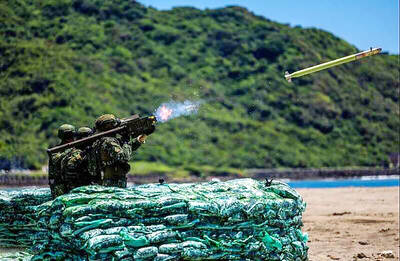
BATCH 1: The military has plans to assign the weapons to the army to defend Taiwan proper, as well as outlying islands and the navy for the Marine Corps, the official said Taiwan is to receive 500 Stinger missiles and 178 launchers from the US by the end of the year, the first batch under a planned two-stage acquisition totaling 2,621 missiles and 763 launchers, a defense official said yesterday on condition of anonymity. The portable missiles would play a vital role in the nation’s air defense capabilities, the source said. The army plans to deploy 2,235 missiles and 657 launchers to defend Taiwan proper and outlying islands, they said, citing military documents. The navy is allotted 295 missiles and 85 launchers to arm the Marine Corps and some surface vessels that lack air defense
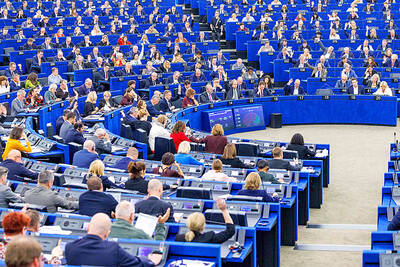
The European Parliament on Wednesday adopted a recommendation on EU-China political relations that rejected China’s efforts to restrict Taiwan’s participation in international organizations and exchanges. The recommendation, addressed to the European Council, the European Commission and EU High Representative for Foreign Affairs and Security Policy Kaja Kallas, includes several references to EU-Taiwan relations and expresses support for closer ties, saying they would bring positive benefits and have strategic importance. Describing Taiwan as a valuable partner in trade and technology, the European Parliament said it “rejects China’s attempts to coerce international organizations, third countries and other actors into restricting Taiwan’s international participation and
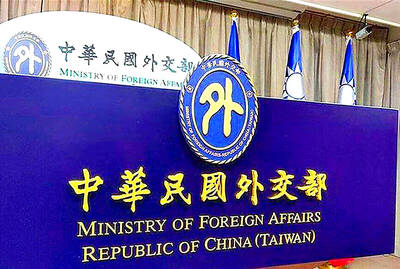
‘EQUALS’: The ROC and PRC are not subordinate to each other, which is the consensus among Taiwanese, who are the only ones who can decide Taiwan’s future, MOFA said Taiwan yesterday urged China to stop its hostile rhetoric toward Taiwan as the US welcomed President William Lai’s (賴清德) commitment to Taiwan Strait stability in his Double Ten National Day speech. Lai on Saturday described Taiwan as a “city upon a hill” and said that “Taiwan cherishes peace, but we will not give up our freedom. We are open to exchanges, but will not accept subordination.” China’s Taiwan Affairs Office said Lai’s speech “disregards facts, distorts the truth, misleads the public and reveals ulterior motives.” Taiwan is part of China and Taiwan’s future “can and must be decided jointly by all the


 RSS
RSS