


The office of former Democratic Progressive Party (DPP) chairperson Tsai Ing-wen (蔡英文) yesterday confirmed that it had sent a delegation to Beijing for an academic exchange on economic issues, but denied that Tsai has decided to run in the DPP chairman election in May as reported by the media.
Storm Media, an online news Web site, on Saturday night published a report on Tsai’s chairmanship bid and another report on the delegation yesterday morning.
The first report quoted unnamed sources as saying that Tsai has decided to run for the chairmanship in May even if former premier Frank Hsieh (謝長廷) also throws his hat into the race, which means that the election could be a three-way race between Tsai, Hsieh and DPP Chairman Su Tseng-chang (蘇貞昌).
“The [Tsai’s] office has not yet discussed the issue of entering the chairman election,” spokesperson Hung Yao-fu (洪耀福) said.
Tsai and Su’s wish to vie for DPP’s nomination in the 2016 presidential election is an “open secret,” and Tsai has taken the first step toward that goal, so her competition with Su in the chairmanship election would be inevitable, the report said.
A possible scenario could be a coalition between Tsai and Hsieh, with either one challenging Su’s re-election bid, the report said, adding that Hsieh had sent DPP Legislator Lee Ying-yuan (李應元) to contact fellow Legislator Chen Chi-mai (陳其邁), who is close to Tsai, about “integrating” the two camps.
Chen and Lin He-ming (林鶴明), spokesperson for Hsieh’s office, also denied the report.
Tsai’s office confirmed another Storm Media report, which said that a delegation led by former minister of finance Lin Chuan (林全) visited Beijing for an academic exchange with Chinese economists between Wednesday and yesterday, saying that a press conference to brief the public on the trip has been scheduled for today.
The office said the trip was a “return visit” for the attendance of two prominent Chinese economists — Bank of China chief economist Cao Yuanzheng (曹遠征) and Ding Zhijie (丁志杰) of the University of International Business and Economics — at an event organized by Tsai’s Thinking Taiwan Foundation in July last year.
DPP legislators Hsiao Bi-khim (蕭美琴) and Tsai Chi-chang (蔡其昌) were on the nine-member delegation, according to the office.
Tsai’s office denied the trip has been part of her efforts to “gain an upper hand” in the DPP’s cross-strait engagement after the party announced on the heels of its China policy review on Jan. 9 that it would facilitate official contact between its think tank and its Chinese counterpart, adding that the visit was not arranged for political purposes.
DPP spokesperson Xavier Chang (張惇涵) said the party encouraged and welcomed any member’s confident and active engagement with Beijing.
In related news, Su embarked on a week-long European tour last night with the main objective of explaining and promoting the DPP’s latest review of its China policy, the DPP said.
DPP headquarters declined to reveal a detailed itinerary of the delegation, but said Su is expected to visit the UK, Germany and Belgium, among other countries.
Su is scheduled to deliver a speech on cross-strait relations and the situation in the Asia-Pacific region at the University of London’s School of Oriental and African Studies, the DPP said.
The trip would be Su’s sixth overseas visit during his two-year term, which ends in May.
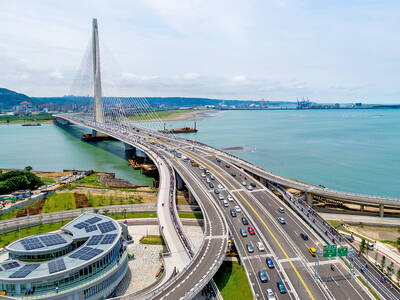
The Ministry of Transportation and Communications yesterday inaugurated the Danjiang Bridge across the Tamsui River in New Taipei City, saying that the structure would be an architectural icon and traffic artery for Taiwan. Feted as a major engineering achievement, the Danjiang Bridge is 920m long, 211m tall at the top of its pylon, and is the longest single-pylon asymmetric cable-stayed bridge in the world, the government’s Web site for the structure said. It was designed by late Iraqi-British architect Zaha Hadid. The structure, with a maximum deck of 70m, accommodates road and light rail traffic, and affords a 200m navigation channel for boats,
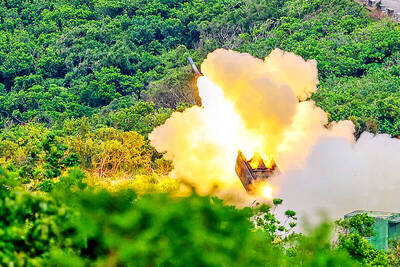
PRECISION STRIKES: The most significant reason to deploy HIMARS to outlying islands is to establish a ‘dead zone’ that the PLA would not dare enter, a source said A High Mobility Artillery Rocket System (HIMARS) would be deployed to Penghu County and Dongyin Island (東引) in Lienchiang County (Matsu) to force the Chinese military to retreat at least 100km from the coastline, a military source said yesterday. Taiwan has been procuring HIMARS and Army Tactical Missile Systems (ATACMS) from the US in batches. Once all batches have been delivered, Taiwan would possess 111 HIMARS units and 504 ATACMS, which have a range of 300km. Considering that “offense is the best defense,” the military plans to forward-deploy the systems to outlying islands such as Penghu and Dongyin so that

WHAT WAS ALL THAT FOR? Jaw Shaw-kong said that Cheng Li-wen had pushed for more drastic cuts and attacked him, just for the outcome to be nearly identical to his bill The legislature yesterday passed a supplementary budget bill to fund the purchase of separate packages of US military equipment, with the combined amount of spending capped at NT$780 billion (US$24.8 billion). The Chinese Nationalist Party (KMT) and Taiwan People’s Party (TPP) used their legislative majority to pass the bill, which runs until 2033 and has two main funding provisions. One was for NT$300 billion of arms sales already approved by the US for Taiwan on Dec. 17 last year, the other was for NT$480 billion for another arms package expected to be announced by Washington. The bill, which fell short of the NT$1.25

‘CLEAR MESSAGE’: The bill would set up an interagency ‘tiger team’ to review sanctions tools and other economic options to help deter any Chinese aggression toward Taiwan US Representative Young Kim has introduced a bill to deter Chinese aggression against Taiwan, calling for an interagency “tiger team” to preplan coordinated sanctions and economic measures in response to possible Chinese military or political action against Taiwan. “[Chinese President] Xi Jinping [習近平] has directed the People’s Liberation Army to be ready to invade Taiwan by 2027. China has a plan. America should have one too,” Kim said in a news release on Thursday last week. She introduced the “Deter PRC [People’s Republic of China] aggression against Taiwan act” to “ensure the US has a coordinated sanctions strategy ready should


 RSS
RSS