


Seeking to join various US-led military drills, including the Rim of the Pacific Exercise (RIMPAC), is an area in which Taiwan has wished to further its military cooperation with the US this year, Representative to the US King Pu-tsung (金溥聰) said in a written report to the legislature.
In addition to 35 military cooperation projects scheduled to take place this year, up from 18 projects last year, “we will continue to strive for participation in all major military drills led by the US, including RIMPAC,” King said.
He did not elaborate on what the cooperation projects are.
A meeting has been scheduled for tomorrow, where King is to brief lawmakers in the legislature’s Foreign Affairs and National Defense Committee on the prospects for US-Taiwan relations this year and to take their questions.
In the report, King identified five broad areas of further cooperation between Taiwan and the US — strengthening bilateral relations; highlighting the importance of bilateral economic and trade ties; consolidating the military and security partnership; joining hands in dealing with global affairs and crises; and collaborating in territorial disputes in the East China Sea and the South China Sea.
On the security front, King said that US President Barack Obama’s administration has attached high importance to Taiwan’s national security, of which the record-high arms sale of US$12 billion during his presidency is testimony, while Taiwan received more support from the US Congress last year than ever before.
Last year marked the first time that US lawmakers voiced support for Taiwan’s inclusion in the RIMPAC naval exercise, when eight US congressmen signed a bipartisan letter in October requesting that US Secretary of Defense Chuck Hagel invite Taiwan to take part in this year’s drill, King said.
In November last year, US Senator Dan Coats submitted an amendment stating that Taiwan should be invited to participate at this year’s RIMPAC to help its proficiency in humanitarian assistance and disaster relief, he added.
Hosted by the US Navy, RIMPAC, the world’s largest international maritime exercise, is held biennially during June and July in Honolulu, Hawaii, and is designed to foster and sustain the cooperative relationships critical to ensuring safety of sea lanes and security on the world’s oceans, according to the US Navy Web site.
China’s People’s Liberation Army in November last year agreed to participate in RIMPAC for the first time this year, in response to an invitation extended by former US secretary of defense Leon Panetta during a visit to Beijing in 2012.
King also revealed for the first time in the report that Taiwan had stayed in touch with the US since the Liaoning, China’s first aircraft carrier, started passing through the Taiwan Strait on Nov. 28, amid tensions over China’s unilateral designation of an air defense identification zone in the East China Sea.
Taiwan and the US monitored the Liaoning’s course closely, King said.
King’s statement somewhat contradicted a report on Nov. 29 by the Global Times, a mouthpiece of the Chinese Communist Party, saying that Taiwan turned down requests by the US and Japan to conduct surveillance of the carrier in relay.
According to a report by the Taipei Times on Nov. 7, US Admiral Samuel Locklear III, the Commander of US Pacific Command, did not respond affirmatively when asked at a briefing at the Washington Foreign Press Center about the possibility of the US inviting Taipei to join this year’s RIMPAC.
King added in the report that the Taipei Economic and Cultural Representative Office in the US has scheduled conferences and other events in Washington this year to mark the 35th anniversary of the enactment of the Taiwan Relations Act to highlight the importance of the law.
Although tensions across the Taiwan Strait have gradually eased, threats of force by China against Taiwan must never be ignored, King said.
If the US can continue to provide Taiwan with weapons, in accordance with the Taiwan Relations Act, it can not only help Taiwan beef up its self-defense capability and boost confidence in its negotiations with China, but also lay down foundations for stability in cross-strait relations and peace in East Asia, King said.
Taiwan welcomes more US arms sales, including “advanced fighter jets,” and looks forward to consolidating its military and security partnership with the US in the areas of coordination of military strategies, anti-terrorism and cybersecurity, he said.
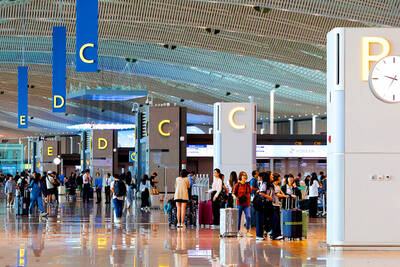
South Korea has adjusted its electronic arrival card system to no longer list Taiwan as a part of China, a move that the Ministry of Foreign Affairs said would help facilitate exchanges between the two sides. South Korea previously listed “Taiwan” as “Taiwan (China)” in the drop-down menus of its online arrival card system, where people had to fill out where they came from and their next destination. The ministry had requested South Korea make a revision and said it would change South Korea’s name on Taiwan’s online immigration system from “Republic of Korea” to “Korea (South),” should the issue not be

Tainan, Taipei and New Taipei City recorded the highest fines nationwide for illegal accommodations in the first quarter of this year, with fines issued in the three cities each exceeding NT$7 million (US$220,639), Tourism Administration data showed. Among them, Taipei had the highest number of illegal short-term rental units, with 410. There were 3,280 legally registered hotels nationwide in the first quarter, down by 14 properties, or 0.43 percent, from a year earlier, likely indicating operators exiting the market, the agency said. However, the number of unregistered properties rose to 1,174, including 314 illegal hotels and 860 illegal short-term rental
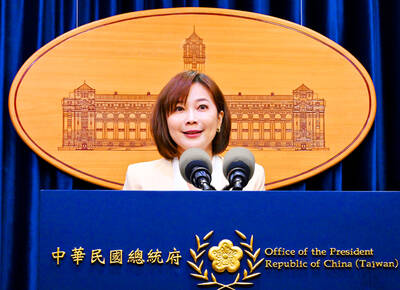
ECONOMIC COERCION: Such actions are often inconsistently applied, sometimes resumed, and sometimes just halted, the Presidential Office spokeswoman said The government backs healthy and orderly cross-strait exchanges, but such arrangements should not be made with political conditions attached and never be used as leverage for political maneuvering or partisan agendas, Presidential Office spokeswoman Karen Kuo (郭雅慧) said yesterday. Kuo made the remarks after China earlier in the day announced 10 new “incentive measures” for Taiwan, following a landmark meeting between Chinese President Xi Jinping (習近平) and Chinese Nationalist Party (KMT) Chairwoman Cheng Li-wun (鄭麗文) in Beijing on Friday. The measures, unveiled by China’s Xinhua news agency, include plans to resume individual travel by residents of Shanghai and China’s Fujian

Chinese President Xi Jinping (習近平) and Chinese Nationalist Party (KMT) Chairwoman Cheng Li-wun (鄭麗文) met in Beijing yesterday, where they vowed to bring people on both sides of the Taiwan Strait closer to facilitate the “great rejuvenation of the Chinese nation.” The meeting was held in the East Hall of the Great Hall of the People, a venue typically reserved for meetings between Xi and foreign heads of state. In public remarks prior to a closed-door meeting, Xi, in his role as head of the Chinese Communist Party (CCP), said that Taiwan is historically part of China, and remains an “inalienable” and


 RSS
RSS