


Taking clear aim at China’s growing aggressiveness in territorial disputes with its smaller neighbors, US Secretary of State John Kerry yesterday announced that Washington would boost maritime security assistance to Southeast Asian countries amid rising tensions with Beijing.
On his first visit to Vietnam as the US’ top diplomat, Kerry pledged an additional US$32.5 million for ASEAN members to protect their territorial waters and navigational freedom in the South China Sea, where four states have competing claims with China. Included in the new aid is up to US$18 million for Vietnam alone that will include five fast patrol boats for its coast guard.
With the new contribution, US maritime security assistance to the region will exceed US$156 million over the next two years, he said.
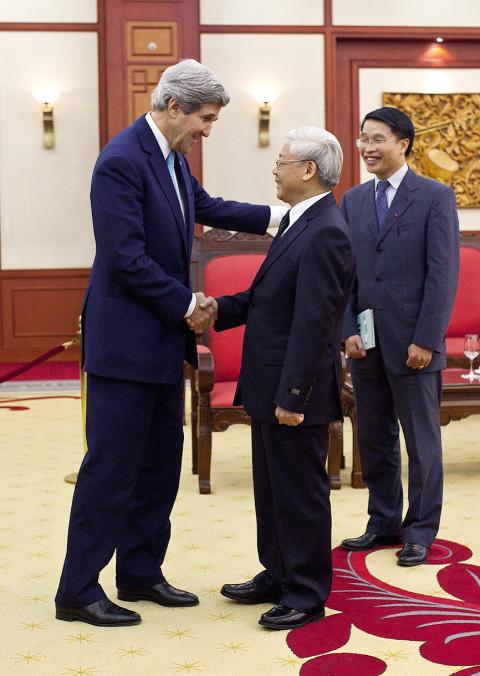
Photo: Reuters
Kerry said the new assistance was not a “quickly conceived reaction to any events in the region,” but rather a “gradual and deliberate expansion” of US support as part of US President Barack Obama’s administration’s broader decision to refocus attention on the Asia-Pacific region.
However, his comments came as Washington and Beijing trade barbs over a near collision between US and Chinese naval vessels in the South China Sea on Dec. 5.
China announced late last month that it was establishing a defense zone over the East China Sea, a maritime area between China, Taiwan, South Korea and Japan. All aircraft entering the zone must notify Chinese authorities beforehand, and China would take unspecified defensive measures against those that do not comply.
Neighboring countries and the US have said they will not honor the new zone — believed to be aimed at claiming disputed territory — and have said it unnecessarily raises tensions.
Already, China has claimed it has a sovereign right to establish a similar zone over the South China Sea, where China and the Philippines are locked in another long-running territorial dispute.
“Peace and stability in the South China Sea is a top priority for us and for countries in the region,” Kerry told reporters at a news conference with Vietnamese Foreign Minister Pham Binh Minh. “We are very concerned by and strongly opposed to coercive and aggressive tactics to advance territorial claims.”
While stressing US neutrality on the competing sovereignty claims, Kerry called on China and ASEAN to quickly agree to a binding code of conduct for the South China Sea and to resolve their disputes peacefully through negotiations.
China’s increasing assertiveness in the region — including the establishment of the East China Sea air defense zone — has alarmed many of the 10 ASEAN members , including Vietnam and the Philippines, which Kerry will visit today.
In addition, Kerry made clear that the aid is designed to help Southeast Asian nations defend their waters from encroachment and his announcement was accompanied by blunt criticism of China for its creation of a new air defense zone and suggestions that it might do the same in the South China Sea.
As such, it is almost certain to anger Beijing, which bristles at what it sees as US interference in areas China considers to be in its “core interest.”

LEVERAGE: China did not ‘need to fire a shot’ to deny Taiwan airspace over Africa when it owns ‘half the continent’s debt,’ a US official said, calling it economic warfare The EU has raised concerns about overflight rights following the delay of President William Lai’s (賴清德) planned state visit to the Kingdom of Eswatini after three African nations denied overflight clearance for his charter at the last minute. Taiwanese allies Paraguay and Saint Kitts and Nevis, as well as several US lawmakers and the Inter-Parliamentary Alliance on China (IPAC) condemned China for allegedly pressuring the countries. Lai was scheduled to fly directly to Taiwan’s only African ally from yesterday to Sunday to celebrate the 40th anniversary of King Mswati III’s accession and his 58th birthday, but Seychelles, Mauritius and Madagascar suddenly revoked
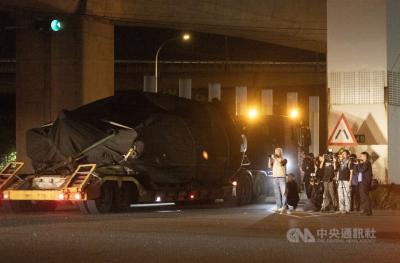
The final batch of 28 M1A2T Abrams tanks purchased from the US arrived at Taipei Port last night and were transported to the Armor Training Command in Hsinchu County’s Hukou Township (湖口), completing the military’s multi-year procurement of 108 of the tanks. Starting at 12:10am today, reporters observed more than a dozen civilian flatbed trailers departing from Taipei Port, each carrying an M1A2T tank covered with black waterproof tarps. Escorted by military vehicles, the convoy traveled via the West Coast Expressway to the Armor Training Command, with police implementing traffic control. The army operates about 1,000 tanks, including CM-11 Brave Tiger
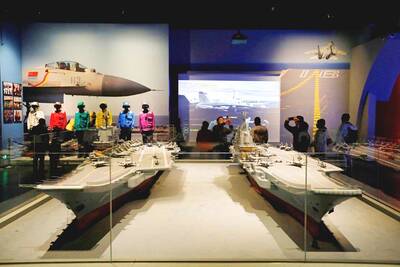
China on Wednesday teased in a video an aircraft carrier that could be its fourth, and the first using nuclear power, while making an allusion to Taiwan and vowing to further build up its islands, as it looks to boost maritime power, secure resources and bolster territorial claims. The video, issued on the eve of the 77th founding anniversary of the Chinese People’s Liberation Army Navy, featured fictional officers with names that are homophones of three commissioned aircraft carriers, the Liaoning (遼寧), Shandong (山東) and Fujian (福建). Titled Into the Deep, it showed a 19-year-old named “Hejian” (何劍) joining the group, sparking
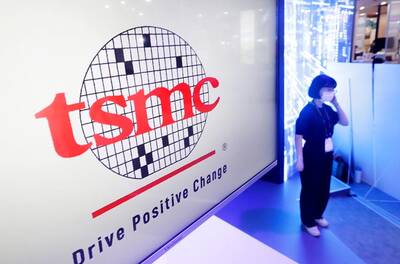
BIG YEAR: The company said it would also release its A12 chip the same year to keep a ‘reliable stream of new silicon technologies’ flowing to its customers Taiwan Semiconductor Manufacturing Co (TSMC, 台積電) yesterday said its newest A13 chip is to enter volume production in 2029 as the chipmaker seeks to hold onto its tech leadership and demand for next-generation chips used in artificial intelligence (AI), high-performance-computing (HPC) and mobile applications. TSMC, the world’s biggest contract chipmaker, also unveiled its A12 chip at its annual technology symposium in Santa Clara, California. The A12 chip, which features TSMC’s super-power-rail technology to provide backside power delivery for AI and HPC applications, is also to enter volume production in 2029, a year after the scheduled release of the A14 chip. The technology moves


 RSS
RSS