


Compal Electronics Inc (仁寶電腦) and Kinpo Electronics Inc (金寶電子) yesterday said they had agreed to sell their unprofitable telecom subsidiary Vibo Telecom Inc (威寶電信) to 4G license winner Taiwan Star Cellular Corp (台灣之星) in a NT$4 billion (US$136 million) share-swap deal.
The deal came on the heels of the 4G spectrum auction last week and marks the latest industry consolidation — a decade after Far EasTone Telecommunications Co (遠傳電信) acquired KG Telecommunications Co (和信電訊) in 2003, when local telecoms operators began providing 3G services.
Taiwan Star became one of the nation’s six 4G license holders after winning a bandwidth of 10 megahertz each for upload and download for NT$3.66 billion.
Food conglomerate Ting Hsin International Group (頂新集團), which owns Wei Chuan Foods Corp (味全食品) in Taiwan and instant-noodle brand Master Kong (康師傅) in China, is a major shareholder of Taiwan Star.
Vibo provides 3G mobile services, but did not join the 4G auction because of its financial woes.
Industry insiders expect the market to become even more competitive as Taiwan makes the transition to 4G. With more players entering the market and given the expensive licensing fees and hefty investment in 4G infrastructure required, profitability in service provision will also be a challenge.
“Following the transaction, Compal will be able to focus on the development of its core business, improve its asset efficiency and lift its profitability,” Compal spokesman Gary Lu (呂清雄) said in a statement.
Over the past 10 years, Compal booked NT$11.7 billion in equity losses from Vibo’s operations and will book another NT$4.9 billion loss for the disposal of its 47.32 percent stake in the telecom company, Lu said yesterday.
Based on the agreement, Compal will exchange its 691 million Vibo shares for 200 million shares of Taiwan Star.
“We are selling Vibo shares at a slight premium. It is a fair deal,” Lu said.
Compal is selling the stock for NT$3 per share, slightly above its net value of NT$2.9 per share, Lu said.
“Vibo has talked to several companies about selling and their offers were very similar,” he said.
Vibo currently has 1.5 million mobile subscribers and 7,000 base stations. It posted NT$1.89 billion in losses for the first half of this year on revenue of NT$3.59 billion. Vibo has not made any profit since its establishment in 2000.
Kinpo, which owns 47.95 percent of Vibo, also said it agreed to swap all of its Vibo shares for 200 million Taiwan Star shares.
Kinpo has booked NT$12.89 billion in losses from Vibo and will have to book another NT$4.93 billion from the deal.
Together, Compal and Kinpo will hold 16 percent of Taiwan Star when the 4G license holder expands its capital to 2.5 billion shares by the end of next year.

PROVOCATIVE: Chinese Deputy Ambassador to the UN Sun Lei accused Japan of sending military vessels to deliberately provoke tensions in the Taiwan Strait China denounced remarks by Japan and the EU about the South China Sea at a UN Security Council meeting on Monday, and accused Tokyo of provocative behavior in the Taiwan Strait and planning military expansion. Ayano Kunimitsu, a Japanese vice foreign minister, told the Council meeting on maritime security that Tokyo was seriously concerned about the situation in the East China and South China seas, and reiterated Japan’s opposition to any attempt to change the “status quo” by force, and obstruction of freedom of navigation and overflight. Stavros Lambrinidis, head of the EU delegation to the UN, also highlighted South China Sea

The final batch of 28 M1A2T Abrams tanks purchased from the US arrived at Taipei Port last night and were transported to the Armor Training Command in Hsinchu County’s Hukou Township (湖口), completing the military’s multi-year procurement of 108 of the tanks. Starting at 12:10am today, reporters observed more than a dozen civilian flatbed trailers departing from Taipei Port, each carrying an M1A2T tank covered with black waterproof tarps. Escorted by military vehicles, the convoy traveled via the West Coast Expressway to the Armor Training Command, with police implementing traffic control. The army operates about 1,000 tanks, including CM-11 Brave Tiger
Taiwan Semiconductor Manufacturing Co (TSMC, 台積電), the world’s largest contract chipmaker, said it expects its 2-nanometer (2nm) chip capacity to grow at a compound annual rate of 70 percent from this year to 2028. The projection comes as five fabs begin volume production of 2-nanometer chips this year — two in Hsinchu and three in Kaohsiung — TSMC senior vice president and deputy cochief operating officer Cliff Hou (侯永清) said at the company’s annual technology symposium in Silicon Valley, California, last week. Output in the first year of 2-nanometer production, which began in the fourth quarter of last year, is expected to
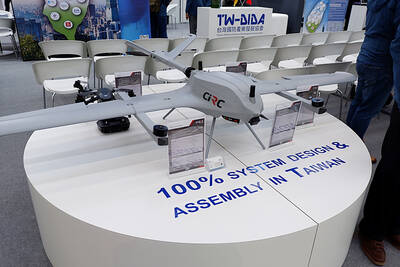
Taiwan’s drone exports surged past US$100 million in the first quarter, exceeding last year’s full-year total, with the Czech Republic emerging as the largest buyer, the Ministry of Economic Affairs said. Exports of complete drones reached US$115.85 million in the period, about 1.2 times the total recorded for all of last year, the ministry said in a report. Exports to the Czech Republic accounted for about US$100 million, far outpacing other markets. Poland, last year’s top destination, recorded about US$11.75 million in the first quarter. Taiwan’s drone exports have expanded rapidly in the past few years, with last year’s total


 RSS
RSS