


At the request of President Ma Ying-jeou (馬英九), the Chinese Nationalist Party (KMT) yesterday revoked Legislative Speaker Wang Jin-pyng’s (王金平) party membership, a move that could strip him of the position he has occupied since 1999, the longest in the nation’s history.
If Wang, a KMT legislator-at-large, fails to reverse the decision through appeals to the party leadership or through other judicial means, his status as a lawmaker will be nullified and he will lose his post as speaker.
The decision was reached by a meeting of the KMT’s Central Evaluation and Discipline Committee.
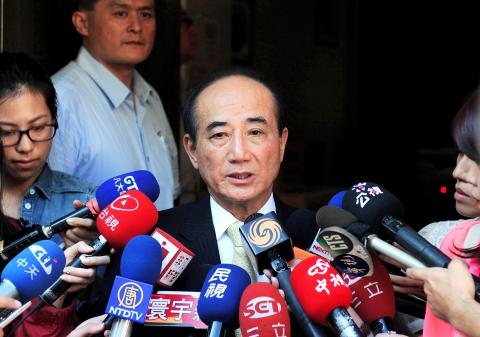
Photo: CNA
Before the meeting began, Ma delivered a harshly worded statement to the media at 8:30am saying that the influence-peddling case in which Wang is allegedly involved “disqualified” him from being the legislative speaker.
It was the second strongly worded statement about Wang that the president has made since the Supreme Prosecutors’ Office Special Investigation Division (SID) on Friday last week accused Wang of meddling in a breach of trust lawsuit on behalf of Democratic Progressive Party caucus whip Ker Chien-ming (柯建銘) by urging two high-ranking judicial officials to influence a prosecutor into refraining from appealing Ker’s not-guilty verdict.
Huang Chao-yuan (黃昭元), head of the disciplinary committee, said the decision was made after more than two hours of discussion in which it was concluded that Wang “has seriously damaged the party’s image and reputation.”
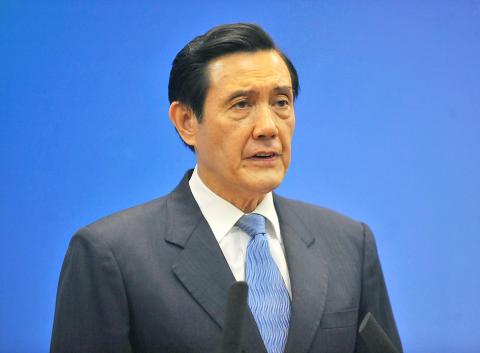
Photo: Mandy Cheng / AFP
The 15-seat committee was composed of Huang, deputy committee head John Shen (沈榮峰) and 13 other members whose identities were not made public. Four members were absent for various reasons.
Ma, who heads the KMT as chairman, arrived at the party’s headquarters early in the morning and stayed in his office until the committee handed down the ruling at about 11:30am, apparently to see if it would oblige his request that Wang be removed from the party.
As a result, Ma’s 10:15am meeting at the Presidential Office with El Salvadoran Parliament Speaker Sigfrido Reyes was canceled and Reyes was received by Vice President Wu Den-yih (吳敦義) instead.
At the 8:30am press conference, Ma said he has refrained from saying that Wang should resign on his own accord since the SID disclosed the case.
“What I had hoped was that Wang would voluntarily offer to resign as legislative speaker and as KMT legislator-at-large to preserve some dignity for the legislature and the KMT,” Ma said.
Now that Wang has failed to offer to resign, the responsibility to deprive him of his office lay with the KMT, the president said.
“Doing otherwise would be tantamount to acquiescing to judicial dignity being trampled upon,” Ma said.
He again criticized Wang for his “evasiveness” about the “fact” that he “has engaged in influence peddling in Ker’s [case].”
The “hard facts” of Wang’s involvement are obvious, but Wang “didn’t even apologize” for his misconduct, Ma said.
Addressing a meeting of the KMT’s Central Standing Committee in the afternoon, the president applauded the disciplinary committee for making the “right” decision, although it was a “painful” one.
He added that Wang had contributed significantly to the party over the years, “but the [influence-peddling] incident was a chance for the party to wipe away [our] past mistakes and engage in reform, which is the only way to move the party forward and to promote party unity.”
KMT officials who declined to be named said the legislative speaker attended the meeting for just five minutes and told the disciplinary committee that he had neither interfered with a judicial process nor violated the party’s regulations.
After Wang left, Ma was invited to give his position on the matter, a KMT official said, adding that the president had teared up as he talked about his feelings on Wang’s alleged misconduct.
During the discussion, concerns were raised that the membership revocation would be a disadvantage when soliciting votes in southern Taiwan and one attendee questioned Wang’s loyalty to the party, a KMT official said.
A member of the disciplinary committee said he wondered why Wang had reportedly tried to help Ker, but not other party members involved in lawsuits, like Taipei City Councilor Lai Su-ju (賴素如), former Executive Yuan secretary-general Lin Yi-shih (林益世) and Keelung Mayor Chang Tong-rong (張通榮).
Later yesterday, Central Election Commission Vice Chairman Liu I-chou (劉義周) confirmed that the commission had received a message from KMT headquarters voiding Wang’s membership in the afternoon, adding that it forwarded the notice to the Legislative Yuan.
“We received the notice in the afternoon and have forwarded it to the Legislative Yuan,” Liu told the Taipei Times in a telephone interview.
“The Legislative Yuan will now remove Wang as a legislator and notify us in writing once they void his status as a legislator,” Liu said.
“Upon receiving confirmation from the Legislative Yuan, we will formally announce the name of the person who will take over Wang’s seat,” Liu added.
Liu added that, according to the law, Wang would lose his status as a legislator the same day his party membership is rescinded.
Additional reporting by Loa Iok-sin

‘NO SECURITY RISK’: The Railway Bureau reassured the public that the technicians’ activities were limited to technical guidance and did not involve sensitive systems The Railway Bureau yesterday said it had invited eight Chinese technicians to assist with an airport MRT construction project. The bureau issued the confirmation after an Internet user said Chinese nationals had entered the construction zone of Taiwan Taoyuan International Airport’s Terminal 3 project. They asked why “individuals from an enemy state” were allowed access to such a major national infrastructure project, which raised serious concerns over Taiwan’s industrial safety, sensitive systems and information security. The bureau’s Northern Region Engineering Branch Office said subcontractor Taiwan Handle Industrial Co (台灣手把工業) of the Taoyuan airport MRT’s “Contract No. CU05 Project A14 Station Civil, MEP &

The National Chungshan Institute of Science and Technology yesterday showcased its locally developed variants of the Vision 60 robotic patrol dog, which it plans to deploy on the nation’s outlying territories in the South China Sea. The variants were produced under the Joint Lab project — created by the institute and domestic companies — and assembled with domestically produced motors, lenses and artificial intelligence (AI) systems alongside licensed tech from the US, Missile and Rocket Systems Research Division deputy director Jen Kuo-kang (任國光) told the media event at a military base in Taipei’s Dazhi (大直) area. Taiwan has built up its strengths
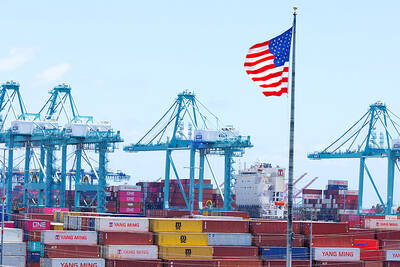
NOT IMMEDIATE: Taiwan has a chance to appeal the proposed 10 percent tariff before it starts, while other countries face a 12.5 percent tariff from the trade office Taiwan is among 60 economies determined by the US to have failed to impose or enforce a ban on the importation of goods produced with forced labor, according to a notice released on Tuesday by the Office of the US Trade Representative (USTR), which proposed imposing an additional 10 percent or more tariff on them. The USTR in a statement said that following an investigation, it had determined under Section 301 of the Trade Act of 1974 that the failure of the 60 economies to impose and effectively enforce a prohibition on the importation of goods produced with forced labor is

RIGHT DIRECTION: Taiwan’s efforts to prevent forced labor include a proposal to ‘fully prohibit’ employers from withholding workers’ documents, an official said Taiwan is to establish a mechanism to restrict imports of goods linked to forced labor, the Executive Yuan said yesterday, after the US proposed imposing additional tariffs on Taiwanese goods over labor concerns. “The Ministry of Labor and the Ministry of Economic Affairs are to establish an interministerial review procedure,” Executive Yuan spokesperson Michelle Lee (李慧芝) said at a news briefing in Taipei. “The government is to use the Foreign Trade Act [貿易法] as the legal basis to restrict imports of goods produced with forced labor” and bring its supply chain governance more in line with international standards on human rights, resilience


 RSS
RSS