


Democratic Progressive Party (DPP) lawmakers yesterday accused the National Security Bureau (NSB) of monitoring hundreds of students, academics and activists involved in protests over land expropriation in Dapu Borough (大埔), Miaoli County.
“[The monitoring] is a modern-day White Terror. We ask the national security agencies to immediately stop such monitoring,” DPP Legislator Chen Chi-mai (陳其邁) told a press conference.
Chen said the watch list included film directors Yang Ya-che (楊雅吉吉), Leon Dai (戴立忍) and Ko I-cheng (柯一正), university student group leaders Chen Wei-ting (陳為廷) and Lin Fei-fan (林飛帆) and several professors, including Hsu Shih-jung (徐世榮), Liao Pen-chuan (廖本全) and Frida Tsai (蔡培慧).
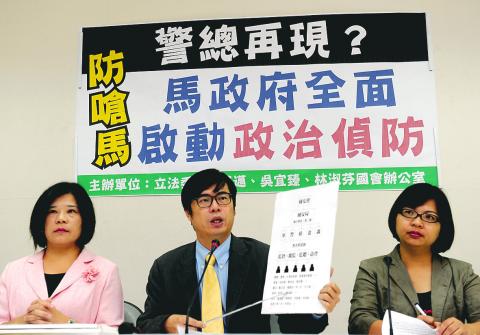
Photo: CNA
The people on the watch list were either being wiretapped, spied upon or investigated by police or bureau investigators, and anyone on the list who shows up at events attended by President Ma Ying-jeou (馬英九), Vice President Wu Den-yih (吳敦義), Premier Jiang Yi-huah (江宜樺) or Miaoli County Commissioner Liu Cheng-hung (劉政鴻) would be closely watched and removed, if necessary, Chen said.
The NSB has “instructed” the military, the military police, the police, prosecutors, the Ministry of Justice’s Bureau of Investigation and the Ministry of Education to gather information about people who were active in the protests, the lawmaker said.
However, on Monday, the National Police Agency denied the accusation by Lala Lin (林羿含), a singer who performed at an Aug. 16 rally in Miaoli, that she had been put on a watch list and police officers had visited her home in Greater Tainan.
DPP Legislator Wu Yi-chen (吳宜臻) said the NSB’s actions have violated the public’s freedom of speech and right to assembly. Students should not be placed on a watch list just for attending protests, Wu said.
The NSB issued a press release yesterday denying the accusations. The statement said the bureau was in charge of intelligence gathering and the planning and execution of special tasks.
“The bureau does not engage in those practices that go beyond its authorization,” it said.

‘NO SECURITY RISK’: The Railway Bureau reassured the public that the technicians’ activities were limited to technical guidance and did not involve sensitive systems The Railway Bureau yesterday said it had invited eight Chinese technicians to assist with an airport MRT construction project. The bureau issued the confirmation after an Internet user said Chinese nationals had entered the construction zone of Taiwan Taoyuan International Airport’s Terminal 3 project. They asked why “individuals from an enemy state” were allowed access to such a major national infrastructure project, which raised serious concerns over Taiwan’s industrial safety, sensitive systems and information security. The bureau’s Northern Region Engineering Branch Office said subcontractor Taiwan Handle Industrial Co (台灣手把工業) of the Taoyuan airport MRT’s “Contract No. CU05 Project A14 Station Civil, MEP &

A US uncrewed surface vessel (USV) encountered multiple Chinese warships during an autonomous transit of the Taiwan Strait, US defense company Seasats said in a statement on Wednesday. Seasats announced that a Lightfish USV had completed the first autonomous transit of the Taiwan Strait. Over five days, the USV traversed the entire length of the Strait while constantly monitoring surface vessel traffic, the company said. The Lightfish encountered multiple Chinese warships, one of which was a Chinese People’s Liberation Army Navy (PLAN) Type 056 corvette, it said. The Chinese vessels were operating “well within Taiwan’s exclusive economic zone without transmitting their identity via the
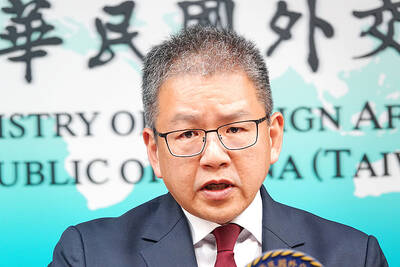
Taiwan is still in the process of assessing the possibility of recruiting workers from Eswatini, the Ministry of Foreign Affairs said yesterday, adding that its goal is to help Eswatini upgrade its vocational training centers. If there are plans to recruit workers from Eswatini, safeguarding national security, protecting public health and ensuring the employment rights of Taiwanese would be prerequisites, Department of West Asian and African Affairs Director-General Yen Chia-liang (顏嘉良) told a news conference. Key considerations would also include filling labor shortages in specific industries, and fostering bilateral professional and technical exchanges, he said. Yen was asked about the progress of labor
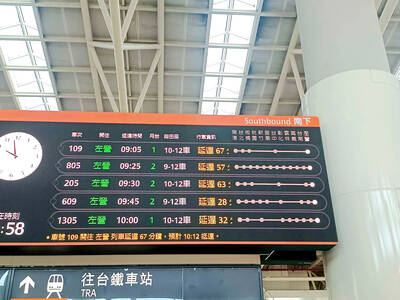
The nation’s usually punctual high-speed rail system yesterday was hit by major disruptions after all scheduled services were canceled and replaced with three hourly trains offering only non-reserved seating, affecting more than 200,000 passengers. Preliminary findings indicate the disruption was caused by a faulty power module in a track switch control cabinet, Taiwan High-Speed Rail Corp (THSRC) said, adding that as a full system inspection could only be conducted after operations end for the day, a decision on whether normal service would resume today would be announced before the first train departs. During a routine inspection early yesterday, a switch signal abnormality


 RSS
RSS