


Having first played together as teenagers, Taiwan’s Hsieh Su-wei (謝淑薇) and China’s Peng Shuai (彭帥) won their maiden Grand Slam title with a 7-6 (7/1), 6-1 victory on Saturday over Australian duo Ashleigh Barty and Casey Dellacqua in the women’s doubles final at Wimbledon.
Hsieh became the first Taiwanese tennis player to claim a Grand Slam title, while Peng gave China its first doubles success in seven years at one of the sport’s four biggest tournaments.
“It’s very special because I don’t think tennis is popular in Taiwan,” Hsieh said. “We didn’t see many media during this tournament. We’re very proud we can win this tournament together with my good friend. It’s our first title, for Taiwan, so I think it’s big thing in Taiwan.”
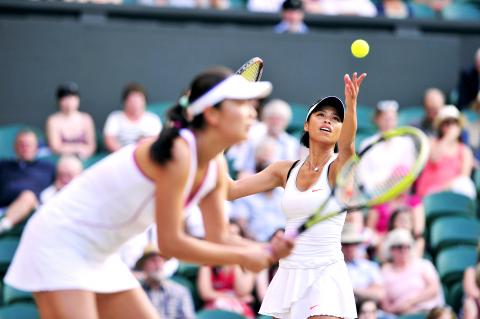
Photo: AFP
The eighth-seeded pair withstood a tight first set and fought their way back to force a tie-break after the Australian duo broke for 3-1. Hsieh and Peng dominated the tie-break, taking it 7-1. From there the pair took control, capitalizing on the Australians’ errors, and cruised to victory.
The 12th-seeded Dellacqua and Barty were bidding to become the first all-Australian team to win the women’s title at the All England Club since 1978.
Hsieh and Peng, who are both 27, played a few tournaments together as juniors, but ended their partnership after turning pro.
As teenagers they had shared everything, including clothes and money, Hsieh recalled.
They were nicknamed the “Crab Duo” because their surnames combine to sound like the Mandarin pronunciation of “crab.” However, they have recently become known as the “Cross-Strait Duo.”
After a seven-year hiatus, Hsieh’s father, Hsieh Tzu-lung (謝子龍), suggested that the pair join forces again in 2008.
The friends resumed their partnership by the end of the year and won their first 11 matches, claiming titles in Bali and Sydney.
They lost to Serena and Venus Williams in the 2009 Australian Open quarter-finals, but advanced to the semi-finals of the French Open in the same year.
Their longtime friendship is now embellished with a Grand Slam title, which Hsieh’s father had predicted since the pair’s early success together.
“Your dad’s dream has come true,” Peng told Hsieh after the match.
“I’ll leave my best moment here. I can retire,” Hsieh joked at the press conference after the final.
Both Peng and Hsieh play double-handed on both sides, like Frenchwoman Marion Bartoli, who won the Wimbledon women’s singles title on Saturday.
“It’s probably the first time [double-handed players] win the singles and the doubles,” Peng said.
Peng and Hsieh said they opted for this unorthodox style of play because they were too small to hold their rackets with one hand when they were kids.
The triumphant duo plan to compete at the US Open and the WTA Tour Championships held at the end of the season by the Women’s Tennis Association (WTA), the Taiwanese No. 1 said.
The annual tour championships feature the season’s top eight singles players and top four doubles teams, and Hsieh and Peng were ranked seventh as of June 24.
Meanwhile, Liao Yu-hui (廖裕輝), chairman of the Chinese Taipei Tennis Association, announced in Taipei yesterday that he will donate NT$1 million (US$33,100) to set up a fund in Hsieh’s name to cultivate local talent.
The fund will be used mainly to support young Taiwanese players taking part in overseas competitions, the association said.

The nation’s fastest supercomputer, Nano 4 (晶創26), is scheduled to be launched in the third quarter, and would be used to train large language models in finance and national defense sectors, the National Center for High-Performance Computing (NCHC) said. The supercomputer, which would operate at about 86.05 petaflops, is being tested at a new cloud computing center in the Southern Taiwan Science Park in Tainan. The exterior of the server cabinet features chip circuitry patterns overlaid with a map of Taiwan, highlighting the nation’s central position in the semiconductor industry. The center also houses Taiwania 2, Taiwania 3, Forerunner 1 and
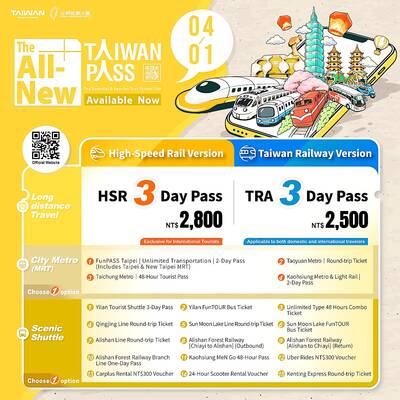
MORE POPULAR: Taiwan Pass sales increased by 59 percent during the first quarter compared with the same period last year, the Tourism Administration said The Tourism Administration yesterday said that it has streamlined the Taiwan Pass, with two versions available for purchase beginning today. The tourism agency has made the pass available to international tourists since 2024, allowing them to access the high-speed rail, Taiwan Railway Corp services, four MRT systems and four Taiwan Tourist Shuttles. Previously, five types of Taiwan Pass were available, but some tourists have said that the offerings were too complicated. The agency said only two types of Taiwan Pass would be available, starting from a three-day pass with the high-speed rail and a three-day pass with Taiwan Railway Corp. The former costs NT$2,800

FIRST TRIAL: Ko’s lawyers sought reduced bail and other concessions, as did other defendants, but the bail judge denied their requests, citing the severity of the sentences Former Taipei mayor Ko Wen-je (柯文哲) was yesterday sentenced to 17 years in prison and had his civil rights suspended for six years over corruption, embezzlement and other charges. Taipei prosecutors in December last year asked the Taipei District Court for a combined 28-year, six-month sentence for the four cases against Ko, who founded the Taiwan People’s Party (TPP). The cases were linked to the Core Pacific City (京華城購物中心) redevelopment project and the mismanagement of political donations. Other defendants convicted on separate charges included Chinese Nationalist Party (KMT) Taipei City Councilor Angela Ying (應曉薇), who was handed a 15-year, six-month sentence; Core Pacific
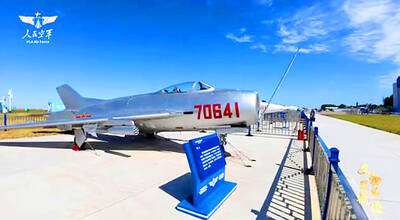
J-6 REMODEL: The converted drones are part of Beijing’s expanding mix of airpower weapons, including bombers with stand-off missiles and UAV swarms, the report said China has stationed obsolete supersonic fighters converted to attack drones at six air bases close to the Taiwan Strait, a report published this month by the Arlington, Virginia-based Mitchell Institute for Aerospace Studies said. Satellite imagery of the airfields from the institute’s “China Airpower Tracker” shows what appear to be lines of stubby, swept-winged aircraft matching the shape of J-6 fighters that first flew with the Chinese People’s Liberation Army (PLA) Air Force in the 1960s. Since their conversion to drones, the aircraft have been identified at five bases in China’s Fujian Province and one in Guangdong Province, the report said. J.


 RSS
RSS