


The US may be playing a major behind-the-scenes role in trying to calm growing tensions between Taiwan and the Philippines over the killing of a Taiwanese fisherman last week, a US Department of State official indicated on Wednesday.
“We urge the Philippines and Taiwan to take all appropriate measures to clarify disagreements and prevent recurrence of such tragic events,” acting deputy US Department of State spokesman Patrick Ventrell said.
Ventrell confirmed the US was in close communication with both sides, but refused to give details of Washington’s diplomatic involvement.
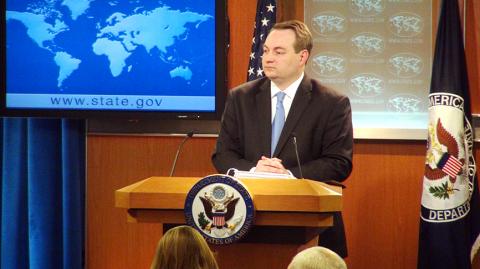
Photo: CNA
“We’re concerned by the increase in tensions between two neighboring democracies and close partners of the United States in the Asia-Pacific region,” Ventrell said.
He said that Philippine President Benigno Aquino III had appointed a personal representative to Taiwan to convey his deep regret and to apologize.
Another diplomatic source told the Taipei Times that Washington was “actively engaged” in trying to stop the incident from escalating and that there had been talks at the highest levels.
Speaking at the daily US Department of State press briefing, Ventrell said the US continued to urge both parties to ensure maritime safety and refrain from actions that could “further escalate tensions” in the region, and undermine the prospects for a rapid and effective resolution of differences.
“These are partners with whom we have extensive relationships,” he said. “I’m not going to get into the day-to-day readout of our diplomacy, whether it’s from Washington or our posts overseas. I’m just not going to get into that level of detail.”
He added that he did not know when the Philippine investigation into the shooting would be completed.
“It appears the incident took place in or near disputed waters, where the Philippines and Taiwan both claim fishing rights,” Ventrell said.
The US does not take a position on the proper location of a maritime boundary in that area.
Ventrell was reminded at the hearing that President Ma Ying-jeou (馬英九) had rejected the Philippines’ apology as lacking sincerity.
Asked if the US considered the apology to be sincere, Ventrell said that was a determination for Taiwan to make and discuss “as appropriate” with the Philippines.
Ventrell was asked if the Taiwan-Philippines “conflict” could undermine US interests in the Asia-Pacific region.
“I’m not going to draw that broad a conclusion, other than to say that we’re concerned about this increase in tension,” Ventrell said. “These are two partners that we have a robust relationship with ... and we want them to work through their differences on this issue as expeditiously as they can.”
Ventrell said that it was “precisely incidents such as this” which underscore the need for a code of conduct in the Pacific Ocean, where there are numerous disputed areas of territorial waters.
Asked if the US had dissuaded Taiwan from sending a military vessel to protect its fishermen in waters near the Philippines, Ventrell said he had no information on that suggestion “one way or the other.”


RESILIENCE: Taiwan plays a key role in semiconductors, energy, information infrastructure and advanced manufacturing, AIT Director Raymond Greene said Taiwan’s continued investment in deterrence and resilience remains vital, especially in uncrewed systems and other emerging technologies, American Institute in Taiwan (AIT) Director Raymond Greene said yesterday. Greene made the remarks at the annual National Strategic Summit on Supply Chain Resilience held by the Research Institute for Democracy, Society and Emerging Technology (DSET), a government-backed think tank. As Taiwan last year became the US’ fourth-largest trading partner and supply chain security is becoming more important, cooperation in emerging technologies continues to deepen between the two countries, he said. The US is committed to accelerating innovation, building key infrastructure, strengthening cooperation

The National Chungshan Institute of Science and Technology yesterday showcased its locally developed variants of the Vision 60 robotic patrol dog, which it plans to deploy on the nation’s outlying territories in the South China Sea. The variants were produced under the Joint Lab project — created by the institute and domestic companies — and assembled with domestically produced motors, lenses and artificial intelligence (AI) systems alongside licensed tech from the US, Missile and Rocket Systems Research Division deputy director Jen Kuo-kang (任國光) told the media event at a military base in Taipei’s Dazhi (大直) area. Taiwan has built up its strengths

RIGHT DIRECTION: Taiwan’s efforts to prevent forced labor include a proposal to ‘fully prohibit’ employers from withholding workers’ documents, an official said Taiwan is to establish a mechanism to restrict imports of goods linked to forced labor, the Executive Yuan said yesterday, after the US proposed imposing additional tariffs on Taiwanese goods over labor concerns. “The Ministry of Labor and the Ministry of Economic Affairs are to establish an interministerial review procedure,” Executive Yuan spokesperson Michelle Lee (李慧芝) said at a news briefing in Taipei. “The government is to use the Foreign Trade Act [貿易法] as the legal basis to restrict imports of goods produced with forced labor” and bring its supply chain governance more in line with international standards on human rights, resilience

NOT IMMEDIATE: Taiwan has a chance to appeal the proposed 10 percent tariff before it starts, while other countries face a 12.5 percent tariff from the trade office Taiwan is among 60 economies determined by the US to have failed to impose or enforce a ban on the importation of goods produced with forced labor, according to a notice released on Tuesday by the Office of the US Trade Representative (USTR), which proposed imposing an additional 10 percent or more tariff on them. The USTR in a statement said that following an investigation, it had determined under Section 301 of the Trade Act of 1974 that the failure of the 60 economies to impose and effectively enforce a prohibition on the importation of goods produced with forced labor is


 RSS
RSS