


Minister of Education Chiang Wei-ling (蔣偉寧) said yesterday that he would continue to push for a limit to be placed on pensions for retired public school teachers who continue teaching at private schools, a proposal that was recently turned down by the Cabinet.
“We will deal with the issue in a proactive manner,” Chiang said after visiting National Federation of Teachers Unions (NFTU) president Liu Chin-hsu (劉欽旭), who is on a hunger strike.
Chiang played down the proposal that was rejected by the Cabinet on April 25.
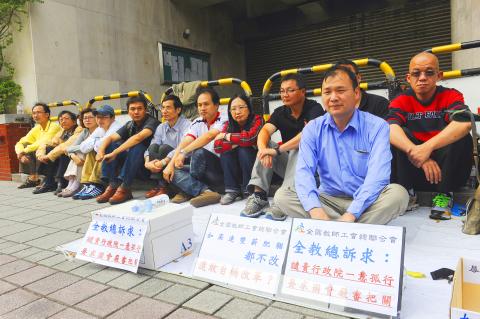
Photo: George Tsorng, Taipei Times
“It is not that [the Cabinet] denied the proposal. [The Cabinet] wanted to have an equitable principle for retired teachers, military personnel and civil servants. Therefore, there is still a need for further discussion of the issue,” Chiang said.
Chiang had planned to include the proposal in a package of government reforms aimed at improving the nation’s retirement insurance system for military personnel, civil servants and public school teachers, which operates on an increasingly unsustainable system of low contributions and a high replacement rate.
At a Cabinet meeting on April 25, the Cabinet finalized plans to reform the pension system, but excluded a stipulation that would have caused retired public school teachers who teach in private schools to receive only 40 percent of their monthly pension.
The ceiling was set at 40 percent because that would be equivalent to the amount contributed by the teachers themselves, if the pension reform, which is pending legislative approval, is adopted.
The government would contribute the remaining 60 percent.
The Cabinet’s decision was opposed by the NFTU, a nationwide teachers’ union of more than 80,000 teachers in 19 counties and cities, and Liu started a hunger strike on Friday at 10:30am to protest the measure.
“The hunger strike will continue until the government gives a positive response to our demands,” NFTU executive secretary Kuo Shih-tsan (郭石燦) said.
Given that private schools are operated under a franchise arrangement and regularly receive grants from the government, positions in private schools are likely to be much more accessible to teachers affiliated with the public sector than regular citizens, NFTU vice president Wu Chung-tai (吳忠泰) said.
“It’s not difficult to understand why the issue needs to be addressed. Retired public school teachers continue to be hired in private schools and so receive double payment — a monthly retirement payout and a salary from the private school,” Wu said.
According to the NTFU, about 2,500 teachers or staff of private schools are retired government employees, of which, 1,500 come from public schools and 1,000 from defense-related agencies or other government agencies.
The legislature is aware of the problem and has adopted several resolutions since last year demanding that the Executive Yuan address the double payment issue, Wu said.
What the government should do is to push the Ministry of National Defense and the Ministry of Civil Service to follow Chiang’s steps to present proposals applicable to retired military personnel and civil servants, rather than rejecting the proposal, he said.
If the problem could be adequately addressed, it would help people with doctor’s degrees and higher education find more jobs in schools, Kuo said.
The unemployment level for people with a doctorate or post-graduate degree hit a record high of more than 4.5 percent this year.
“Many people with doctorates can’t find a teaching position in schools because there are no vacancies,” he said.
Democratic Progressive Party legislators Lin Chia-lung (林佳龍), Chiu Chih-wei (邱志偉) and Hsu Chih-chieh (許智傑) have initiated various proposals to address the problem.
Executive Yuan spokesperson Cheng Li-wun (鄭麗文) said that the Cabinet would not present its own version of the issue, but would be receptive to ideas.

A signaling system malfunction disrupted high-speed rail (HSR) services beginning at 8am today, with trains temporarily reduced to three northbound and three southbound trains per hour as authorities conduct inspections. The malfunction occurred on a section of track in Miaoli County during pre-operation checks early this morning, forcing northbound and southbound trains to use a single track, the HSR operator said. The regular schedule has been replaced with three hourly trains offering only nonreserved seating in each direction, stopping at every station, it said, adding that business class cars would still have reserved seating. Departures from terminal stations are scheduled at the top

DRONE CENTRAL: Taiwan aims to become Asia’s democratic hub for drones, with most exports focused on high-quality military-grade models, an official said Taiwan’s drone industry is expected to expand significantly by 2030, producing 100,000 units per month and exporting half of them, the Ministry of Economic Affairs said yesterday. Current drone production capacity is about 15,000 units per month, but the industry can quickly scale up as demand increases, Industrial Development Administration Director-General Chiou Chyou-huey (邱求慧) told a news conference in Taipei. Taiwan’s drone output grew 2.5-fold last year to NT$12.9 billion (US$408.3 million) under a government program to develop the uncrewed vehicle sector, he said. The Executive Yuan in October last year approved plans to invest NT$44.2 billion into domestic production of uncrewed aerial

VERBOSE VESSELS: A CGA cutter and a China Coast Guard exchanged verbal barbs for more than a day in Taiwanese-controlled waters before the Chinese vessel left The Taiwanese and Chinese coast guards had a standoff near the strategically located Pratas Islands (Dongsha Islands, 東沙群島) in the north of the South China Sea, the Coast Guard Administration (CGA) said yesterday. The two sides engaged in intense radio exchanges over sovereignty claims during the 33-hour standoff. China Coast Guard vessel 3501 eventually left the restricted waters, 26.6 nautical miles (49.2km) west of the Pratas Islands, at 5pm yesterday, the CGA said. Lying approximately between southern Taiwan and Hong Kong, the Taiwan-controlled Pratas are seen by some security experts as vulnerable to Chinese attack due to their distance — more than
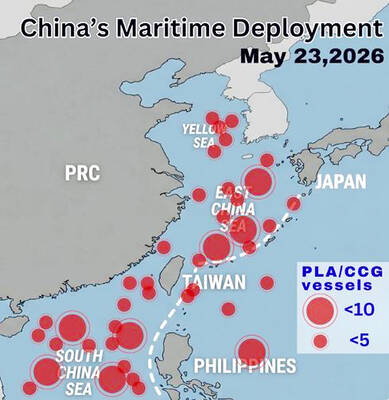
WARNING: China should stop engaging in actions that undermine regional peace and stability, as it would only build resentment among people across the Strait, the CGA said China has deployed more than 100 navy, coast guard and other vessels in waters from the Yellow Sea to the South China Sea and the western Pacific since US President Donald Trump and Chinese President Xi Jinping (習近平) met in Beijing, National Security Council Secretary-General Joseph Wu (吳釗燮) said yesterday. “In this part of the world, #China is the one & only PROBLEM wrecking the #StatusQuo & threatening regional peace & stability,” Wu wrote on X. In a separate post, he said Beijing was coercing Taiwan’s maritime domain, calling it illegal and provocative, after the Coast Guard Administration (CGA) expelled a


 RSS
RSS