


Investigators were seeking a motive for the Boston Marathon bombings and whether others were involved as they awaited a chance yesterday to interview the surviving ethnic Chechen suspect.
Dzhokhar Tsarnaev, 19, was in a Boston hospital seriously wounded and unable to speak, after he was captured late on Friday at the end of a huge manhunt.
His brother, Tamerlan Tsarnaev, 26, was killed in a firefight with police earlier on Friday.
Investigators are trying to determine if others had a role in detonating bombs made in pressure cookers and packed with ball bearings and nails that exploded at the Boston Marathon on Monday last week, killing three people and injuring 176.
Tamerlan traveled to Moscow in January last year and spent six months in the region, a law enforcement source said. However, it was unclear what he did while he was there and if he could have had contact with militant Islamist groups in Russia’s Caucasus region.
Authorities have yet to charge Dzhokhar, who will be defended by the US Federal Public Defender Office that represents criminal suspects who cannot afford a lawyer.
Sources had said he would face charges on Saturday, but late in the evening officials from the US Attorneys’ Office and the US Department of Justice indicated no statement would be made before yesterday.
The role of the FBI is also being questioned after the agency said it had interviewed Tamerlan in 2011 after Russian security services raised concerns he followed radical Islam. The FBI said it did not find any “terrorism activity” at that time.
However, the brothers’ mother, Zubeidat Tsarnaeva told a Russian TV station that Tamerlan had been under FBI surveillance for years.
The New York Times, citing unnamed federal officials, reported authorities had held up Tamerlan’s application for US citizenship because of the FBI’s 2011 interview.
Records show Tamerlan was arrested when police were called to a report of domestic violence in 2009.
Dzhokhar, a student at the University of Massachusetts Dartmouth, was shot in the throat and could not speak, a source said.
“We have a million questions and those questions need to be answered,” Massachusetts Governor Deval Patrick said on Saturday.
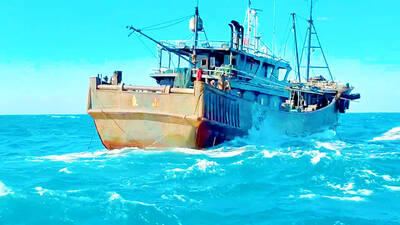
MAKING WAVES: China’s maritime militia could become a nontraditional threat in war, clogging up shipping lanes to prevent US or Japanese intervention, a report said About 1,900 Chinese ships flying flags of convenience and fishing vessels that participated in China’s military exercises around Taiwan last month and in January have been listed for monitoring, Coast Guard Administration (CGA) Deputy Director-General Hsieh Ching-chin (謝慶欽) said yesterday. Following amendments to the Commercial Port Act (商港法) and the Law of Ships (船舶法) last month, the CGA can designate possible berthing areas or deny ports of call for vessels suspected of loitering around areas where undersea cables can be accessed, Oceans Affairs Council Minister Kuan Bi-ling (管碧玲) said. The list of suspected ships, originally 300, had risen to about 1,900 as

Japan’s strategic alliance with the US would collapse if Tokyo were to turn away from a conflict in Taiwan, Japanese Prime Minister Sanae Takaichi said yesterday, but distanced herself from previous comments that suggested a possible military response in such an event. Takaichi expressed her latest views on a nationally broadcast TV program late on Monday, where an opposition party leader criticized her for igniting tensions with China with the earlier remarks. Ties between Japan and China have sunk to the worst level in years after Takaichi said in November that a hypothetical Chinese attack on Taiwan could bring about a Japanese
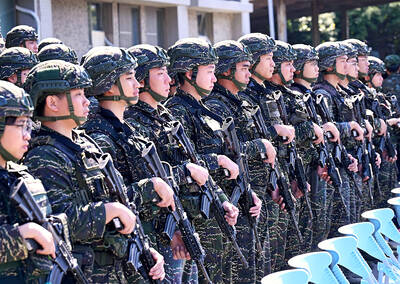
MORE RESPONSIBILITY: Draftees would be expected to fight alongside professional soldiers, likely requiring the transformation of some training brigades into combat units The armed forces are to start incorporating new conscripts into combined arms brigades this year to enhance combat readiness, the Executive Yuan’s latest policy report said. The new policy would affect Taiwanese men entering the military for their compulsory service, which was extended to one year under reforms by then-president Tsai Ing-wen (蔡英文) in 2022. The conscripts would be trained to operate machine guns, uncrewed aerial vehicles, anti-tank guided missile launchers and Stinger air defense systems, the report said, adding that the basic training would be lengthened to eight weeks. After basic training, conscripts would be sorted into infantry battalions that would take
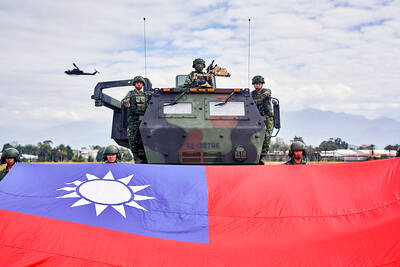
DEEP-STRIKE CAPABILITY: The scenario simulated a PLA drill that turned into an assault on Taiwan’s critical infrastructure, with the launchers providing fire support Taiwan yesterday conducted this year’s first military exercises at Longsiang Base in Taichung, demonstrating the newly acquired High Mobility Artillery Rocket System’s (HIMARS) ability to provide fire support and deep-strike capabilities. The scenario simulated an attack on Penghu County, with HIMARS trucks immediately rolling into designated launch areas and firing barrages at the Wangan (望安) and Cimei (七美) islands, simulating the provision of fire support against invading forces. The HIMARS are supposed to “fire and leave,” which would significantly increase personnel and equipment survivability, a military official said. The drill simulated an exercise launched by the Chinese People’s Liberation Army (PLA) Eastern


 RSS
RSS