


An opinion poll published yesterday showed that former Democratic Progressive Party (DPP) chairperson Tsai Ing-wen (蔡英文) and New Taipei City (新北市) Mayor Eric Chu (朱立倫) of the Chinese Nationalist Party (KMT) are seen as politicians most capable of fighting corruption, with each winning support from more than 40 percent of respondents.
Tsai was named as the most trustworthy politician among a selection of 10 politicians when it comes to tackling corruption, with a support rate of 46.5 percent in the survey conducted by Taiwan Indicators Survey Research (TISR). Chu was second with 41.1 percent.
All four DPP politicians on the list were in the top five. DPP Chairman Su Tseng-chang (蘇貞昌) came in third with 38.5 percent, ahead of Greater Kaohsiung Mayor Chen Chu’s (陳菊) 37.2 percent and Greater Tainan Mayor William Lai’s (賴清德) 34.3 percent.
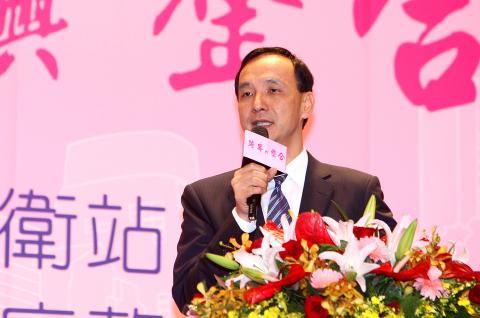
Photo: Ho Yu-hua, Taipei Times
The results showed widespread public disappointment with the government’s efforts to fight graft, as President Ma Ying-jeou (馬英九) and Vice President Wu Den-yih (吳敦義), plagued by a series of government corruption cases, endured embarrassing results.
Ma ranked second to last with 17.6 percent, while Wu was last with 12.6 percent. Premier Jiang Yi-huah (江宜樺) placed eighth, one place above Ma, with 18.4 percent, trailing Greater Taichung Mayor Jason Hu (胡志強) and Taipei Mayor Hau Lung-bin (郝龍斌).
With regards to political parties, 30.1 percent said both the KMT and the DPP were incapable of monitoring potential corruption when in power, with 26.2 percent saying the DPP was better and 18.9 percent voting for the KMT. Just 6.2 percent supported both parties’ efforts, while 18.6 percent were unsure.
The survey also found that people’s confidence in the judicial system has dramatically waned since 2006, with 69.2 percent saying they did not believe the judicial system could uphold fairness and justice.
That was up from 48.5 percent who expressed their lack of confidence in the judiciary in 2006, 47.2 percent in 2009 and 63.3 percent in July last year, TISR said.
Only 18.6 percent believed that justice and fairness would be upheld, a far cry from the 40.4 percent in 2006 and 39.1 percent in 2009.
The poll, conducted on Monday and Tuesday, had 1,005 valid samples and a margin of error of 3.1 percentage points.
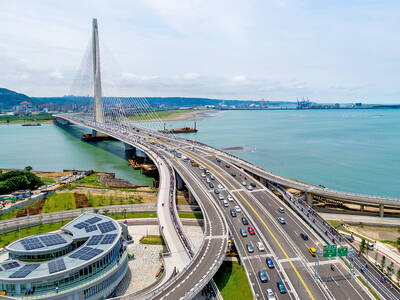
The Ministry of Transportation and Communications yesterday inaugurated the Danjiang Bridge across the Tamsui River in New Taipei City, saying that the structure would be an architectural icon and traffic artery for Taiwan. Feted as a major engineering achievement, the Danjiang Bridge is 920m long, 211m tall at the top of its pylon, and is the longest single-pylon asymmetric cable-stayed bridge in the world, the government’s Web site for the structure said. It was designed by late Iraqi-British architect Zaha Hadid. The structure, with a maximum deck of 70m, accommodates road and light rail traffic, and affords a 200m navigation channel for boats,
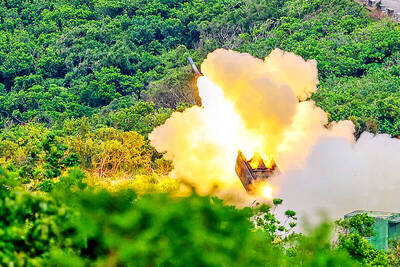
PRECISION STRIKES: The most significant reason to deploy HIMARS to outlying islands is to establish a ‘dead zone’ that the PLA would not dare enter, a source said A High Mobility Artillery Rocket System (HIMARS) would be deployed to Penghu County and Dongyin Island (東引) in Lienchiang County (Matsu) to force the Chinese military to retreat at least 100km from the coastline, a military source said yesterday. Taiwan has been procuring HIMARS and Army Tactical Missile Systems (ATACMS) from the US in batches. Once all batches have been delivered, Taiwan would possess 111 HIMARS units and 504 ATACMS, which have a range of 300km. Considering that “offense is the best defense,” the military plans to forward-deploy the systems to outlying islands such as Penghu and Dongyin so that
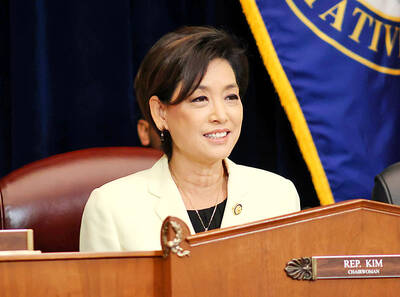
‘CLEAR MESSAGE’: The bill would set up an interagency ‘tiger team’ to review sanctions tools and other economic options to help deter any Chinese aggression toward Taiwan US Representative Young Kim has introduced a bill to deter Chinese aggression against Taiwan, calling for an interagency “tiger team” to preplan coordinated sanctions and economic measures in response to possible Chinese military or political action against Taiwan. “[Chinese President] Xi Jinping [習近平] has directed the People’s Liberation Army to be ready to invade Taiwan by 2027. China has a plan. America should have one too,” Kim said in a news release on Thursday last week. She introduced the “Deter PRC [People’s Republic of China] aggression against Taiwan act” to “ensure the US has a coordinated sanctions strategy ready should

TAIWAN ISSUE: US treasury secretary Scott Bessent said on the first day of meetings that ‘it wouldn’t be a US-China summit without the Taiwan issue coming up’ There were no surprises on the first day of the summit between US President Donald Trump and Chinese President Xi Jinping (習近平), the Mainland Affairs Council (MAC) said yesterday, as the government reiterated that cross-strait stability is crucial to the Asia-Pacific region, as well as the world. As the two presidents met for a highly anticipated summit yesterday, Chinese state media reported that Xi warned Trump that missteps regarding Taiwan could push their two countries into “conflict.” Trump arrived in China with accolades for his host, calling Xi a “great leader” and “friend,” and extending an invitation to visit the White House


 RSS
RSS