

Taiwan and Japan yesterday inked a fisheries agreement in a bid to end controversies over fishing in waters surrounding the contested Diaoyutai Islands (釣魚台). The agreement includes an escape clause which Taipei said allows both sides to set aside disputes over their competing sovereignty claims.
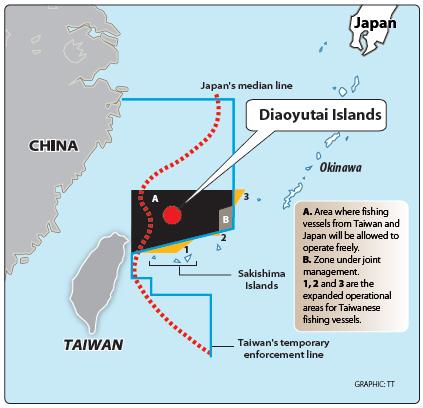
The agreement assured Taiwanese vessels an intervention-free fishing zone in waters between 27° north latitude and the Sakishima Islands, Okinawa Prefecture, and gave Taiwan an additional fishing zone of 1,400 square nautical miles (4,800km2) outside Taiwan’s temporary enforcement line, government officials said.
Under the deal, fishing vessels from both countries can operate in a large area within the designated zone without being subject to the jurisdiction of the other side, while a smaller area of the zone, where Japanese fishing vessels frequently operate, is under joint management by the two governments.
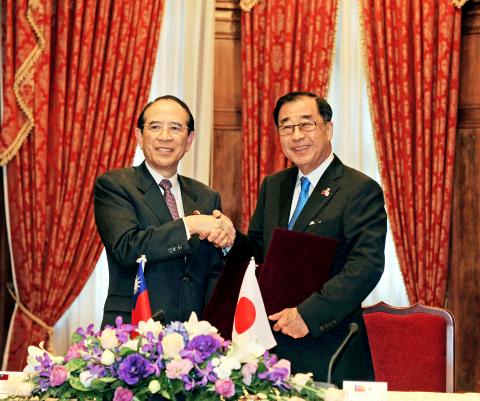
Photo: CNA
Provisions under the agreement do not apply to waters within 12 nautical miles — a state’s territorial waters — surrounding the Diaoyutai Islands, because the islands are claimed by both Taiwan and Japan, which calls them the Senkaku Islands.
China also claims sovereignty over the Diaoyutais. Japan and China signed a fisheries agreement in 1997, which took effect in 2000, under which both sides co-manage waters above 27° north latitude.
At the signing ceremony at the Taipei Guest House, Association of East Asian Relations Chairman Liao Liou-yi (廖了以) and Interchange Association, Japan Chairman Mitsuo Ohashi hailed the agreement, which they said marked a big step forward in bilateral relations.
The negotiations yesterday were the 17th round since talks started in August 1996.
Taipei and Tokyo initiated fishery talks following incidents of Taiwanese fishing boats being seized, detained or expelled by the Japan Coast Guard after Tokyo ratified the UN Law of the Sea Treaty in 1996 and set up a 200 nautical mile exclusive economic zone that included waters surrounding the Diaoyutais.
Ohashi said it was “with great pleasure” that the deal was finally signed.
The primary goals were to “maintain peace and stability in East China Sea” and to “strengthen the existing friendly relations with Taiwan,” he said.
At a press conference after the signing ceremony, Minister of Foreign Affairs David Lin (林永樂) said that the agreement did not address the competing claims over the Diaoyutais, as both governments agreed to “set aside the dispute.”
As stated in Article 4, provisions that both sides have agreed to under the deal have no effect on each side’s sovereignty claims over the Diaoyutais, Lin said, adding that the escape clause was written into the agreement at Taipei’s insistence.
"We did not back down one bit over the sovereignty issue in the talks,” Lin said.
Waters within 12 nautical miles surrounding the Diaoyutais were exempted from the agreement because “we insisted that the area is our territorial sea, while Japan upheld its position” that it is theirs, Lin said.
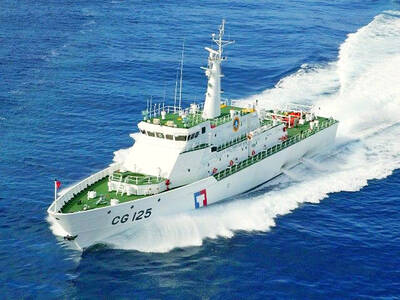
Coast Guard Administration Minister Wang Jinn-wang (王進旺) called on Japanese and Chinese fishing vessels not to operate in waters within the 12 nautical miles surrounding the Diaoyutais and vowed to adopt appropriate measures against Chinese and Japanese fishing vessels to protect the rights of Taiwanese fishermen.
Under the agreement, Taiwan and Japan also agreed to establish a fisheries commission to discuss other issues, including the delineation of overlapping waters in their respective exclusive economic zones above 27º north latitude and waters south of Sakishima Islands, on an annual basis.
Meanwhile, China yesterday expressed concern about the new agreement.
“We are extremely concerned about Japan and Taiwan discussing and signing a fishing agreement,” Chinese Ministry of Foreign Affairs spokesman Hong Lei (洪磊) told a daily news briefing.
“We hope that Japan earnestly abide by its promises on the Taiwan issue and act cautiously and appropriately,” she said.
Additional reporting by Reuters
History of negotiations
‧ First two rounds of negotiations, 1996: Both sides insisted on their respective sovereign claims over the Diaoyutai Islands and did not have substantial discussions about fisheries issues.
‧ Third round of negotiations, 1997: Working-level discussions began about fishing grounds, but delimitation was not discussed.
‧ Fourth, fifth and sixth rounds of negotiations, 1998 to 2000: Taiwan proposed that a commission be set up to co-manage fisheries in the area and that fishing grounds be delimited based on “equitable principle.” Japan rejected the proposals.
‧ Seventh to 15th rounds of negotiations, 2000 to 2005: Taiwan demanded co-management of waters below 27o north latitude and that Taiwanese fishermen have the rights to fish in waters between 27o north latitude to 29o18’ north latitude, because this is within Taiwan’s Exclusive Economic Zone. Japan rejected the proposal and wanted to negotiate based on the principle of a “geographic median line.” It also rejected Taiwan’s claim to fish in waters above 27o north latitude because the area was marked as a zone of joint control between China and Japan in their bilateral fisheries agreement signed in 1997.
‧ Sixteenth round of negotiations, 2009: Consensus was reached on four general principles to deal with disputes on fisheries issues. No substantial discussions on delimitation were held.
Prepared by staff reporter Shih Hsiu-chuan
GEOPOLITICAL SIGNIFICANCE: The CGA’s nonmilitary role makes it a tool to avert diplomatic issues, an official said, while confirming the donation of a ship to Manila Coast Guard Administration (CGA) ships are scheduled to sail to the Philippines bearing the words “Taiwan Coast Guard” in a high-profile visit in October next year, the first such visit by a Taiwanese maritime law enforcement vessel to the Southeast Asian nation, the agency said yesterday. The CGA also confirmed that it had donated one of its decommissioned patrol vessels to the Philippines in a rare transfer of a retired ship to a nondiplomatic ally. The Republic of China (ROC) Navy last made such a visit in 1974, shortly before the Philippines switched diplomatic recognition to the People’s Republic of China in

CALL FOR CHANGE: They urged the UN to facilitate Taiwan’s involvement in the body, recognize its peace efforts and to work with members in preventing military conflict Representatives to the UN from five of Taiwan’s diplomatic allies sent a joint letter to UN Secretary-General Antonio Guterres on Friday, calling for the country’s inclusion in the body. Allies in the letter sent ahead of the 81st session of the UN General Assembly General Debate made three demands in support of Taiwan: inclusion, recognition and camaraderie. They implored the UN to seek an appropriate way to facilitate Taiwan’s meaningful involvement in the world governing body, saying that UN Resolution 2758, which accepted the People’s Republic of China (PRC) as a member of the UN, does not exclude Taiwan. Beijing claims that the

‘GLOBAL WARNING’: The infiltration is not just a local problem, as Beijing has been deploying the same tactics worldwide against Western democracies, a report said Between 50,000 and 100,000 Chinese spies are operating in Taiwan, far more than the National Security Bureau’s previous estimate of 5,000, German journalist and author Jurgen Kremb said on Monday. Kremb presented his research, titled “The War of Spies: How China’s Intelligence Services Are Infiltrating Taiwan — and What Europe Must Learn from It,” at a joint event held by the Taiwan offices of the Friedrich Naumann Foundation and the European Values Center for Security Policy. The report was published in June in the Ministry of Justice Investigation Bureau’s Prospect & Exploration Monthly (展望與探索月刊). By spies, he said he was referring to informants,
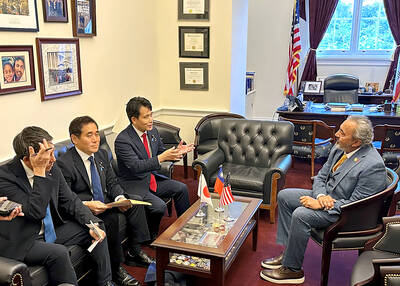
WASHINGTON MEETING: Japan’s Hirofumi Takinami said participants rejected the idea that the US should limit its defensive perimeter to the Second Island Chain US and Japanese lawmakers agree that the US must defend the First Island Chain, including Taiwan, and should not fall back to the Second Island Chain, while “a Taiwan contingency is a Japan contingency and therefore a US-Japan alliance contingency,” media reported after a meeting between officials of the two nations in Washington on Tuesday. A delegation of Japanese lawmakers from the Liberal Democratic Party met with US Senator Thom Tillis, co-chair of the Senate Taiwan Caucus, and US Representative Ami Bera, co-chair of the US Congressional Taiwan caucus, to discuss issues concerning East Asia and the Taiwan Strait. The Japanese and


 RSS
RSS