


Activists yesterday clashed with police during a protest outside Premier Jiang Yi-huah’s (江宜樺) residence, asking him to halt construction work at Losheng (Happy Life) Sanatorium and rebuild demolished buildings on the site.
“Premier Jiang, please save Losheng, halt the construction, rebuild the sanatorium,” dozens of members of the Youth Alliance for Losheng shouted as they clashed with police outside the premier’s residence in Taipei.
The activists arrived outside Jiang’s residence at about 6am without prior notice, hoping to see Jiang and deliver their petition to him before he left for work.
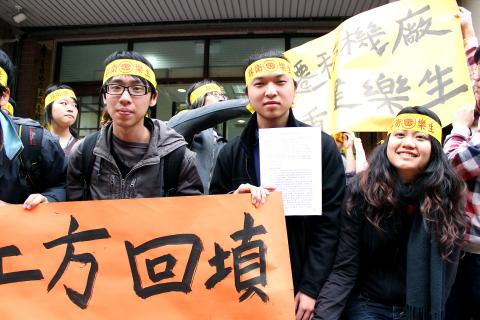
Photo: Hou Po-ching, Taipei Times
However, though the shouting attracted the attention of Jiang, who looked out from a second-floor window for a few seconds, he neither met with the students nor took their petition.
Police quickly removed the protesters by force and arrested 14.
Jiang made no comment on the protest when he left home at about 8am.
“We came here to see Jiang, because when we went to the Executive Yuan on Feb. 27, he simply ignored us,” Lin Ching (林沁), a National Taiwan University (NTU) student and a member of the alliance, told reporters. “In March last year, the government promised that construction at Losheng Sanatorium — suspended due to landslides — would not resume until they find a way to solve the landslide issue. However, construction resumed last week.”
“As a political science professor at NTU, Jiang visited Losheng in 2007 and signed a petition to support its preservation. We want to remind him of the promise he made, and ask him to host talks to resolve the issue,” Lin said.
Losheng Sanatorium, located in New Taipei City’s (新北市) Sinjhuang District (新莊), was built in the 1930s for people with leprosy.
A movement to preserve the sanatorium complex began in 2004 when it was selected as the site for a Mass Rapid Transit system maintenance depot and was to be completely demolished.
In 2007, a compromise plan allowed for the preservation of a small part of the complex, while the rest was to be demolished.
However, work has stopped several times due to landslides.
Another NTU student, Lin Hsiu-tung (林秀芃), accused Jiang of “not wanting to face the mistakes that the government made.”
“He saw us from his second-floor window, but would not meet us or speak with us,” Lin said.
Of the 14 students arrested, 13 were released soon after, while 21-year-old NTU student Kuo Kuan-chun (郭冠均) was charged with violations of the Social Order Maintenance Act (社會秩序維護法).
Several activists rallied outside the Taipei District Court in support of Kuo and accused the police of brutality as Kuo appeared in court.
At about 4:30pm, Kuo walked free as the judge cleared him of any wrongdoing.

The National Chungshan Institute of Science and Technology yesterday showcased its locally developed variants of the Vision 60 robotic patrol dog, which it plans to deploy on the nation’s outlying territories in the South China Sea. The variants were produced under the Joint Lab project — created by the institute and domestic companies — and assembled with domestically produced motors, lenses and artificial intelligence (AI) systems alongside licensed tech from the US, Missile and Rocket Systems Research Division deputy director Jen Kuo-kang (任國光) told the media event at a military base in Taipei’s Dazhi (大直) area. Taiwan has built up its strengths

RIGHT DIRECTION: Taiwan’s efforts to prevent forced labor include a proposal to ‘fully prohibit’ employers from withholding workers’ documents, an official said Taiwan is to establish a mechanism to restrict imports of goods linked to forced labor, the Executive Yuan said yesterday, after the US proposed imposing additional tariffs on Taiwanese goods over labor concerns. “The Ministry of Labor and the Ministry of Economic Affairs are to establish an interministerial review procedure,” Executive Yuan spokesperson Michelle Lee (李慧芝) said at a news briefing in Taipei. “The government is to use the Foreign Trade Act [貿易法] as the legal basis to restrict imports of goods produced with forced labor” and bring its supply chain governance more in line with international standards on human rights, resilience
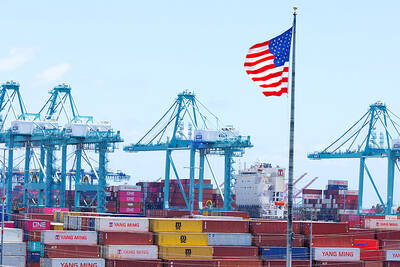
NOT IMMEDIATE: Taiwan has a chance to appeal the proposed 10 percent tariff before it starts, while other countries face a 12.5 percent tariff from the trade office Taiwan is among 60 economies determined by the US to have failed to impose or enforce a ban on the importation of goods produced with forced labor, according to a notice released on Tuesday by the Office of the US Trade Representative (USTR), which proposed imposing an additional 10 percent or more tariff on them. The USTR in a statement said that following an investigation, it had determined under Section 301 of the Trade Act of 1974 that the failure of the 60 economies to impose and effectively enforce a prohibition on the importation of goods produced with forced labor is
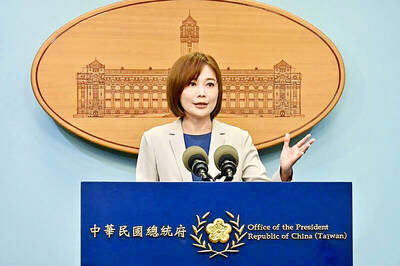
TIT-FOR-TAT: The US allegedly revoked the visa of a Chinese national working at Xinhua News Agency in the US in response to Beijing’s expulsion of Vivian Wang The Presidential Office yesterday condemned China for expelling a New York Times correspondent from Beijing following the newspaper’s interview with President William Lai (賴清德), saying the move highlighted Beijing’s suppression of press freedom and its threat to international news media. Taiwan has noted a series of recent incidents in which Beijing used similar tactics to “threaten and pressure international media outlets and journalists,” Presidential Office spokeswoman Karen Kuo (郭雅慧) said in a statement. “This concerns not only press freedom and freedom of expression, but also the safety of journalists, and Taiwan and relevant partners are paying close attention to the situation,” she


 RSS
RSS