


Hundreds of Tibetans and supporters yesterday took to the streets of Taipei to commemorate the 54th anniversary of the 1959 Tibetan Uprising and the 110 Tibetans who have self-immolated to protest against Chinese occupation, while calling for an end to Chinese repression of Tibetans.
“Free Tibet! Tibet belongs to Tibetans! China, get out of Tibet!” demonstrators chanted in Tibetan, Mandarin and English as they marched from Zhongxiao Fuxing MRT station to Taipei 101.
Leading the march was a group dressed as Chinese soldiers escorting tied-up Tibetan monks to re-enact the arrests of monks.
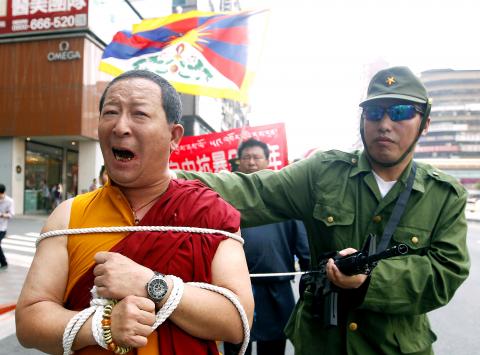
Photo: Chuang Pichi, Reuters
Following the actors were 110 people holding portraits of the 110 Tibetans who have self-immolated since 2009. They lay down on Zhongxiao E Road, near Guangfu S Road, and observed a minute of silence.
“We will never give up pursuing independence for Tibet, because we can only be truly free once Tibet is independent,” Regional Tibetan Youth Congress Taiwan chairman Tenzin Chompel told the crowd. “We will not believe the lies of the Chinese again — from the 17-point peace agreement to the Sino-Tibetan talks, China has never kept its word.”
Chompel was referring to an agreement signed between the Tibetan and Chinese governments in the 1950s, following China’s invasion of Tibet.
In the agreement, China promised to protect Tibetan culture, language, and religion, but, the promises were broken and led to uprisings against Chinese rule and the exile of the Dalai Lama.
Taiwan Tibetan Welfare Association adviser Tashi Tsering said Tibetans do not hate Chinese.
“Tibetans and Chinese are all humans. As long as Chinese respect Tibetans’ rights to our own culture, religion, language and self-determination, we will respect the Chinese as brothers and good neighbors,” he said.
Democratic Progressive Party (DPP) Chairman Su Tseng-chang (蘇貞昌) expressed his support, saying that as a people who had struggled against an authoritarian regime, Taiwanese understand the suffering of Tibetans and would support their struggle for freedom.
“Even today, there is still injustice and we should give each other support until all the repressed are liberated,” Su said.
Some Chinese — including Ao Bo (敖博), lead vocalist of the exiled Chinese rock band Punk God, and students attending universities in Taiwan — also joined the march.
“As a human living on Earth, I am obliged to help Tibetans gain the independence of their country through whatever I can do,” Ao said.
“That’s why this is the sixth time I have taken part in the rally,” he said.
Several DPP politicians, including legislators Hsiao Bi-khim (蕭美琴), Yu Mei-nu (尤美女) and Chen Chieh-ju (陳節如), as well as Taipei City councilors Chien Yu-yen (簡余晏), Alan Lee (李慶鋒) and Hsu Chia-ching (徐佳青), also took part.
“In addition to showing support through taking part in the march, I’ve also proposed a refugee bill granting asylum to Tibetans or other asylum seekers,” Hsiao said. “Unfortunately, it has been blocked since March last year, when I first made the proposal. I hope my colleagues will give me a hand so that we may better protect rights of refugees.”
Near Taipei 101, some Chinese onlookers gave the thumbs-down to the marchers, while police had to force a car driven by a member of a pro-unification organization to pull over and turn off the Chinese communist music that it was blaring out.
Meanwhile, former DPP chairperson Tsai Ing-wen (蔡英文) voiced her support in a message on her Facebook page.
“Our grief for the more than 100 Tibetans who have self-immolated in the past three years is indescribable. As we are free, we should fight for the freedom of those who suffer and make the annual March 10 march a regular element in Taiwan’s social movement,” Tsai wrote.
Former US president John F. Kennedy expressed support for West Germany and people’s rights to pursuit freedom and human rights by saying that he was a Berliner in a speech in 1963, Tsai said.
“Today, the 54th anniversary of the Tibetan Uprising, I offer the same support. I am a Tibetan. We are all Tibetans,” she wrote.
Additional reporting by Chris Wang and J. Michael Cole

‘NO SECURITY RISK’: The Railway Bureau reassured the public that the technicians’ activities were limited to technical guidance and did not involve sensitive systems The Railway Bureau yesterday said it had invited eight Chinese technicians to assist with an airport MRT construction project. The bureau issued the confirmation after an Internet user said Chinese nationals had entered the construction zone of Taiwan Taoyuan International Airport’s Terminal 3 project. They asked why “individuals from an enemy state” were allowed access to such a major national infrastructure project, which raised serious concerns over Taiwan’s industrial safety, sensitive systems and information security. The bureau’s Northern Region Engineering Branch Office said subcontractor Taiwan Handle Industrial Co (台灣手把工業) of the Taoyuan airport MRT’s “Contract No. CU05 Project A14 Station Civil, MEP &

A US uncrewed surface vessel (USV) encountered multiple Chinese warships during an autonomous transit of the Taiwan Strait, US defense company Seasats said in a statement on Wednesday. Seasats announced that a Lightfish USV had completed the first autonomous transit of the Taiwan Strait. Over five days, the USV traversed the entire length of the Strait while constantly monitoring surface vessel traffic, the company said. The Lightfish encountered multiple Chinese warships, one of which was a Chinese People’s Liberation Army Navy (PLAN) Type 056 corvette, it said. The Chinese vessels were operating “well within Taiwan’s exclusive economic zone without transmitting their identity via the

Taiwan is still in the process of assessing the possibility of recruiting workers from Eswatini, the Ministry of Foreign Affairs said yesterday, adding that its goal is to help Eswatini upgrade its vocational training centers. If there are plans to recruit workers from Eswatini, safeguarding national security, protecting public health and ensuring the employment rights of Taiwanese would be prerequisites, Department of West Asian and African Affairs Director-General Yen Chia-liang (顏嘉良) told a news conference. Key considerations would also include filling labor shortages in specific industries, and fostering bilateral professional and technical exchanges, he said. Yen was asked about the progress of labor
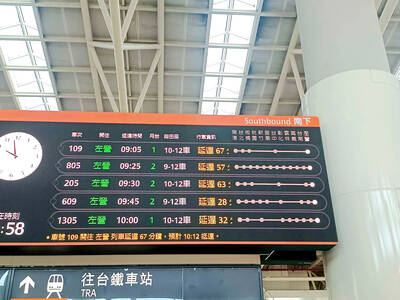
The nation’s usually punctual high-speed rail system yesterday was hit by major disruptions after all scheduled services were canceled and replaced with three hourly trains offering only non-reserved seating, affecting more than 200,000 passengers. Preliminary findings indicate the disruption was caused by a faulty power module in a track switch control cabinet, Taiwan High-Speed Rail Corp (THSRC) said, adding that as a full system inspection could only be conducted after operations end for the day, a decision on whether normal service would resume today would be announced before the first train departs. During a routine inspection early yesterday, a switch signal abnormality


 RSS
RSS