


Former premier Frank Hsieh’s (謝長廷) account on the Chinese microblogging Web site Sina Weibo (新浪微博) was suspended for unknown reasons yesterday, less than 24 hours after he made his account public.
He joined the Web site on Feb. 9, but only announced it on Tuesday during his weekly radio talk show. Within hours, he had more than 60,000 followers.
Hsieh, who in October last year became the first senior Democratic Progressive Party (DPP) politician to visit China, also became the first DPP veteran to join the microblogging service.
In one of his weibo messages, Hsieh wrote: “True freedom of speech is not whether or not you’re allowed to criticize government officials, but whether you lose your freedom after speaking your mind.”
Hsieh’s account was suspended at about 2:30pm, with a message showing that the account was not accessible due to unusual activity.
Hsieh said he did not know what happened, but that he would try to apply for a new account.
Before the suspension, Hsieh told reporters that social media was a good platform to get to know more about China’s civil society.
DPP Legislator Tsai Chi-chang (蔡其昌), one of the first DPP members to open a weibo account, supported Hsieh’s freedom of speech message in his own weibo post yesterday.
DPP Chairman Su Tseng-chang (蘇貞昌) said the incident showed how valuable Taiwanese democracy and freedom are, and Taiwanese were best advised “not to have false expectations of the Chinese government.”
In other news, Hsieh rebutted a local media report saying that he would be meeting Chinese President Xi Jinping (習近平) at an art exhibition in Beijing late next month or in early April, along with former Chinese Nationalist Party (KMT) chairman Lien Chan (連戰) and former Taiwan Solidarity Union chairman Su Chin-chiang (蘇進強).
Hsieh said he declined an invitation from Su Chin-chiang, who is the president of the Foundation of Taiwanese Culture, the exhibition organizer, adding that he had no plans to visit China in the near future.
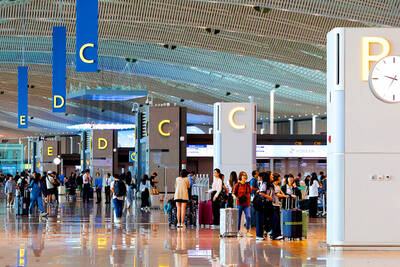
South Korea has adjusted its electronic arrival card system to no longer list Taiwan as a part of China, a move that the Ministry of Foreign Affairs said would help facilitate exchanges between the two sides. South Korea previously listed “Taiwan” as “Taiwan (China)” in the drop-down menus of its online arrival card system, where people had to fill out where they came from and their next destination. The ministry had requested South Korea make a revision and said it would change South Korea’s name on Taiwan’s online immigration system from “Republic of Korea” to “Korea (South),” should the issue not be

Tainan, Taipei and New Taipei City recorded the highest fines nationwide for illegal accommodations in the first quarter of this year, with fines issued in the three cities each exceeding NT$7 million (US$220,639), Tourism Administration data showed. Among them, Taipei had the highest number of illegal short-term rental units, with 410. There were 3,280 legally registered hotels nationwide in the first quarter, down by 14 properties, or 0.43 percent, from a year earlier, likely indicating operators exiting the market, the agency said. However, the number of unregistered properties rose to 1,174, including 314 illegal hotels and 860 illegal short-term rental
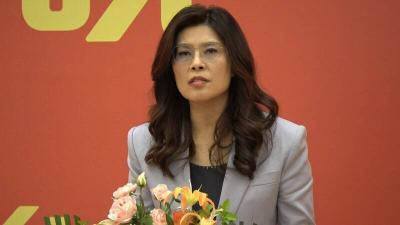
Both sides of the Taiwan Strait share a political foundation based on the “1992 consensus” and opposition to Taiwanese independence, Chinese Nationalist Party (KMT) Chairwoman Cheng Li-wun (鄭麗文) today said during her meeting with Chinese President Xi Jinping (習近平). Both sides of the Strait should plan and build institutionalized and sustainable mechanisms for dialogue and cooperation based on that foundation to make peaceful development across the Strait irreversible, she said. Peace is a shared moral value across the Strait, and both sides should move beyond political confrontation to seek institutionalized solutions to prevent war, she said. Mutually beneficial cross-strait relations are what the
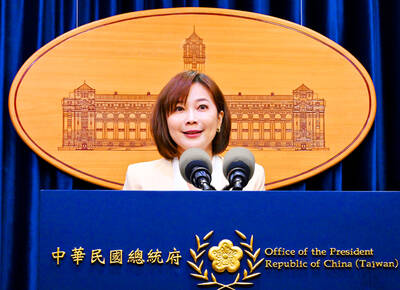
ECONOMIC COERCION: Such actions are often inconsistently applied, sometimes resumed, and sometimes just halted, the Presidential Office spokeswoman said The government backs healthy and orderly cross-strait exchanges, but such arrangements should not be made with political conditions attached and never be used as leverage for political maneuvering or partisan agendas, Presidential Office spokeswoman Karen Kuo (郭雅慧) said yesterday. Kuo made the remarks after China earlier in the day announced 10 new “incentive measures” for Taiwan, following a landmark meeting between Chinese President Xi Jinping (習近平) and Chinese Nationalist Party (KMT) Chairwoman Cheng Li-wun (鄭麗文) in Beijing on Friday. The measures, unveiled by China’s Xinhua news agency, include plans to resume individual travel by residents of Shanghai and China’s Fujian


 RSS
RSS