


China’s army controls hundreds if not thousands of virulent and cutting-edge hackers, according to a report issued yesterday by a US Internet security firm that traced a host of cyberattacks to an anonymous building in Shanghai.
Mandiant said its hundreds of investigations showed that groups hacking into US newspapers, government agencies, and companies “are based primarily in China and that the Chinese government is aware of them.”
The 74-page report focused on one group, which it called “APT1” from the initials “Advanced Persistent Threat.” The New York Times, citing experts, said the group was targeting crucial infrastructure such as the US energy grid.
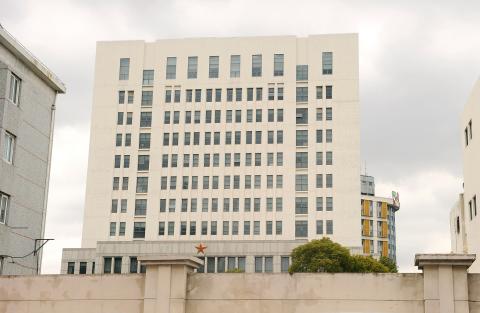
Photo: AFP
“We believe that APT1 is able to wage such a long-running and extensive cyber espionage campaign in large part because it receives direct government support,” Mandiant said.
The group, it said, was believed to be a branch of the People’s Liberation Army (PLA) called Unit 61398, and digital signatures from its cyberattacks were traced back to the direct vicinity of a nondescript, 12-story building on the outskirts of Shanghai.
“We believe the totality of the evidence we provide in this document bolsters the claim that APT1 is Unit 61398,” Mandiant said, estimating it is “staffed by hundreds, and perhaps thousands of people.”
China’s Ministry of Defense said its army had never supported any kind of hacking activity, adding: “Not only are reports that China’s army has been involved in hacking unprofessional, they do not fit with the facts.”
“Hacking attacks are a global problem. Like other countries, China also faces the threat of hacking attacks, and is one of the main countries falling victim to hacking attacks,” the ministry said.
The Chinese Ministry of Foreign Affairs also rejected “groundless accusations” of Chinese involvement in hacking.
In its report, Mandiant said that APT1 — known also as “Comment Crew” for its practice of planting viruses on the comment sections of Web sites — has stolen hundreds of terabytes of data from at least 141 organizations spanning 20 industries.
The Times, which was given early access to the report, said the researchers had found that the Comment Crew was increasingly focused on companies involved in US infrastructure, including in its electrical power grid, gas lines and water works. It said one target was a company with remote access to more than 60 percent of oil and gas pipelines in North America.
The Comment Crew was also among those that attacked the computer security firm RSA, whose computer codes protect confidential corporate and government databases, the Times said.
The building pinpointed as the hacking headquarters sits in the Shanghai suburb of Gaoqiao, near a petrochemical complex and surrounded by small shops. There is no name plate outside, but framed posters showing soldiers are displayed on a high wall surrounding the complex, while the PLA’s symbol of a red star is mounted over the main door of the building.
One soldier in camouflage uniform stood at the main gate yesterday. Another wearing a PLA overcoat was stationed in the guardhouse.
Additional reporting by NY Times News Service

‘NO SECURITY RISK’: The Railway Bureau reassured the public that the technicians’ activities were limited to technical guidance and did not involve sensitive systems The Railway Bureau yesterday said it had invited eight Chinese technicians to assist with an airport MRT construction project. The bureau issued the confirmation after an Internet user said Chinese nationals had entered the construction zone of Taiwan Taoyuan International Airport’s Terminal 3 project. They asked why “individuals from an enemy state” were allowed access to such a major national infrastructure project, which raised serious concerns over Taiwan’s industrial safety, sensitive systems and information security. The bureau’s Northern Region Engineering Branch Office said subcontractor Taiwan Handle Industrial Co (台灣手把工業) of the Taoyuan airport MRT’s “Contract No. CU05 Project A14 Station Civil, MEP &

The National Chungshan Institute of Science and Technology yesterday showcased its locally developed variants of the Vision 60 robotic patrol dog, which it plans to deploy on the nation’s outlying territories in the South China Sea. The variants were produced under the Joint Lab project — created by the institute and domestic companies — and assembled with domestically produced motors, lenses and artificial intelligence (AI) systems alongside licensed tech from the US, Missile and Rocket Systems Research Division deputy director Jen Kuo-kang (任國光) told the media event at a military base in Taipei’s Dazhi (大直) area. Taiwan has built up its strengths

NOT IMMEDIATE: Taiwan has a chance to appeal the proposed 10 percent tariff before it starts, while other countries face a 12.5 percent tariff from the trade office Taiwan is among 60 economies determined by the US to have failed to impose or enforce a ban on the importation of goods produced with forced labor, according to a notice released on Tuesday by the Office of the US Trade Representative (USTR), which proposed imposing an additional 10 percent or more tariff on them. The USTR in a statement said that following an investigation, it had determined under Section 301 of the Trade Act of 1974 that the failure of the 60 economies to impose and effectively enforce a prohibition on the importation of goods produced with forced labor is

TIT-FOR-TAT: The US allegedly revoked the visa of a Chinese national working at Xinhua News Agency in the US in response to Beijing’s expulsion of Vivian Wang The Presidential Office yesterday condemned China for expelling a New York Times correspondent from Beijing following the newspaper’s interview with President William Lai (賴清德), saying the move highlighted Beijing’s suppression of press freedom and its threat to international news media. Taiwan has noted a series of recent incidents in which Beijing used similar tactics to “threaten and pressure international media outlets and journalists,” Presidential Office spokeswoman Karen Kuo (郭雅慧) said in a statement. “This concerns not only press freedom and freedom of expression, but also the safety of journalists, and Taiwan and relevant partners are paying close attention to the situation,” she


 RSS
RSS