


A high-level Chinese official has called for talks with Japan over a disputed island chain, in an apparent attempt by Beijing to cool tensions that have seen both sides scramble jet fighters to the area in recent days.
Chinese People’s Political Consultative Conference Chairman Jia Qinglin (賈慶林) made the gesture at a meeting in Beijing with former Japanese prime minister Yukio Hatoyama, the official China Daily newspaper reported yesterday.
Japan has steadfastly refused past calls by China to hold talks over the islands, with Tokyo arguing that it holds sovereignty over the islets and thus there is nothing to negotiate.
Jia is believed to be the highest-ranking Chinese official to publicly issue such a call, and the mild tenor of his remarks — omitting China’s standard accusation that Japan is wholly responsible for the frictions — was seen as a signal Beijing hopes to arrest momentum toward an all-out crisis.
“The two sides should appropriately handle questions surrounding the Diaoyu Islands (釣魚嶼) and other issues on which their stances’ differ,” Jia said, using the Chinese term for the tiny uninhabited islands lying north of Taiwan.
Japan, which controls the islands, calls them the Senkakus, while Taiwan, which also lays claim to them, calls them the Diaoyutais (釣魚台).
Jia is due to retire in March and Hatoyama has long been an advocate of closer ties with China, though he has lost influence under new Japanese Prime Minister Shinzo Abe. China’s call for talks in a meeting on Wednesday could represent a way to ask for talks that is less risky than an official, high-level exchange.
However, Japan showed no sign of budging from its position.
Responding to reports that Hatoyama had agreed with Jia on the need for negotiations — and that the islands were in dispute — Japan’s chief Cabinet spokesman Yoshihide Suga expressed the Abe government’s disapproval.
“This is clearly not a comment that reflects the position of the Japanese government and we very much regret that someone who was once the prime minister of our country would make such remarks,” Suga told reporters in Tokyo.
Feng Wei (馮偉), a researcher at Fudan University’s Japanese Studies Center in Shanghai, said that Jia represents “the official stance, which is to ease tensions.”
“That’s also why he [Hatoyama] was invited to China in the first place. It’s highly symbolic,” Feng said.
Also yesterday, US Assistant Secretary of State for East Asian and Pacific Affairs Kurt Campbell called for “quiet diplomacy” between Japan, China and South Korea over territorial disputes in northeast Asia, but said the US would not play the role of mediator.
Meanwhile, China’s Ministry of Foreign Affairs reiterated demands that Tokyo do more to ease tensions.
“The priority now is for Japan to make real efforts and do something real to improve China-Japan relations,” ministry spokesman Hong Lei (洪磊) said.
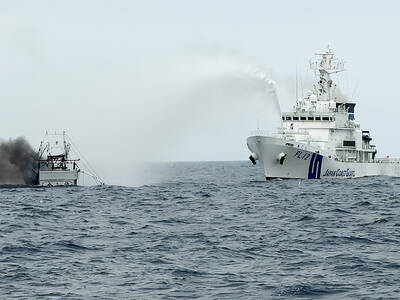
CREDIT-GRABBER: China said its coast guard rescued the crew of a fishing vessel that caught fire, who were actually rescued by a nearby Taiwanese boat and the CGA Maritime search and rescue operations do not have borders, and China should not use a shipwreck to infringe upon Taiwanese sovereignty, the Coast Guard Administration (CGA) said yesterday. The coast guard made the statement in response to the China Coast Guard (CCG) saying it saved a Taiwanese fishing boat. The Chuan Yu No. 6 (全漁6號), a fishing vessel registered in Keelung, on Thursday caught fire and sank in waters northeast of Diaoyutai Islands (釣魚台). The vessel left Keelung’s Badouzih Fishing Harbor (八斗子漁港) at 3:35pm on Sunday last week, with seven people on board — a 62-year-old Taiwanese captain surnamed Chang (張) and six

LEVERAGE: China did not ‘need to fire a shot’ to deny Taiwan airspace over Africa when it owns ‘half the continent’s debt,’ a US official said, calling it economic warfare The EU has raised concerns about overflight rights following the delay of President William Lai’s (賴清德) planned state visit to the Kingdom of Eswatini after three African nations denied overflight clearance for his charter at the last minute. Taiwanese allies Paraguay and Saint Kitts and Nevis, as well as several US lawmakers and the Inter-Parliamentary Alliance on China (IPAC) condemned China for allegedly pressuring the countries. Lai was scheduled to fly directly to Taiwan’s only African ally from yesterday to Sunday to celebrate the 40th anniversary of King Mswati III’s accession and his 58th birthday, but Seychelles, Mauritius and Madagascar suddenly revoked
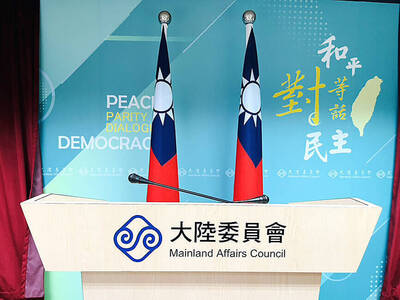
RISKY BUSINESS: The ‘incentives’ include initiatives that get suspended for no reason, creating uncertainty and resulting in considerable losses for Taiwanese, the MAC said China’s “incentives” failed to sway sentiment in Taiwan, as willingness to work in China hit a record low of 1.6 percent, a Ministry of Labor survey showed. The Directorate-General of Budget, Accounting and Statistics (DGBAS) also reported that the number of Taiwanese workers in China has nearly halved from a peak of 430,000 in 2012 to an estimated 231,000 in 2024. That marked a new low in the proportion of Taiwanese going abroad to work. The ministry’s annual survey on “Labor Life and Employment Status” includes questions respondents’ willingness to seek employment overseas. Willingness to work in China has steadily declined from
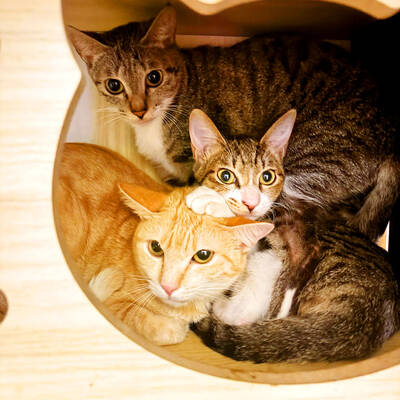
The number of pet cats in Taiwan surpassed that of pet dogs for the first time last year, reaching 1,742,033, a 32.8 percent increase from 2023, the Ministry of Agriculture said yesterday, citing a survey. By contrast, the number of pet dogs declined slightly by 1.2 percent over the same period to 1,462,528, the ministry said. Despite the shift, households with dogs still slightly outnumber those with cats by 1.2 percent. However, while the number of households with multiple dogs has remained relatively stable, households keeping more than two cats have increased, contributing to the overall rise in the feline population. The trend


 RSS
RSS