


Furious combat raged around strategic airports in northern Syria yesterday, the day after the UN gave a staggering toll of 60,000 dead in the country’s 21-month civil war.
Insurgents besieged troops on the perimeter of the international airport in Aleppo, the hard fought-over main city of Syria’s north, and a military airbase in Idlib Province, the Syrian Observatory for Human Rights said.
Aleppo’s critical civilian transportation hub has been closed since Tuesday after repeated attacks by rebels, according to an airport official, who said it would reopen as soon as the army regained control of the surrounding areas.

Photo: Reuters
Rebels holding much of the area surrounding Aleppo were targeted by government shelling overnight in the city’s Sakhur District and in the towns of Marea and Aazaz farther north near the Turkish border.
Meanwhile, hundreds of fighters with two hardcore Islamist rebel groups, al-Nusra Front and Ahrar al-Sham, fought soldiers around the Taftanaz airbase in Idlib, the British-based Observatory said, adding that air strikes were blasting rebel positions.
The rebels had remotely detonated a bomb at one of the airport’s gates the day before, but were pushed back by the army, according to both the Observatory and a military source inside the base.
The military source said that clashes outside the base had gone on non-stop for more than 48 hours, and there had been a large number of rebel casualties.
Three rebels were killed in combat with troops around the Deir Ezzor military airport, as fighting also broke out in the nearby provincial capital in the east of the country.
Near Damascus, warplanes carried out air strikes and ground troops launched rockets on the southwest towns of Daraya and Moadamiyet al-Sham in fresh attempts to wrest back control. In the town of Mleha, just east of Damascus, bodies were being recovered from a service station hit by a regime air strike on Wednesday.
The toll from that attack was not yet known, but the Observatory said at least 12 bodies were recovered, several of them rebels. The Local Coordination Committees, a grassroots network of activists, estimated that at least 50 people were killed.
The Observatory said 219 people died on Wednesday nationwide: 115 civilians, 57 rebels and 47 soldiers.
The overall death toll of the 21-month Syrian conflict has unsettled observers.
The UN High Commissioner for Human Rights Navi Pillay on Wednesday called it “truly shocking,” as she revealed a vetted UN tally nearly a third higher than that previously compiled by the Observatory.
“The number of casualties is much higher than we expected, and is truly shocking,” she said in a statement.
“Given there has been no let-up in the conflict since the end of November, we can assume that more than 60,000 people have been killed by the beginning of 2013,” Pillay said.
The average number of deaths recorded in recent months was five times that registered in the middle of 2011, reflecting intensifying viciousness and the regime’s use of air strikes.
Pillay said in her statement that “this massive loss of life could have been avoided” if the government of Syrian President Bashar al-Assad had not chosen the “ruthless suppression” of what initially were peaceful protests.
Meanwhile, a freelance US reporter who contributed videos to Agence France-Presse (AFP) in recent months was kidnapped in Syria six weeks ago and has been missing since, his family revealed on Wednesday.
James Foley, 39, an experienced war reporter who has covered other conflicts, was seized by armed men in Idlib on Nov. 22, witnesses say.
No group has claimed responsibility for the abduction.
Foley’s family, which had earlier asked media groups not to report the abduction in the hope that a low profile would assist in efforts to free him, broke their silence on Wednesday to reveal his plight.
“We want Jim to come safely home, or at least we need to speak with him to know he’s okay,” said his father, John Foley.
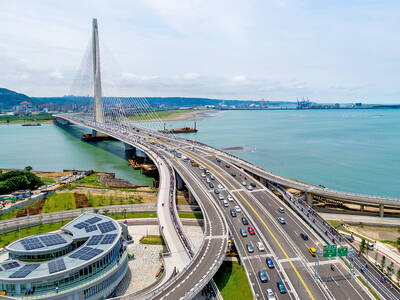
The Ministry of Transportation and Communications yesterday inaugurated the Danjiang Bridge across the Tamsui River in New Taipei City, saying that the structure would be an architectural icon and traffic artery for Taiwan. Feted as a major engineering achievement, the Danjiang Bridge is 920m long, 211m tall at the top of its pylon, and is the longest single-pylon asymmetric cable-stayed bridge in the world, the government’s Web site for the structure said. It was designed by late Iraqi-British architect Zaha Hadid. The structure, with a maximum deck of 70m, accommodates road and light rail traffic, and affords a 200m navigation channel for boats,
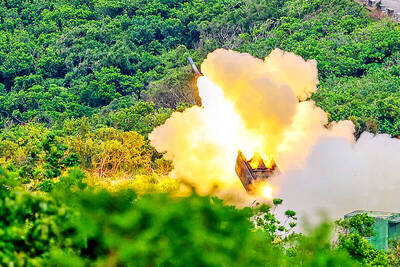
PRECISION STRIKES: The most significant reason to deploy HIMARS to outlying islands is to establish a ‘dead zone’ that the PLA would not dare enter, a source said A High Mobility Artillery Rocket System (HIMARS) would be deployed to Penghu County and Dongyin Island (東引) in Lienchiang County (Matsu) to force the Chinese military to retreat at least 100km from the coastline, a military source said yesterday. Taiwan has been procuring HIMARS and Army Tactical Missile Systems (ATACMS) from the US in batches. Once all batches have been delivered, Taiwan would possess 111 HIMARS units and 504 ATACMS, which have a range of 300km. Considering that “offense is the best defense,” the military plans to forward-deploy the systems to outlying islands such as Penghu and Dongyin so that

WHAT WAS ALL THAT FOR? Jaw Shaw-kong said that Cheng Li-wen had pushed for more drastic cuts and attacked him, just for the outcome to be nearly identical to his bill The legislature yesterday passed a supplementary budget bill to fund the purchase of separate packages of US military equipment, with the combined amount of spending capped at NT$780 billion (US$24.8 billion). The Chinese Nationalist Party (KMT) and Taiwan People’s Party (TPP) used their legislative majority to pass the bill, which runs until 2033 and has two main funding provisions. One was for NT$300 billion of arms sales already approved by the US for Taiwan on Dec. 17 last year, the other was for NT$480 billion for another arms package expected to be announced by Washington. The bill, which fell short of the NT$1.25

‘CLEAR MESSAGE’: The bill would set up an interagency ‘tiger team’ to review sanctions tools and other economic options to help deter any Chinese aggression toward Taiwan US Representative Young Kim has introduced a bill to deter Chinese aggression against Taiwan, calling for an interagency “tiger team” to preplan coordinated sanctions and economic measures in response to possible Chinese military or political action against Taiwan. “[Chinese President] Xi Jinping [習近平] has directed the People’s Liberation Army to be ready to invade Taiwan by 2027. China has a plan. America should have one too,” Kim said in a news release on Thursday last week. She introduced the “Deter PRC [People’s Republic of China] aggression against Taiwan act” to “ensure the US has a coordinated sanctions strategy ready should


 RSS
RSS