

Despite the Ministry of Foreign Affairs’ recent refusal to issue a visa to the Dalai Lama, the legislature’s Internal Administration Committee yesterday passed a resolution to invite the Tibetan spiritual leader to visit Taiwan.
“The Dalai Lama is a very respected religious leader. It harms Taiwan’s reputation as a democracy when we refuse to issue him a visa,” said Democratic Progressive Party (DPP) Legislator Chen Chi-mai (陳其邁), who proposed the resolution. “I therefore suggest that the committee should adopt a resolution sincerely welcoming him.”
Asked for her opinion, Mongolian and Tibetan Affairs Commission Minister Lo Ying-hsueh (羅瑩雪) said she would “be happy to see [the invitation] come true.”
“The Dalai Lama is a respectable religious leader and a learned monk,” Lo said. “The commission would look forward to a visit, but the national security agencies may have another opinion.”
However, some Chinese Nationalist Party (KMT) legislators, such as Chiu Wen-yen (邱文彥), disagreed with the wording of the proposal, which condemns the Chinese government’s repression of the Tibetan independence movement and says the Dalai Lama is welcome to visit Taiwan “at any time, under any status, through any means.”
After negotiations, the two parties agreed to change the wording to simply say that “the Internal Administration Committee sincerely invites Tibetan spiritual leader the Dalai Lama to visit Taiwan.”
That version was passed unanimously.
Asked after the meeting when the committee would send a formal invitation, Chen said the resolution would become official only after it passes a third reading in the legislature.
In related developments, DPP legislators Tuan Yi-kang (段宜康) and Lee Chun-yi (李俊俋) criticized Lo for inviting the vice president of Minzu University of China, Sherab Nyma, to take part in a cross-strait conference.
Sherab Nyma is a Chinese Tibetan academic who has been supportive of Beijing’s policies in Tibet, while accusing the Dalai Lama of stirring up social unrest in the region.
He has also called on the Chinese government to pay more attention to the separatist activities of the Dalai Lama, adding that “supporting the Dalai Lama is encouraging violations of human rights.”
“Sherab Nyma has authored several books against the Dalai Lama, making groundless accusations. He is an academic with no credibility,” Tuan said. “It doesn’t make any sense that the commission is spending taxpayers’ money inviting such a person to participate in a conference.”
Lee echoed Tuan, saying it was inappropriate to invite Sherab Nyma.
Lo said that the commission had invited Sherab Nyma so that attendees have the chance to hear different opinions.
“We expressed opposition in private to some of his remarks while he was here and it embarrassed him a little,” Lo said.
To show the committee’s displeasure with Sherab Nyma’s visit, DPP and KMT lawmakers agreed to cut NT$4 million (US$137,000) from the commission’s budget.
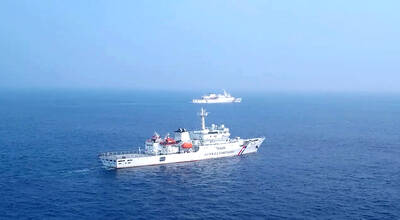
PATROL PARTNERS: The ‘Chiayi’ and the ‘Penghu’ departed for a two-day joint patrol of Palau’s exclusive economic zone, the CGA’s second diplomatic visit to the country The Coast Guard Administration (CGA) set a record for its southernmost deployment of a coast guard vessel as the vessels Chiayi and the Penghu reached Palau’s Pulo Anna Island on Saturday in a cooperative exercise between the two countries. The island, about 217 nautical miles (401km) southwest of Koror in the Palauan state of Sonsorol and 1,220 nautical miles from Taiwan’s southernmost point, Oluanpi (鵝鑾鼻), is the furthest south a CGA vessel has sailed. The two vessels are in Palau for the coast guard’s second diplomatic visit to the country. They docked at Malakal Harbor on Tuesday last week. The coast guard
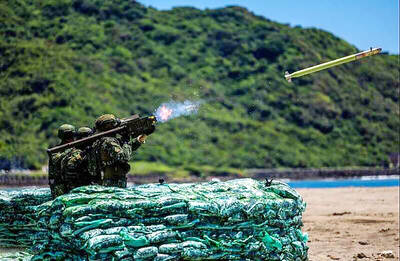
BATCH 1: The military has plans to assign the weapons to the army to defend Taiwan proper, as well as outlying islands and the navy for the Marine Corps, the official said Taiwan is to receive 500 Stinger missiles and 178 launchers from the US by the end of the year, the first batch under a planned two-stage acquisition totaling 2,621 missiles and 763 launchers, a defense official said yesterday on condition of anonymity. The portable missiles would play a vital role in the nation’s air defense capabilities, the source said. The army plans to deploy 2,235 missiles and 657 launchers to defend Taiwan proper and outlying islands, they said, citing military documents. The navy is allotted 295 missiles and 85 launchers to arm the Marine Corps and some surface vessels that lack air defense

The European Parliament on Wednesday adopted a recommendation on EU-China political relations that rejected China’s efforts to restrict Taiwan’s participation in international organizations and exchanges. The recommendation, addressed to the European Council, the European Commission and EU High Representative for Foreign Affairs and Security Policy Kaja Kallas, includes several references to EU-Taiwan relations and expresses support for closer ties, saying they would bring positive benefits and have strategic importance. Describing Taiwan as a valuable partner in trade and technology, the European Parliament said it “rejects China’s attempts to coerce international organizations, third countries and other actors into restricting Taiwan’s international participation and
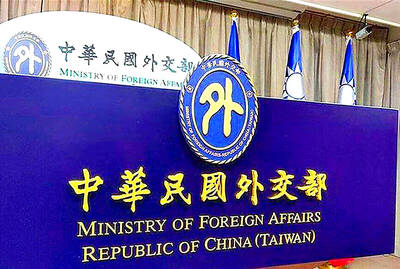
‘EQUALS’: The ROC and PRC are not subordinate to each other, which is the consensus among Taiwanese, who are the only ones who can decide Taiwan’s future, MOFA said Taiwan yesterday urged China to stop its hostile rhetoric toward Taiwan as the US welcomed President William Lai’s (賴清德) commitment to Taiwan Strait stability in his Double Ten National Day speech. Lai on Saturday described Taiwan as a “city upon a hill” and said that “Taiwan cherishes peace, but we will not give up our freedom. We are open to exchanges, but will not accept subordination.” China’s Taiwan Affairs Office said Lai’s speech “disregards facts, distorts the truth, misleads the public and reveals ulterior motives.” Taiwan is part of China and Taiwan’s future “can and must be decided jointly by all the


 RSS
RSS