


The New Taipei City (新北市) Government, apparently in a bid to curb increasing cases of groups of young people having drug parties in hotels and recreational facilities, has asked entertainment establishments to strengthen self-management by informing the police when more than six people aged 30 and under check into rooms with KTV and special multimedia facilities.
The new measure took effect yesterday morning and prompted mixed reactions.
The city government told a news conference on Friday that so far this year the police have registered a total of 61 cases, involving 265 people, of drug use in hotels, guest houses and motels. Among them, 16 cases, involving 165 people, were drug parties with more than six participants, with an average of 10 people per party, it added.
To prevent more people from holding drug parties at hotels, guest houses and the like, the city government’s Public Safety Inspection Team has decided to employ Article 23 of the Regulations for the Administration of Hotels (旅館業管理規則), as a basis for the new measure. The article requires that hotel administrators register guests’ information.
Effective yesterday, hotels in the city are required to inform their local police station as soon as more than six young people aged 30 and under check into special types of rooms that have multimedia facilities installed.
Establishments that fail to report such cases may face a fine of between NT$15,000 and NT$50,000, in line with Article 55 of the Act for the Development of Tourism (發展觀光條例).
Hotel operators had mixed feelings about the policy. While some said it was troublesome and that “young people often show low degrees of cooperation,” others said that the policy would make it easier to request guests’ information. They added that reducing the number of drug-using guests could strengthen the positive image of hotels, as well as attract “normal consumers.”
A hotel operator surnamed Chen (陳) said it is already difficult to have guests register their personal information when they check in, and “now it would be even more troublesome to require young people to register their personal information.”
Another operator, surnamed Huang (黃), noting that the new measure targets special rooms with KTV facilities, said people who intend to “misbehave” could easily get around the measure by “squeezing into standard rooms.”
He also asked, since the new policy only targets cases where more than six people check in at the same time, “what if two people check in and four other people arrive later as visiting guests? How are we then to request that they all register their personal information?”
New Taipei City Hotel Association chairperson Lin Chung-tai (林忠泰), on the other hand, was positive about the policy.
When drug users leave a hotel room, the room often looks like it has been bombed, he said, adding that as the quality of customers has improved over recent years, he believes hotels can attract many better guests as long as the hotels provide a good environment.
New Taipei City councilors across party lines disapproved of the policy targeting a selected group of customers and behavior.
“This is wrong,” New Taipei City Councilor Chou Sheng-kao (周勝考) of the Chinese Nationalist Party (KMT) said.
“People enjoy freedom of movement and have the freedom to consume whatever they want wherever they want to, and having hotels report information to the police without the customers behaving suspiciously seems to be a human rights violation,” he said.
“It’s like being in a police state,” New Taipei City Councilor Chiang Yung-chang (江永昌) of the Democratic Progressive Party said, adding it is inappropriate for government agencies to expand their administrative powers without a legal basis.

‘NO SECURITY RISK’: The Railway Bureau reassured the public that the technicians’ activities were limited to technical guidance and did not involve sensitive systems The Railway Bureau yesterday said it had invited eight Chinese technicians to assist with an airport MRT construction project. The bureau issued the confirmation after an Internet user said Chinese nationals had entered the construction zone of Taiwan Taoyuan International Airport’s Terminal 3 project. They asked why “individuals from an enemy state” were allowed access to such a major national infrastructure project, which raised serious concerns over Taiwan’s industrial safety, sensitive systems and information security. The bureau’s Northern Region Engineering Branch Office said subcontractor Taiwan Handle Industrial Co (台灣手把工業) of the Taoyuan airport MRT’s “Contract No. CU05 Project A14 Station Civil, MEP &

A US uncrewed surface vessel (USV) encountered multiple Chinese warships during an autonomous transit of the Taiwan Strait, US defense company Seasats said in a statement on Wednesday. Seasats announced that a Lightfish USV had completed the first autonomous transit of the Taiwan Strait. Over five days, the USV traversed the entire length of the Strait while constantly monitoring surface vessel traffic, the company said. The Lightfish encountered multiple Chinese warships, one of which was a Chinese People’s Liberation Army Navy (PLAN) Type 056 corvette, it said. The Chinese vessels were operating “well within Taiwan’s exclusive economic zone without transmitting their identity via the
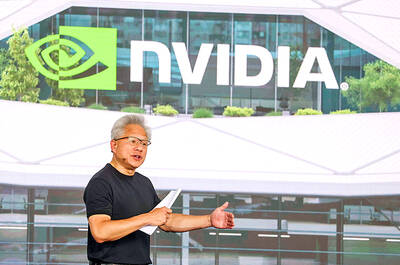
‘BOOMING’: ’ The number of partners we have here is incredible. You can see from their stock prices. They’re doing so well, they’re so happy,’ Jensen Huang said Nvidia Corp’s spending in Taiwan has ballooned to about US$150 billion a year, 10 times the US$10 billion to US$15 billion the company spent five years ago, Nvidia chief executive officer Jensen Huang (黃仁勳) said yesterday, suggesting Taiwan’s strategic importance in the global artificial intelligence (AI) supply chain. “Taiwan is the epicenter of the AI revolution. This is where the chips come, packaging comes. This is where the systems are made. This is where AI supercomputers were created,” Huang said at a meeting for the company’s employees in Beitou-Shilin Technology Park (北投士林科技園區) in Taipei, the planned site of Nvidia’s Taipei headquarters. “Taiwan
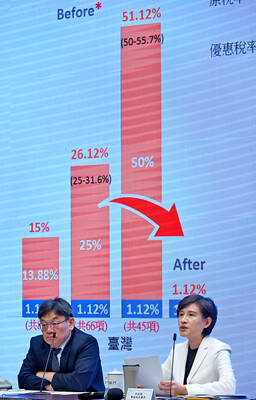
GREATER REACH? Auto parts and wood products would face tariffs of up to 15%, matching those targeting the EU, Japan and South Korea, Vice Premier said The US has announced that preferential tariff treatment for Taiwan’s non-semiconductor Section 232 goods would take effect retroactively from May 1, the Executive Yuan said yesterday. The US government yesterday posted a notice on the Federal Register’s public inspection Web site previewing tariff concessions for Taiwan under a memorandum of understanding (MOU) on Taiwan-US investment after two months of negotiations. The MOU signed on Jan. 15 stipulated three major preferential tariff arrangements: a 15 percent “reciprocal” tariff rate for Taiwan without stacking most-favored nation (MFN) rates; preferential Section 232 treatment for semiconductors and related products; and preferential Section 232 treatment for non-semiconductor


 RSS
RSS