


Israeli aircraft bombed Hamas government buildings in Gaza yesterday, including the prime minister’s office, after Israel’s Cabinet authorized the mobilization of up to 75,000 reservists, preparing for a possible ground invasion.
Israeli planes shattered the office building of Gaza Strip Prime Minister Ismail Haniyeh — where he had met on Friday with Egyptian Prime Minister Hisham Kandil — and struck the Interior Ministry.
Loud explosions regularly rocked the densely populated Palestinian territory, sending plumes of smoke billowing into the sky. The occasional hiss of outgoing rocket fire showed Islamist militants were pursuing their defiance of the assault.
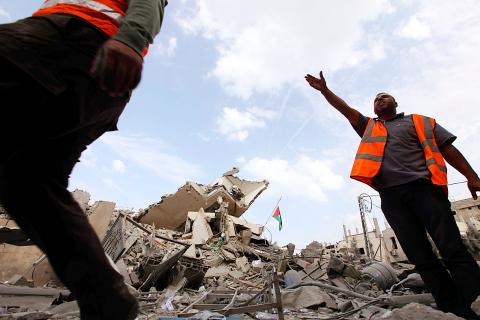
Photo: EPA
Despite the violence, Tunisia’s foreign minister arrived in the enclave yesterday in a show of solidarity, denouncing the Israeli attacks as illegitimate and unacceptable.
Officials in Gaza said 41 Palestinians, among them 20 civilians, including eight children and a pregnant woman, had been killed in Gaza since Israel began operations four days ago.
Three Israeli civilians were killed by a rocket on Thursday.
Israel’s military said its air force had hit at least 180 targets since midnight on Friday, including a police headquarters, government buildings, rocket launching squads and a Hamas training facility in the impoverished territory.
A three-story house belonging to Hamas official Abu Hassan Salah was also hit and completely destroyed early yesterday. Rescuers said at least 30 people were pulled from the rubble.
“What Israel is doing is not legitimate and is not acceptable at all,” Tunisian Foreign Minister Rafik Abdesslem said as he visited Haniyeh’s wrecked headquarters. “It does not have total immunity and is not above international law.”
Israel launched a massive air campaign on Wednesday with the declared aim of deterring Hamas from launching cross-border rocket salvoes that have plagued southern Israel for years.
The Palestinians have fired hundreds of rockets out of Gaza, including one at Jerusalem and three at Tel Aviv — Israel’s commercial center. Jerusalem had not been targeted in such a way since 1970, and Tel Aviv since 1991.
Although there were no reports of casualties or damage in either city, the long-range attacks came as a shock and advanced the prospect of an Israeli ground invasion into Gaza
“This will last as long as is needed; we have not limited ourselves in means or in time,” Israeli Foreign Minister Avigdor Lieberman told Israel’s Channel One TV yesterday.
Hamas says it is committed to continued confrontation with Israel and is eager not to seem any less resolute than smaller, more radical groups that have emerged in Gaza in recent years.
The Islamist Hamas has ruled Gaza since 2007. Israel pulled settlers out of Gaza in 2005, but has maintained a blockade of the territory.
Israeli Prime Minister Benjamin Netanyahu held a four-hour strategy session late on Friday with a clutch of senior ministers on widening the military campaign, while other Cabinet members were polled by telephone on increasing mobilization.
Political sources said they decided to more than double the current reserve troop quota set for the Gaza offensive to 75,000. It did not necessarily mean all would be called up.
Three soldiers were lightly hurt by fire from the Gaza Strip yesterday, the Israeli army said.

NETWORK-MAPPING PROJECT: The database contains 170 detailed files of Taiwanese politicians and about 23 million records of household registration data in Taiwan China has developed a network-mapping project targeting political figures and parties in Taiwan to monitor public opinion during elections and to craft tailored influence campaigns aimed at dividing Taiwanese society, according to documents leaked by Chinese technology firm GoLaxy (中科天璣). The documents, collected by Taipei-based Doublethink Lab, showed a database was specifically created to gather detailed information on Taiwanese political figures, including their political affiliations, job histories, birthplaces, residences, education, religion and a brief biography about them. Several notable Taiwanese politicians are in the database, including President William Lai (賴清德), former president Tsai Ing-wen (蔡英文), Minister of Foreign Affairs Lin Chia-lung (林佳龍),

RECOGNITION: Former Fijian prime minister Mahendra Chaudhry said that Taiwan’s New Southbound Policy serves as a stabilizing force in the Indo-Pacific region Taiwan can lead the unification of the Chinese people, Nobel Peace Prize laureate and former Polish president Lech Walesa said in Taipei yesterday, adding that as the world order is changing, peaceful discussion would find good solutions, and that the use of force and coercion would always fail. Walesa made the remarks during his keynote address at a luncheon of the Yushan Forum in Taipei, titled “Indo-Pacific Partnership Prospects: Taiwan’s Values, Technology and Resilience,” organized by the Taiwan-Asia Exchange Foundation with the Ministry of Foreign Affairs. Walesa said that he had been at the forefront of a big peaceful revolution and “if
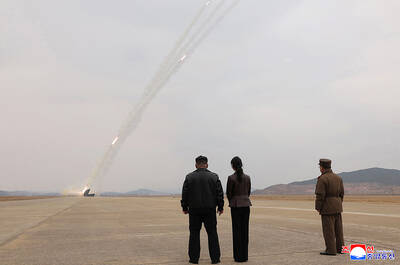
North Korea tested nuclear-capable rocket launchers, state media reported yesterday, a day after Seoul detected the launch of about 10 ballistic missiles. The test comes after South Korean and US forces launched their springtime military drills, due to run until Thursday. North Korean leader Kim Jong-un on Saturday oversaw the testing of the multiple rocket launcher system (MRLS), the Korean Central News Agency (KCNA) said. The test involved 12 600mm-caliber ultra-precision multiple rocket launchers and two artillery companies, it said. Kim said the drill gave Pyongyang’s enemies, within the 420km striking range, a sense of “uneasiness” and “a deep understanding

North Korea yesterday fired about 10 ballistic missiles to the sea toward Japan, the South Korean Joint Chiefs of Staff (JCS) said, days after Pyongyang warned of “terrible consequences” over ongoing South Korea-US military drills. Pyongyang recently dashed hopes of a diplomatic thaw with Seoul, Washington’s security ally, describing its latest peace efforts as a “clumsy, deceptive farce.” Seoul’s military detected “around 10 ballistic missiles launched from the Sunan area in North Korea toward the East Sea [Sea of Japan] at around 1:20pm,” JCS said in a statement, referring to South Korea’s name for the body of water. The missiles


 RSS
RSS