


Minister of Finance Chang Sheng-ford (張盛和) announced yesterday that the ministry will increase various income tax deductions and exemptions for taxpayers because consumer prices for the past three years have reached the tax reduction threshold.
The ministry will announce the final deductions and exemptions by the end of this month at the earliest. The new measures will be applied to the income taxpayers receive next year, with taxes to be reported and submitted in 2014.
Under the Income Tax Act (所得稅法), the Ministry of Finance has to adjust upward the amount of tax deductions and exemptions if the nation’s average headline inflation rate between November and October a year later rises by more than 3 percent compared with the level recorded when the tax was last reduced.
The composite consumer price index (CPI) averaged 108.76 points from November last year to last month and the Directorate-General of Budget, Accounting and Statistics (DGBAS) said the index had reached 110.34 last month.
The 108.76-point level was an increase of 3.47 percent from the average level recorded from November 2007 to October 2008, the year the ministry last adjusted the tax deduction and exemption amounts.
“All of these amounts have to be increased in line with the rising rate of headline inflation,” Chang said in a legislative question-and-answer session.
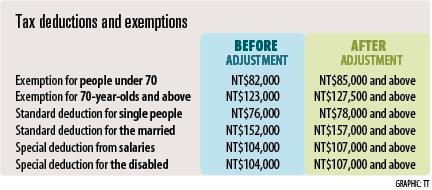
The ministry is expected to raise the exemption amount by NT$3,000 (US$103) for people below the age of 70 and by NT$4,500 for those aged 70 and above, while boosting the standard deduction amount by NT$2,000 for a single person and by NT$5,000 for married couples.
The special income tax deduction from salaries or wages and the special deduction for the disabled will be raised by NT$3,000 each.
The tax reduction plan may lower the nation’s tax revenue by between NT$6.8 billion and NT$7 billion a year, ministry data showed.
In related news, annual growth of the nation’s headline inflation rate slowed to 2.36 percent last month, from the 2.96 percent a month earlier, the DGBAS said in its monthly report.
However, it was the fourth straight month the CPI has grown by more than 2 percent from a year earlier, the report said.
Vegetable and fruit prices saw an 11.57 percent and 18.85 percent increase respectively from the previous year, the report’s data showed.
The increase further drove up the annual growth in overall food prices to 4.24 percent last month — the highest of the seven components in the index, statistics showed.
In the first 10 months of the year, the headline inflation rate rose 2 percent from a year earlier, according to the DGBAS’ data.
However, annual growth in headline inflation may remain lower than 2 percent this year, as vegetable and fruit prices continue to slide back to a steadier level for this month and next month, DGBAS section chief Wang Shu-chuan (王淑娟) said.
In addition, sluggish global economic sentiment has been dragging down prices of international raw materials and weakening consumption, both of which may further slow inflationary pressure in the near-term.

The National Chungshan Institute of Science and Technology yesterday showcased its locally developed variants of the Vision 60 robotic patrol dog, which it plans to deploy on the nation’s outlying territories in the South China Sea. The variants were produced under the Joint Lab project — created by the institute and domestic companies — and assembled with domestically produced motors, lenses and artificial intelligence (AI) systems alongside licensed tech from the US, Missile and Rocket Systems Research Division deputy director Jen Kuo-kang (任國光) told the media event at a military base in Taipei’s Dazhi (大直) area. Taiwan has built up its strengths

RIGHT DIRECTION: Taiwan’s efforts to prevent forced labor include a proposal to ‘fully prohibit’ employers from withholding workers’ documents, an official said Taiwan is to establish a mechanism to restrict imports of goods linked to forced labor, the Executive Yuan said yesterday, after the US proposed imposing additional tariffs on Taiwanese goods over labor concerns. “The Ministry of Labor and the Ministry of Economic Affairs are to establish an interministerial review procedure,” Executive Yuan spokesperson Michelle Lee (李慧芝) said at a news briefing in Taipei. “The government is to use the Foreign Trade Act [貿易法] as the legal basis to restrict imports of goods produced with forced labor” and bring its supply chain governance more in line with international standards on human rights, resilience

NOT IMMEDIATE: Taiwan has a chance to appeal the proposed 10 percent tariff before it starts, while other countries face a 12.5 percent tariff from the trade office Taiwan is among 60 economies determined by the US to have failed to impose or enforce a ban on the importation of goods produced with forced labor, according to a notice released on Tuesday by the Office of the US Trade Representative (USTR), which proposed imposing an additional 10 percent or more tariff on them. The USTR in a statement said that following an investigation, it had determined under Section 301 of the Trade Act of 1974 that the failure of the 60 economies to impose and effectively enforce a prohibition on the importation of goods produced with forced labor is

TIT-FOR-TAT: The US allegedly revoked the visa of a Chinese national working at Xinhua News Agency in the US in response to Beijing’s expulsion of Vivian Wang The Presidential Office yesterday condemned China for expelling a New York Times correspondent from Beijing following the newspaper’s interview with President William Lai (賴清德), saying the move highlighted Beijing’s suppression of press freedom and its threat to international news media. Taiwan has noted a series of recent incidents in which Beijing used similar tactics to “threaten and pressure international media outlets and journalists,” Presidential Office spokeswoman Karen Kuo (郭雅慧) said in a statement. “This concerns not only press freedom and freedom of expression, but also the safety of journalists, and Taiwan and relevant partners are paying close attention to the situation,” she


 RSS
RSS