


The man who shot former Chinese Nationalist Party (KMT) Central Standing Committee member Sean Lien (連勝文) and killed an innocent bystander on the eve of local elections in 2010 was sentenced to life in prison by the Taiwan High Court yesterday.
The court overturned a verdict handed down by the New Taipei City District Court in May in which Lin Cheng-wei (林正偉) was sentenced to 24 years in jail for multiple offenses.
The lower court found Lin guilty of attempting to murder Lien, of the negligent manslaughter of bystander Huang Yun-sheng (黃運聖) and contravening the Act Governing the Control of Guns, Ammunition and Knives (槍砲彈藥刀械管制條例).
While the high court upheld the attempted murder conviction related to the shooting of Lien, it changed the negligent manslaughter conviction involving the bystander to murder after determining that Lin had the “intent” to kill.
Lin fired a shot that went through Lien’s face and killed Huang during a campaign rally for New Taipei Council KMT candidate Chen Hung-yuan (陳鴻源) on Nov. 26, 2010, the night before a special municipalities election. Lin later claimed his target was Chen, but that he shot Lien after mistaking him for Chen.
According to the latest verdict, Lin was wrestling with Lien before he pulled the trigger, but that he still insisted on firing his gun at the dodging Lien without any regard for the other people at the rally.
Even when Lin was surrounded after the shooting, he still attempted to get off another shot, the court said.
The high court added that Lin can appeal the ruling with the Supreme Court.
Sean Lien, former vice president Lien Chan’s (連戰) son, recovered from his wounds and yesterday he called for the investigation into the motives and target to be continued.
In a written statement, Sean Lien shared his dissatisfaction with the court findings, which said Lin had shot Sean Lien by mistake. He urged prosecutors to continue the investigation into the motives and targets, and whether there were any accomplices.
“Prosecutors should continue to look into the key issues of the incident, including the source of the gun and the intended target. Otherwise the incident will become an unresolved case and make a mockery of the government’s pursuit of social and legal justice,” he said.
Sean Lien said Lin had failed to pass polygraph tests when asked two key questions during the second trial — who was his intended target and where he got the firearm — but the court did not take account of the polygraph results in its verdict.
Sean Lien also criticized “top officials” in the government over their description of the incident as an “accidental shooting” and accused prosecutors of carrying out the investigation in accordance with the government’s assumptions.
“There are so many unresolved issues in the case and as a person who enjoys rich resources, I still feel helpless when facing the legal system. It’s unimaginable what others [who are less fortunate] go through when fighting injustice,” he said.

A signaling system malfunction disrupted high-speed rail (HSR) services beginning at 8am today, with trains temporarily reduced to three northbound and three southbound trains per hour as authorities conduct inspections. The malfunction occurred on a section of track in Miaoli County during pre-operation checks early this morning, forcing northbound and southbound trains to use a single track, the HSR operator said. The regular schedule has been replaced with three hourly trains offering only nonreserved seating in each direction, stopping at every station, it said, adding that business class cars would still have reserved seating. Departures from terminal stations are scheduled at the top

DRONE CENTRAL: Taiwan aims to become Asia’s democratic hub for drones, with most exports focused on high-quality military-grade models, an official said Taiwan’s drone industry is expected to expand significantly by 2030, producing 100,000 units per month and exporting half of them, the Ministry of Economic Affairs said yesterday. Current drone production capacity is about 15,000 units per month, but the industry can quickly scale up as demand increases, Industrial Development Administration Director-General Chiou Chyou-huey (邱求慧) told a news conference in Taipei. Taiwan’s drone output grew 2.5-fold last year to NT$12.9 billion (US$408.3 million) under a government program to develop the uncrewed vehicle sector, he said. The Executive Yuan in October last year approved plans to invest NT$44.2 billion into domestic production of uncrewed aerial

VERBOSE VESSELS: A CGA cutter and a China Coast Guard exchanged verbal barbs for more than a day in Taiwanese-controlled waters before the Chinese vessel left The Taiwanese and Chinese coast guards had a standoff near the strategically located Pratas Islands (Dongsha Islands, 東沙群島) in the north of the South China Sea, the Coast Guard Administration (CGA) said yesterday. The two sides engaged in intense radio exchanges over sovereignty claims during the 33-hour standoff. China Coast Guard vessel 3501 eventually left the restricted waters, 26.6 nautical miles (49.2km) west of the Pratas Islands, at 5pm yesterday, the CGA said. Lying approximately between southern Taiwan and Hong Kong, the Taiwan-controlled Pratas are seen by some security experts as vulnerable to Chinese attack due to their distance — more than
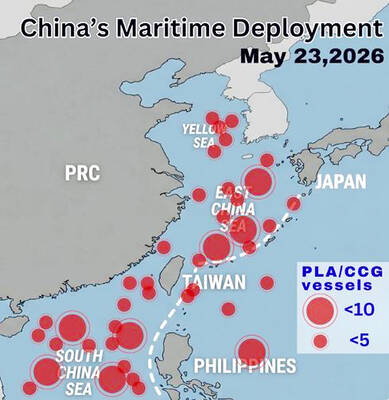
WARNING: China should stop engaging in actions that undermine regional peace and stability, as it would only build resentment among people across the Strait, the CGA said China has deployed more than 100 navy, coast guard and other vessels in waters from the Yellow Sea to the South China Sea and the western Pacific since US President Donald Trump and Chinese President Xi Jinping (習近平) met in Beijing, National Security Council Secretary-General Joseph Wu (吳釗燮) said yesterday. “In this part of the world, #China is the one & only PROBLEM wrecking the #StatusQuo & threatening regional peace & stability,” Wu wrote on X. In a separate post, he said Beijing was coercing Taiwan’s maritime domain, calling it illegal and provocative, after the Coast Guard Administration (CGA) expelled a


 RSS
RSS