


Taiwan Solidarity Union (TSU) Legislator Hsu Chung-hsin (許忠信) yesterday cited a US congressional report on China’s Huawei Technologies (華為技術) and ZTE Inc (中興通訊) and warned that allowing Chinese investment in the telecommunication sector could pose serious threats to national security.
“Despite a US congressional panel warning on Huawei and ZTE’s security threat, Taiwan is considering opening Type I telecommunications enterprises to Chinese investment. We strongly oppose that,” Hsu told a press conference.
A US House of Representatives Intelligence Committee report last week said that, due to security concerns, Huawei and ZTE should be blocked from mergers, takeovers and acquisitions in the US and advised US entities against doing businesses with the companies.
In addition to the US, many other countries, including Canada, the Netherlands, Australia and India, have either barred the companies from investment or are applying strict standards in their reviews of projects involving the Chinese companies, Hsu said.
Hsu questioned why Taiwan insisted on the move despite the WTO members not being required to open their Type I telecommunications sectors, which provides basic services and infrastructure of fixed net, mobile and satellite communication, to foreign companies due to national security concerns.
Citing a recent espionage case, in which former executives of AU Optronics Corp (友達光電), the nation’s second-largest LCD panel maker, stole trade secrets from the company and supplied them to a Chinese rival, Hsu said Taiwan’s confidential information as well as its freedom of communication would be at stake once Chinese investment was allowed in Type I operations.
Current regulations and laws are insufficient to prevent China from stealing sensitive information, Hsu said, adding that an economic espionage act should be enstated to better protect Taiwanese businesses.
Huawei has already set foot on Taiwan, Hsu said, as the firm secured a NT$106 million (US$3.6 million) contract for wireless controllers and base station equipment from Far Eastone Telecommunications Co (遠傳電信) and a NT$20 billion contract for 3.5G network and communication equipment from Asia Pacific Telecom (亞太電信).
In Taiwan, 3G wireless networks cards are almost exclusively made by Huawei, which also manufactures mobile phones for Chunghwa Telecom (中華電信), Taiwan’s largest telecommunications service provider, Hsu said.
President Ma Ying-jeou’s (馬英九) administration should stop embracing Chinese investment and regard it as a solution to stimulate Taiwan’s sluggish economy, because China has long been notorious for its disregard of intellectual property rights and espionage acts, Hsu said.
Hsu was not the first to raise the concerns. In April, DPP lawmakers Pan Men-an (潘孟安) and Cheng Li-chiun (鄭麗君) warned the government on the large-scale procurement of base stations and core systems by major Taiwanese telecoms firms from Huawei, saying that national security could be at risk.
On Monday, senior presidential adviser Richard Lee (李家同) said Taiwan should consider using only local communications systems and software in the government sector for the sake of national security.
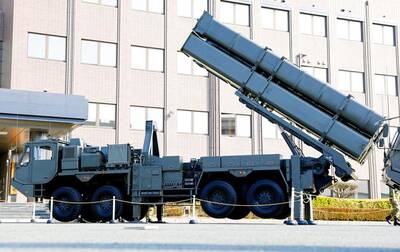
Japan has deployed long-range missiles in a southwestern region near China, the Japanese defense minister said yesterday, at a time when ties with Beijing are at their lowest in recent years. The missiles were installed in Kumamoto in the southern region of Kyushu, as Japan is attempting to shore up its military capacity as China steps up naval activity in the East China Sea. “Standoff defense capabilities enable us to counter the threat of enemy forces attempting to invade our country ... while ensuring the safety of our personnel,” Japanese Minister of Defense Shinjiro Koizumi said. “This is an extremely important initiative for
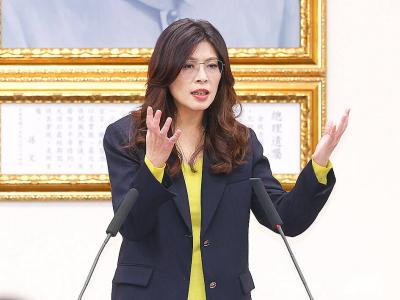
Chinese Nationalist Party (KMT) Chairwoman Cheng Li-wun (鄭麗文) today accepted an invitation from Chinese President Xi Jinping (習近平) to lead a delegation to China next month, saying she hopes to promote the peaceful development of cross-strait relations and bring stability to the Taiwan Strait. “I am grateful and happy to accept this invitation,” Cheng said in a statement from the KMT chairperson’s office. Cheng said she hopes both sides can work together to promote the peaceful development of cross-strait relations, enhance exchange and cooperation, bring stability to the Taiwan Strait and improve people’s livelihoods. At today's news conference, Cheng said any efforts to
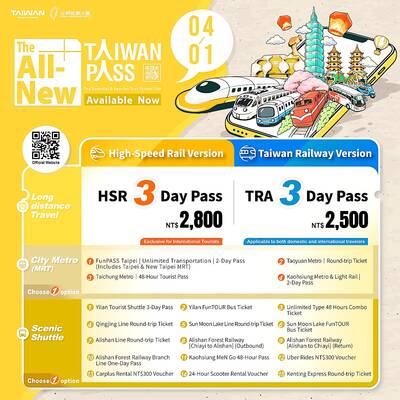
MORE POPULAR: Taiwan Pass sales increased by 59 percent during the first quarter compared with the same period last year, the Tourism Administration said The Tourism Administration yesterday said that it has streamlined the Taiwan Pass, with two versions available for purchase beginning today. The tourism agency has made the pass available to international tourists since 2024, allowing them to access the high-speed rail, Taiwan Railway Corp services, four MRT systems and four Taiwan Tourist Shuttles. Previously, five types of Taiwan Pass were available, but some tourists have said that the offerings were too complicated. The agency said only two types of Taiwan Pass would be available, starting from a three-day pass with the high-speed rail and a three-day pass with Taiwan Railway Corp. The former costs NT$2,800
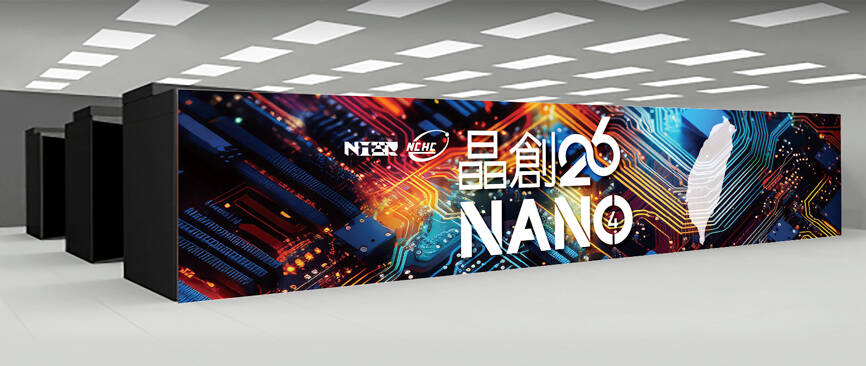
The nation’s fastest supercomputer, Nano 4 (晶創26), is scheduled to be launched in the third quarter, and would be used to train large language models in finance and national defense sectors, the National Center for High-Performance Computing (NCHC) said. The supercomputer, which would operate at about 86.05 petaflops, is being tested at a new cloud computing center in the Southern Taiwan Science Park in Tainan. The exterior of the server cabinet features chip circuitry patterns overlaid with a map of Taiwan, highlighting the nation’s central position in the semiconductor industry. The center also houses Taiwania 2, Taiwania 3, Forerunner 1 and


 RSS
RSS