


US President Barack Obama on Friday blocked a privately owned Chinese company from building wind turbines close to a Navy military site in Oregon due to national security concerns, and the company said it would challenge the action in court.
The rare presidential order to divest interests in the wind farms comes as Obama campaigns for a second term against Republican presidential rival Mitt Romney, who has accused him of being soft on China.
Ralls Corp, which had been installing wind turbine generators made in China by Sany Group, has four wind farm projects that are within or in the vicinity of restricted air space at a naval weapons systems training facility, according to the Obama administration.
“There is credible evidence that leads me to believe” that Ralls Corp, Sany Group and the two Sany Group executives who own Ralls “might take action that threatens to impair the national security of the United States,” Obama said in issuing his decision.
Ralls Corp had filed a lawsuit against the Committee on Foreign Investment in the US (CFIUS) for ordering it to stop all construction and operations at its projects while the government panel completed its investigation and finalized its recommendation to Obama.
After the decision was announced on Friday, the company said it was confident that the courts would vindicate Ralls Corp’s rights under the law and the Constitution.
Sany Group is the parent company of Shanghai-listed Sany Heavy Industry Co, China’s largest construction equipment maker and the seventh-biggest in the world.
Sany’s chairman and controlling shareholder, Liang Wengen (梁穩根), is China’s fifth-richest man, according to the latest ranking by Hurun Report, down from No. 1 last year.
Although CFIUS reviews dozens of foreign investment deals for potential national security concerns every year, the president is rarely called upon to issue a formal order as companies usually abandon their deals or divest assets when the panel takes issue with their transaction.
The last time a president formally blocked a deal on national security grounds was in 1990 when then US president George H.W. Bush stopped a Chinese aero-technology company from acquiring a US manufacturing firm.
“This is a big deal because it is the first time since 1990 that the president of the US has either blocked a transaction from occurring or divested a transaction that has occurred,” said Clay Lowery, a former assistant secretary at the US Treasury who oversaw the CFIUS process and now is with Rock Creek Global Advisors.
Ralls Corp had hired the George W. Bush administration’s top lawyer, Paul Clement, to help represent the company, as well as former US assistant attorney general Viet Dinh, who helped the Republican administration develop the Patriot Act.
Neither Sany Group’s headquarters nor the Chinese Ministry of Commerce could be reached for comment yesterday.
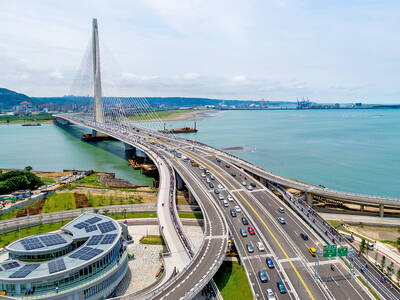
The Ministry of Transportation and Communications yesterday inaugurated the Danjiang Bridge across the Tamsui River in New Taipei City, saying that the structure would be an architectural icon and traffic artery for Taiwan. Feted as a major engineering achievement, the Danjiang Bridge is 920m long, 211m tall at the top of its pylon, and is the longest single-pylon asymmetric cable-stayed bridge in the world, the government’s Web site for the structure said. It was designed by late Iraqi-British architect Zaha Hadid. The structure, with a maximum deck of 70m, accommodates road and light rail traffic, and affords a 200m navigation channel for boats,
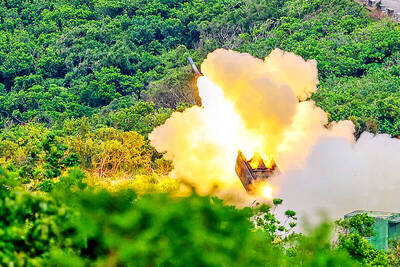
PRECISION STRIKES: The most significant reason to deploy HIMARS to outlying islands is to establish a ‘dead zone’ that the PLA would not dare enter, a source said A High Mobility Artillery Rocket System (HIMARS) would be deployed to Penghu County and Dongyin Island (東引) in Lienchiang County (Matsu) to force the Chinese military to retreat at least 100km from the coastline, a military source said yesterday. Taiwan has been procuring HIMARS and Army Tactical Missile Systems (ATACMS) from the US in batches. Once all batches have been delivered, Taiwan would possess 111 HIMARS units and 504 ATACMS, which have a range of 300km. Considering that “offense is the best defense,” the military plans to forward-deploy the systems to outlying islands such as Penghu and Dongyin so that
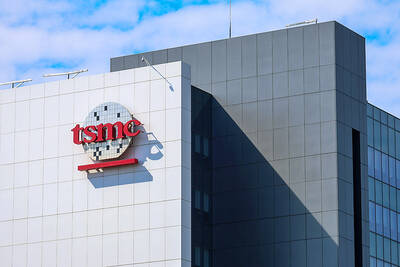
Taiwan Semiconductor Manufacturing Co (TSMC, 台積電), the world’s largest foundry service provider, yesterday said that global semiconductor revenue is projected to hit US$1.5 trillion in 2030, after the figure exceeds US$1 trillion this year, as artificial intelligence (AI) demand boosts consumption of token and compute power. “We are still at the beginning of the AI revolution, but we already see a significant impact across the whole semiconductor ecosystem,” TSMC deputy cochief operating officer Kevin Zhang (張曉強) said at the company’s annual technology symposium in Hsinchu City. “It is fair to say that in the past decade, smartphones and other mobile devices were
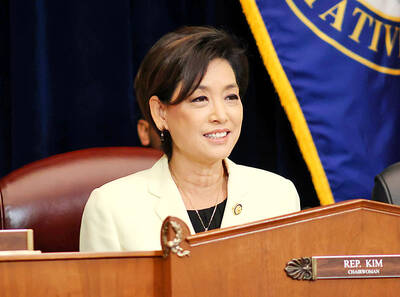
‘CLEAR MESSAGE’: The bill would set up an interagency ‘tiger team’ to review sanctions tools and other economic options to help deter any Chinese aggression toward Taiwan US Representative Young Kim has introduced a bill to deter Chinese aggression against Taiwan, calling for an interagency “tiger team” to preplan coordinated sanctions and economic measures in response to possible Chinese military or political action against Taiwan. “[Chinese President] Xi Jinping [習近平] has directed the People’s Liberation Army to be ready to invade Taiwan by 2027. China has a plan. America should have one too,” Kim said in a news release on Thursday last week. She introduced the “Deter PRC [People’s Republic of China] aggression against Taiwan act” to “ensure the US has a coordinated sanctions strategy ready should


 RSS
RSS