

Up to 100 Taiwanese fishing boats, escorted by 10 Coast Guard Administration ships, embarked on a protest voyage yesterday toward the Diaoyutai Islands (釣魚台) that organizers said was aimed at asserting local fishermen’s rights to operate in what they described as their “traditional fishing grounds.”
If officers on Japanese maritime defense vessels — which usually intercept Taiwanese fishing boats operating in the area — try to board the Taiwanese fishing boats, special service agents traveling on the coast guard vessels will “board our fishing boats to stop” the Japanese from boarding the Taiwanese ships, Coast Guard Administration (CGA) Minister Wang Jinn-wang (王進旺) said.
If the Japanese ships spray water at the Taiwanese fishing boats, Wang said, “we will spray water back at them.”
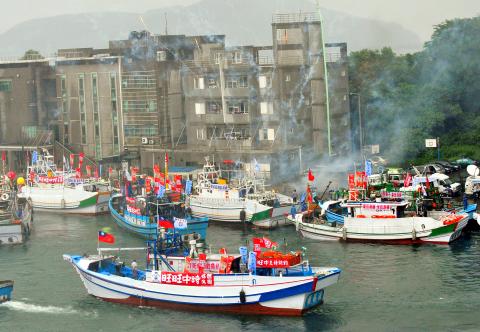
Photo: Mandy Cheng, AFP
He added that he would not rule out the use of arms if “the other side resorts to it first.”
The coast guard official’s statements in the legislature showed Taiwan’s decision to protect local fishermen’s rights to fish in the waters around the disputed island chain, which is currently controlled by Japan, but also claimed by Taiwan and China.
Wang told lawmakers that Taiwan’s fishing boats would sail to waters to the southwest of the islands and that there was little likelihood they would meet a group of Chinese fishing boats also making a protest journey to the area.
More than 70 fishing boats departed from Nanfangao (南方澳) port in Yilan County for the island chain that lies 120 nautical miles (220km) northeast of Taipei.
By the time they arrive in the target area at 5am today, they are set to be joined by other Taiwanese fishing boats to form a 100-strong flotilla in the “biggest-ever action” to demonstrate Taiwan’s sovereignty over the islands, Wang said.
Ten coast guard vessels ranging in size from 100 tonnes to 2,000 tonnes are ready to “intervene” in case Japanese ships attempt to block the Taiwanese fishing boats, he said.
Wang said Taiwan would not partner with China in protecting its fishing rights near the Diaoyutais, adding that the CGA would abide by the precepts of “no provocation, no conflict and no evasion.”
The Chinese Nationalist Party (KMT) caucus said it supported a legislative committee proposal for legislators to board coast guard vessels for an inspection tour of the island group, a move that is also to serve to assert Taiwan’s sovereignty claim.
However, Democratic Progressive Party caucus whip Pan Men-an (潘孟安) advised against such a move, saying that it is not in Taiwan’s interests to highlight its claim at a time when China is doing all it can to assert its sovereignty over the islands.
Pan said that over the past 40 years, China has never made any pitched claim over the Diaoyutais.
“It is doing so only to divert attention from its internal crisis,” he said, urging Taiwan not to get involved.
Minister of National Defense Kao Hua-chu (高華柱) said the military had response measures in place for contingencies that could arise from the visit by the fishing boats.
The military is to step up air patrols over the Diaoyutais and monitor the waters surrounding the islands, Kao told the Foreign Affairs and National Defense Committee.
The coast guard will be responsible for escorting the fishing vessels during the visit, while the military is to provide related support, Kao said.
“The ministry has completed preparations for any response measures,” Kao said, adding that senior officials would be stationed at a command center in Taipei.
UNITY: Lai thanked the nations who spoke up for Taiwan, saying that democracies must stand together to face global authoritarian expansion Taiwan yesterday thanked eight European and Indo-Pacific countries for opposing unilateral changes to the “status quo” in the Taiwan Strait in a joint statement earlier this week, as well as three of Taiwan’s allies for speaking up for the nation’s participation in the UN at the body’s General Assembly in New York. Minister of Foreign Affairs Lin Chia-lung (林佳龍) welcomed the support and expressed his appreciation for the countries’ stance, the Ministry of Foreign Affairs said in a statement. Foreign ministers and senior representatives of Australia, France, Germany, Japan, New Zealand, Poland, South Korea and the UK issued a statement on Tuesday

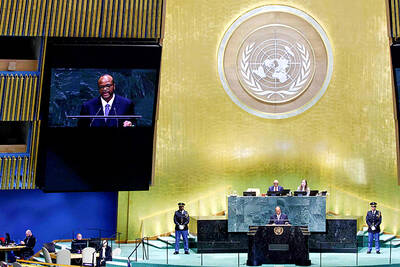
PLEA: How the UN addresses Taiwan’s security issue would be a test of its strength and relevance, Marshall Islands President Hilda Heine told the UN General Assembly Only Taiwan’s elected government can represent the people of Taiwan, Marshall Islands President Hilda Heine said on Friday at the UN General Assembly, calling for the nation’s inclusion in the UN. Taiwan and its 23 million people are a reality, and only its democratically elected government can represent it, Heine said when addressing the 81st session of the UN General Assembly General Debate. Appropriate ways must be found for Taiwan’s substantive participation in UN meetings if the UN is to be truly inclusive and effective in years to come, she said. UN member states would experience pressure to accept a
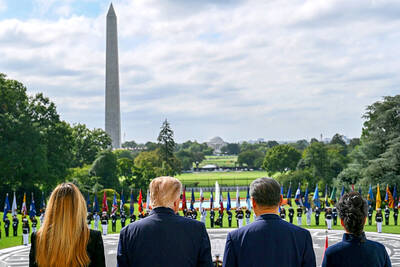
FACTS DISTORTION: The MAC rejected Xi’s remarks that the US and ‘China’ fought side-by-side during WWII, saying the ROC was Washington’s true ally during the war Taiwan yesterday denounced Chinese President Xi Jinping’s (習近平) comments to US President Donald Trump on the nation’s future, after Xi appeared to push Trump for a subtle change in stance that could erode US support for Taiwan. Xi told Trump in Washington on Thursday that he hoped the US would adhere to the “correct position” of opposing Taiwanese independence, according to a Chinese readout of the talks. That would be a tougher version of Washington’s long-standing formulation that it does not “support” independence. There was no immediate White House readout of the exchange. Xi’s remarks represent “the consistent Chinese approach of distorting facts
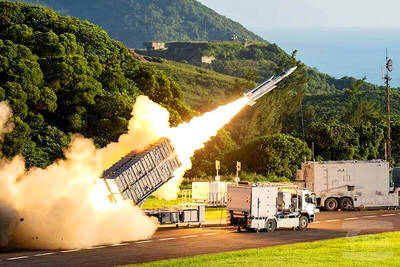
RESILIENCE: Keeping the defense industry’s assembly lines open would prove essential should the nation be involved in a prolonged conflict, a source said The Ministry of National Defense has prepared a NT$22 billion (US$692.3 million) program to acquire about 200 improved Hsiung Feng anti-ship missiles from next year to 2035, a source said. Commenting on condition of anonymity, a high-ranking defense official said the ministry’s plan for enhanced-capability Hsiung Feng II and Hsiung Feng III missiles would be funded as part of the regular defense budget. The 200 missiles would be added on top of the 1,400 missiles being funded via the Sea-Air Combat Power Improvement Plan, they said. The program is not about padding missile numbers, but expanding the capability to defeat


 RSS
RSS