


Following recent accusations of discrimination against foreign workers by Taipei Railway Station, another incident of alleged discrimination has surfaced, with about 1,000 residents in a Taoyuan County community petitioning to have 30 Filipino workers move out of the area.
Hanging up large banners that read “No to foreign workers in our community,” residents of Rueilian Community (瑞聯社區) in the county’s Bade City (八德) said they did not want the foreign workers from the nearby Ablecome Technology company to stay in the community because of safety concerns.
“We are concerned about our safety,” a resident, Lin Feng-mei (林鳳美), said in a video clip aired by Public Television. “There are many children living in this community. Most of the families here have children, and they are afraid of playing in the park because those foreign workers also spend their leisure time in the park.”
About 1,000 residents of the community signed a petition earlier this month, asking Ablecome to resettle the foreign workers as soon as possible.
While Ablecom general manager Liang Chien-fa (梁見發) said he disagreed with their views, he has agreed to find another place for his employees to stay by Oct. 6.
“They [the Filipino workers] have been staying in the community for only about two weeks, and there have been no problems at all,” Liang said, adding that foreign workers are no different from locals, but the company has agreed to relocate them because of the community’s opposition.
Taoyuan County Councilor Lu Lin Hsiao-feng (呂林小鳳), who represents the constituency, denied that residents wanted foreign workers to leave because of racial discrimination.
“It has nothing to do with discrimination,” she said. “With 460 households and more than 1,000 residents, Rueilian is a peaceful community. They are merely worried that clashes could happen because of these foreign workers, with their different skin color and different culture, going in and out of the community.”
The incident in Taoyuan is the second case of apparent discrimination that has surfaced recently in the nation. Earlier this month, Taipei Railway Station came under fire for cordoning off parts of its lobby on weekends after receiving complaints that gatherings of migrant workers to celebrate Eid al-Fitr last month were bothersome.
Taiwan International Workers Association secretary-general Chen Hsiu-lien (陳秀蓮) said that she was not surprised because discrimination has always existed, “it’s just a matter of whether it surfaces.”
“Last Sunday, a member of our association took a group of Filipino workers to Xinsheng Park in Taipei to practice drumming, and police officers appeared within 30 minutes, saying the Filipino workers were too noisy and could disturb people in a nearby library, and that they were violating the Assembly and Parade Act (集會遊行法), because they did not apply for an assembly permit in advance,” Chen said.
“But there’s no library near the park. It’s already very noisy there because it’s close to Songshan airport, and, when have you heard of people needing to apply for a permit to practice drumming in a park? What about those who exercise and do aerobics dancing in the park?” Chen said.
Chen said what happened last Sunday was not an isolated case.
“We often have difficulties renting an office too, because some of our neighbors pressure the landlord since they don’t want ‘people with dark skin’ to be going in and out of the building,” he said.
Taiwan New Immigrant Cultural Exchange Association president Hoang Oanh, from Vietnam, said the government could create special areas for immigrants to exhibit their culture and sell merchandise from their home countries.
“Such places could be ideal for immigrants to spend their leisure time, and it’s also ideal for teaching locals about the cultures of these immigrants,” Hoang said, adding that increased exchanges between locals and immigrants would promote better relations.
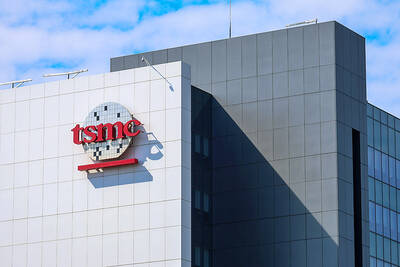
Taiwan Semiconductor Manufacturing Co (TSMC, 台積電), the world’s largest foundry service provider, yesterday said that global semiconductor revenue is projected to hit US$1.5 trillion in 2030, after the figure exceeds US$1 trillion this year, as artificial intelligence (AI) demand boosts consumption of token and compute power. “We are still at the beginning of the AI revolution, but we already see a significant impact across the whole semiconductor ecosystem,” TSMC deputy cochief operating officer Kevin Zhang (張曉強) said at the company’s annual technology symposium in Hsinchu City. “It is fair to say that in the past decade, smartphones and other mobile devices were
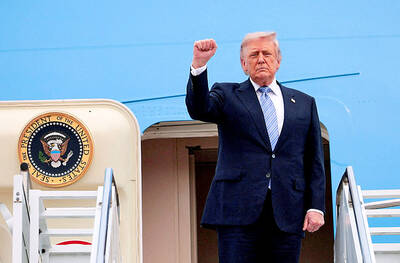
US-CHINA SUMMIT: MOFA welcomed US reassurance of no change in its Taiwan policy; Trump said he did not comment when Xi talked of opposing independence US President Donald Trump yesterday said he has not made a decision on whether to move forward with a major arms package for Taiwan after hearing concerns about it from Chinese President Xi Jinping (習近平). Trump’s comments on Taiwan came as he flew back to Washington after wrapping up critical talks in which both leaders said important progress was made in stabilizing US-China relations even as deep differences persist between the world’s two biggest powers on Iran and Taiwan. “I will make a determination,” Trump said, adding: “I’ll be making decisions. But, you know, I think the last thing we need right
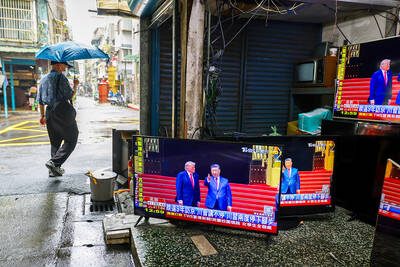
TAIWAN ISSUE: US treasury secretary Scott Bessent said on the first day of meetings that ‘it wouldn’t be a US-China summit without the Taiwan issue coming up’ There were no surprises on the first day of the summit between US President Donald Trump and Chinese President Xi Jinping (習近平), the Mainland Affairs Council (MAC) said yesterday, as the government reiterated that cross-strait stability is crucial to the Asia-Pacific region, as well as the world. As the two presidents met for a highly anticipated summit yesterday, Chinese state media reported that Xi warned Trump that missteps regarding Taiwan could push their two countries into “conflict.” Trump arrived in China with accolades for his host, calling Xi a “great leader” and “friend,” and extending an invitation to visit the White House
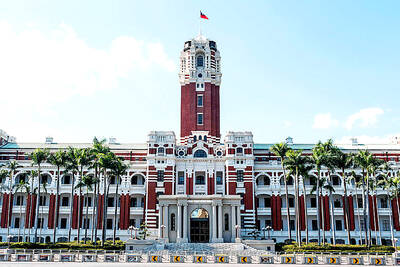
SECURITY: Taipei presses the US for arms supplies, saying the arms sales are not only a reflection of the US security commitment to Taiwan but also serve as a mutual deterrent against regional threats Taiwan is committed to preserving the cross-strait “status quo” and contributing to regional peace and stability, the Presidential Office said yesterday. “It is an undeniable fact that the Republic of China is a sovereign and independent democratic nation,” Presidential Office spokeswoman Karen Kuo (郭雅慧) reiterated, adding that Beijing has no right to claim sovereignty over Taiwan. The statements came after US President Donald Trump warned against Taiwanese independence. Trump wrapped up a state visit to Beijing on Friday, during which Chinese President Xi Jinping (習近平) had pressed him not to support Taiwan. Taiwan depends heavily on US security backing to deter China from carrying


 RSS
RSS