


UN human rights investigators said yesterday they had drawn up a new secret list of Syrians and Syrian military units suspected of committing war crimes who ought to be prosecuted.
The independent investigators, led by Paulo Pinheiro, said they had gathered “a formidable and extraordinary body of evidence” and urged the UN Security Council to refer the situation in Syria to the International Criminal Court (ICC).
“Gross human rights violations have grown in number, in pace and in scale,” Pinheiro told the UN Human Rights Council in Geneva. “There is no statute of limitations on these crimes.”
He did not say if any Syrian rebels were among the names on the list, which updated a confidential list his team submitted to UN High Commissioner for Human Rights Navi Pillay in February.
Pinheiro presented the team’s latest report, issued a month ago, saying Syrian government forces and allied militia have committed war crimes, including the murder and torture of civilians, in what appears to be a state-directed policy.
More than 20,000 people have been killed in the 18-month-old conflict, 1.2 million are uprooted within Syria and more than 250,000 have fled abroad, the UN says.
Food, water and medical supplies have run short in areas subjected to Syrian government air strikes, shelling and sieges, Pinheiro said, adding that investigators had received “numerous accounts … of civilians barely managing to survive.”
Pinheiro reported an “increasing and alarming presence” of Islamist militants in Syria, some joining the rebels and others operating independently.
They tended to radicalize the rebels, who have also committed war crimes, the Brazilian expert said.
It would be “improper” to make public the list of suspects because they were entitled to the presumption of innocence and no mechanism to hold perpetrators responsible was in place yet where allegations could be contested, Pinheiro said.
His team interviewed more than 1,100 victims, refugees and defectors in the past year.
“We have no interviews with wounded soldiers, or families of dead agents of the government because the government of Syria does not allow us access to Syria,” he said.
Syrian Ambassador Faysal Khabbaz Hamoui accused Western and Arab powers of arming and funding rebels conducting a jihad, or holy war, against Damascus, and said that this would backfire.
“The mercenaries are a time bomb that will explode later in the country and in the countries supporting them after they finish their terrorist mission in Syria,” he said.
The report should have named countries that “support the killers,” which he said included the US, Qatar, Saudi Arabia, Turkey and Libya.
“One of the facts that we do not see in the report is that many international parties are working at increasing the crisis in Syria through instigating their media, through training mercenaries, al-Qaeda elements, training them and funding them and sending them to Syria for jihad. This [is done] through fatwas that were issued,” Khabbaz Hamoui said during the four-hour debate.
Syrian ally Russia said rebels were committing “terrorist acts,” including executions.
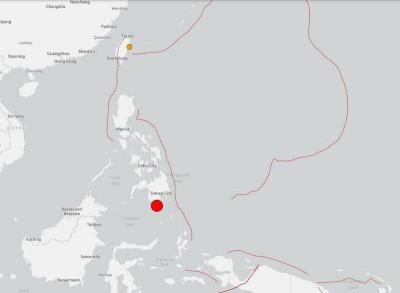
A magnitude 7.8 earthquake struck off the southern coast of Mindanao in the Philippines at 7:38am today, prompting the US Tsunami Warning System to issue an alert for neighboring countries, including Taiwan. The system issued a purple alert indicating a "tsunami threat." The potential threat zone includes Taiwan, the Philippines, Papua New Guinea, Yap and Palau. Philippine authorities were assessing the damage from the quake, with the office of civil defense seeking to verifying initial reports that 15 people had been killed and 129 injured in the region, mostly from falling debris. Arlene Hollero, disaster chief of Maasim town in the Philippines' Sarangani Province,
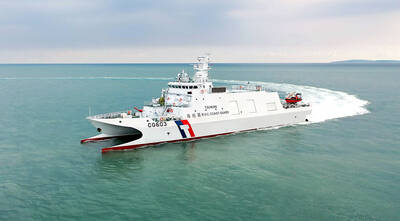
‘GRAY ZONE’ PRESSURE: Beijing’s activities are intended to create the deceitful impression that China has jurisdiction over the area around Taiwan, the CGA said Taiwan’s rights over its territorial waters and exclusive economic zone must not be violated by any country, the Mainland Affairs Council said yesterday, adding that it will not accept any unprovoked actions. The council issued the remarks in response to the China Coast Guard conducting maritime enforcement drills near eastern Taiwan and claiming to fully exercise China’s maritime administrative law enforcement authority. The Coast Guard Administration (CGA) has been closely monitoring the situation and is taking concrete steps to defend the nation’s sovereignty and secure its waters, the council said. China has no sovereign rights over the waters off eastern
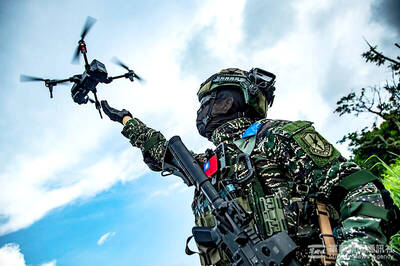
RESILIENCE: Taiwan plays a key role in semiconductors, energy, information infrastructure and advanced manufacturing, AIT Director Raymond Greene said Taiwan’s continued investment in deterrence and resilience remains vital, especially in uncrewed systems and other emerging technologies, American Institute in Taiwan (AIT) Director Raymond Greene said yesterday. Greene made the remarks at the annual National Strategic Summit on Supply Chain Resilience held by the Research Institute for Democracy, Society and Emerging Technology (DSET), a government-backed think tank. As Taiwan last year became the US’ fourth-largest trading partner and supply chain security is becoming more important, cooperation in emerging technologies continues to deepen between the two countries, he said. The US is committed to accelerating innovation, building key infrastructure, strengthening cooperation

RIGHT DIRECTION: Taiwan’s efforts to prevent forced labor include a proposal to ‘fully prohibit’ employers from withholding workers’ documents, an official said Taiwan is to establish a mechanism to restrict imports of goods linked to forced labor, the Executive Yuan said yesterday, after the US proposed imposing additional tariffs on Taiwanese goods over labor concerns. “The Ministry of Labor and the Ministry of Economic Affairs are to establish an interministerial review procedure,” Executive Yuan spokesperson Michelle Lee (李慧芝) said at a news briefing in Taipei. “The government is to use the Foreign Trade Act [貿易法] as the legal basis to restrict imports of goods produced with forced labor” and bring its supply chain governance more in line with international standards on human rights, resilience


 RSS
RSS