


In a surprise move, Taipei Mayor Hau Lung-bin (郝龍斌) yesterday publicly endorsed a proposal that former president Chen Shui-bian (陳水扁) should be granted medical parole, becoming the first political figure in the pan-blue camp to support the idea.
President Ma Ying-jeou’s (馬英九) administration has remained low-key in response to calls from pan-green supporters and civil groups to grant the imprisoned Chen a thorough checkup and treatment in hospital.
Hau raised the issue while attending the launch ceremony for “Liberty Lane” (自由巷) in Taipei in memory of late democracy advocate Deng Nan-jung (鄭南榕), urging the government to handle the issue of Chen’s hospital stay with sensitivity.
“The issue is not only a judicial problem, but also a social issue that involves the feelings of many pan-green supporters. Granting him a hospital stay would be a significant move to heal the scars and bring social reconciliation,” Hau said.
He called on the Ma administration to take responsibility for the issue and adopt a “more positive and active approach” in handling it, suggesting that related government departments should form a medical task force with medical experts and doctors to make assessments of Chen’s physical and mental condition.
“Former president Chen used to be our national leader, and I think he should be treated with respect and maybe more tolerance,” Hau said.
As one of the Chinese Nationalist Party’s (KMT) potential future presidential candidates, Hau’s comments raised eyebrows for straying from the party line on the issue.
He dismissed speculation that he raised the issue to seek more support for his presidential bid in 2016 and said he had not discussed the issue with Ma before making the remarks.
Hau, son of former premier Hau Pei-tsun (郝柏村) and a former New Party politician, is considered a deep-blue politician, although he worked under the former DPP government in 2001 as the chief of the Environmental Protection Agency.
While denying any political motives for the comments, Hau drew attention from both the pan-blue and pan-green camps after the statement.
Ma declined to comment on Hau’s remarks.
The KMT also remained quiet on the issue. KMT spokesperson Ma Wei-kuo (馬瑋國) said the party respected Hau’s personal comments and said the Ministry of Justice would make a decision in accordance with procedure.
The former president is serving a 17-and-a-half-year prison term for corruption. He has complained about physical ailments, including chest pains.
Democratic Progressive Party (DPP) Chairman Su Tseng-chang (蘇貞昌) welcomed Hau’s support of medical parole for Chen.
“I am also glad the issue is getting more attention and we are likely marching closer to a consensus,” Su said.
Su said the DPP had always called for Chen’s release for medical treatment and it had never stopped working toward that goal.
Saying five city and county councils have so far reached resolutions supporting the release, Su said that more councils were expected to follow suit after they returned from recesses.
He said that hopefully there would be more pan-blue supporters showing compassion and supporting Chen’s release and that eventually, Ma Ying-jeou would agree to release Chen for medical treatment.
DPP Taipei City Councilor Chuang Ruei-hsiung (莊瑞雄) said he was surprised by Hau’s comments.
“I’ve been observing Hau’s performance in the Taipei City government during the past six years. Hau, who was never a sharp politician, finally got the point today,” Chuang said.
Hau’s approval ratings could increase by 20 percentage points because of the initiative, Chuang said.
Separately yesterday, the Ministry of Justice said in a press statement that three doctors from the Chang Gung Memorial Hospital’s Linkou Branch had visited Chen on July 20. One of them was a psychiatrist who interviewed Chen for one hour, the statement said, adding that the psychiatrist also inspected Chen’s cell and living conditions.
The statement said the psychiatrist concluded that Chen was not suffering from mental illnesses as previously claimed by Mackay Memorial Hospital psychiatrist Chen Chiao-chicy (陳喬琪), who, after visiting Chen, said the former president was suffering from post-traumatic stress disorder and depression.
Chen therefore does not qualify for medical parole, the statement said. It added that the Taipei Prison had arranged for Chen to receive medical treatment in hospital and that doctors from Chang Gung Memorial Hospital’s Linkou Branch were scheduled to see Chen tomorrow and Monday.
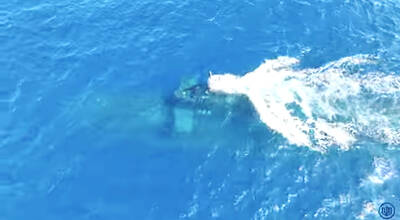
CSBC Corp, Taiwan (台灣國際造船) yesterday released the first video documenting the submerged sea trials of Taiwan’s indigenous defense submarine prototype, the Hai Kun (海鯤), or Narwhal, showing underwater navigation and the launch of countermeasures. The footage shows the vessel’s first dive, steering and control system tests, and the raising and lowering of the periscope and antenna masts. It offered a rare look at the progress in the submarine’s sea acceptance tests. The Hai Kun carried out its first shallow-water diving trial late last month and has since completed four submerged tests, CSBC said. The newly released video compiles images recorded from Jan. 29 to
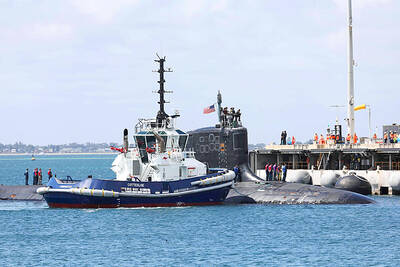
DETERRENCE EFFORTS: Washington and partners hope demonstrations of force would convince Beijing that military action against Taiwan would carry high costs The US is considering using HMAS Stirling in Western Australia as a forward base to strengthen its naval posture in a potential conflict with China, particularly over Taiwan, the Wall Street Journal reported on Saturday. As part of its Indo-Pacific strategy, Washington plans to deploy up to four nuclear-powered submarines at Stirling starting in 2027, providing a base near potential hot spots such as Taiwan and the South China Sea. The move also aims to enhance military integration with Pacific allies under the Australia-UK-US trilateral security partnership, the report said. Currently, US submarines operate from Guam, but the island could
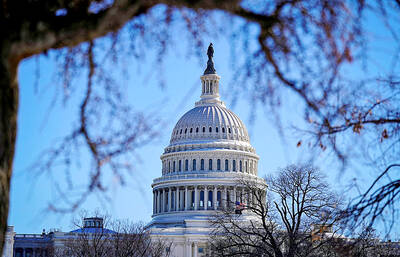
RESTRAINTS: Should China’s actions pose any threat to Taiwan’s security, economic or social systems, China would be excluded from major financial institutions, the bill says The US House of Representatives on Monday passed the PROTECT Taiwan Act, which states that Washington would exclude China from participating in major global financial organizations if its actions directly threaten Taiwan’s security. The bill, proposed by Republican Representative Frank Lucas, passed with 395 votes in favor and two against. It stipulates that if China’s actions pose any threat to Taiwan’s security, economic or social systems, the US would, “to the maximum extent practicable,” exclude Beijing from international financial institutions, including the G20, the Bank for International Settlements and the Financial Stability Board. The bill makes it clear that China must be prepared

Taiwanese trade negotiators told Washington that Taipei would not relocate 40 percent of its semiconductor production to the US, and that its most advanced technologies would remain in the nation, Vice Premier Cheng Li-chiun (鄭麗君) said on Sunday. “I told the US side very clearly — that’s impossible,” Cheng, who led the negotiation team, said in an interview that aired on Sunday night on Chinese Television System. Cheng was referring to remarks last month by US Secretary of Commerce Howard Lutnick, in which he said his goal was to bring 40 percent of Taiwan’s chip supply chain to the US Taiwan’s almost


 RSS
RSS