


About 700 people yesterday protested in front of the CtiTV (中天電視) building in Taipei, calling on Want Want China Times Group (旺旺中時集團) chairman Tsai Eng-meng (蔡衍明) to apologize for leading what they called an “unprofessional media group” and to return to his old business of selling rice crackers.
The protesters were mainly members of the Anti-Media Monster Youth Alliance, which is composed of 30 student clubs from several universities. Teachers, journalists and regular working people also showed up, adding to the mix of placards and posters.
Alliance spokesperson Lin Fei-fan (林飛帆), who is also the chairperson of National Taiwan University’s Graduate Student Association, said the media outlets in the Want Want China Times Group used tremendous resources to attack Academia Sinica associate research fellow Huang Kuo-chang (黃國昌), an outspoken media expert who opposes Want Want’s acquisition of cable TV services owned by China Network Systems (CNS, 中嘉網路).
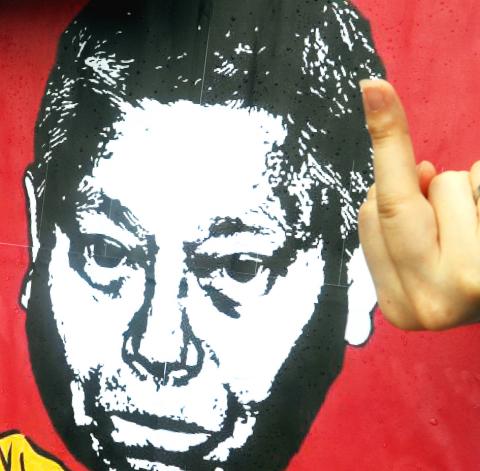
Photo: Chang Chia-ming, Taipei Times
Lin Fei-fan said Want Want media outlets had alleged that Huang paid students to protest in front of the National Communications Commission on Wednesday last week when commissioners granted conditional approval to the Want Want-CNS deal.
China Times Weekly deputy editor-in-chief Lin Chao-hsin (林朝鑫) threatened to sue a student who accused him of being the instigator of the student protests last week.
“The Want Want China Times Group should stop its attacks [on Huang and the students],” Lin Fei-fan said. “We ask Tsai to apologize to the public because the media group has become a terrible and second-rate institution under his leadership. We also ask the new NCC commissioners to revoke the commission’s ruling on the Want Want-CNS deal and review the case again. They must not allow such terrible media to continue to exist in Taiwan.”
In response, CtiTV spokesperson Huang Chun-ren (黃俊仁) reiterated that students had been paid to join the protest, and that the Want Want China Times Group had never said that Huang Kuo-chang was the real organizer of the student protest.
Huang Chun-ren said their reports were not meant to tarnish anyone’s reputation, but rather to make the point that paid social movements should be scrutinized.
The Want Want China Times Group was also victimized by false rumors and it simply wants to find out the truth, Huang Chun-ren said.
In related news, thousands of Chunghwa Telecom (中華電信) Union workers protested in front of the commission’s headquarters yesterday because a proposed amendment to the Telecommunications Act (電信法) would force Chunghwa to relinquish control of “last mile” operations, allowing other telecoms operators to take over.
The “last mile” refers to the final leg of telecommunications connectivity from a communication service provider to a customer.
The commission’s proposed amendment would require Chunghwa Telecom to charge other carriers using the last mile at prices reflecting only its costs. If that move fails to facilitate competition in the telecommunications market, the government could ask Chunghwa to spin off last mile facilities into separate business entities.
The union said that many fixed-network operators had entered the market since the government privatized operations at Chunghwa Telecom.
However, the infrastructure for fixed-telecom networks had not expanded as a result, the union said.
The union said the commission should ask other telecoms operators to build infrastructure, not just Chunghwa Telecom. The government also sold the last mile to Chunghwa when it wanted to turn it into a private firm, the union said.
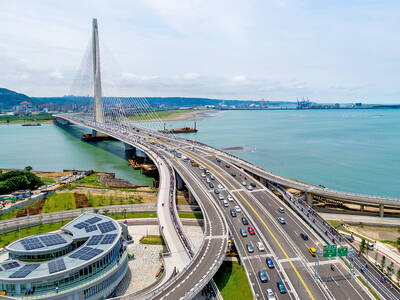
The Ministry of Transportation and Communications yesterday inaugurated the Danjiang Bridge across the Tamsui River in New Taipei City, saying that the structure would be an architectural icon and traffic artery for Taiwan. Feted as a major engineering achievement, the Danjiang Bridge is 920m long, 211m tall at the top of its pylon, and is the longest single-pylon asymmetric cable-stayed bridge in the world, the government’s Web site for the structure said. It was designed by late Iraqi-British architect Zaha Hadid. The structure, with a maximum deck of 70m, accommodates road and light rail traffic, and affords a 200m navigation channel for boats,
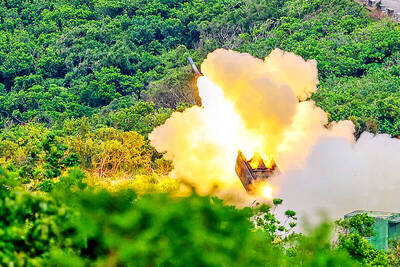
PRECISION STRIKES: The most significant reason to deploy HIMARS to outlying islands is to establish a ‘dead zone’ that the PLA would not dare enter, a source said A High Mobility Artillery Rocket System (HIMARS) would be deployed to Penghu County and Dongyin Island (東引) in Lienchiang County (Matsu) to force the Chinese military to retreat at least 100km from the coastline, a military source said yesterday. Taiwan has been procuring HIMARS and Army Tactical Missile Systems (ATACMS) from the US in batches. Once all batches have been delivered, Taiwan would possess 111 HIMARS units and 504 ATACMS, which have a range of 300km. Considering that “offense is the best defense,” the military plans to forward-deploy the systems to outlying islands such as Penghu and Dongyin so that
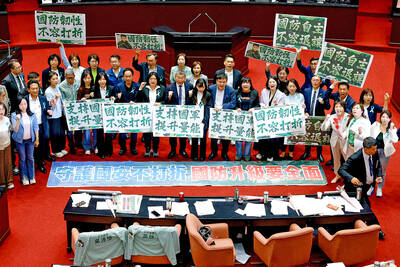
WHAT WAS ALL THAT FOR? Jaw Shaw-kong said that Cheng Li-wen had pushed for more drastic cuts and attacked him, just for the outcome to be nearly identical to his bill The legislature yesterday passed a supplementary budget bill to fund the purchase of separate packages of US military equipment, with the combined amount of spending capped at NT$780 billion (US$24.8 billion). The Chinese Nationalist Party (KMT) and Taiwan People’s Party (TPP) used their legislative majority to pass the bill, which runs until 2033 and has two main funding provisions. One was for NT$300 billion of arms sales already approved by the US for Taiwan on Dec. 17 last year, the other was for NT$480 billion for another arms package expected to be announced by Washington. The bill, which fell short of the NT$1.25
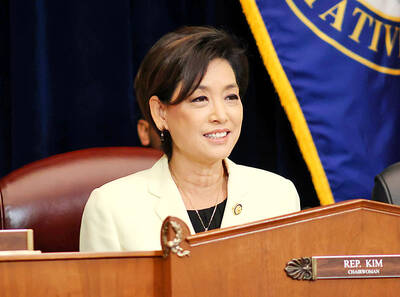
‘CLEAR MESSAGE’: The bill would set up an interagency ‘tiger team’ to review sanctions tools and other economic options to help deter any Chinese aggression toward Taiwan US Representative Young Kim has introduced a bill to deter Chinese aggression against Taiwan, calling for an interagency “tiger team” to preplan coordinated sanctions and economic measures in response to possible Chinese military or political action against Taiwan. “[Chinese President] Xi Jinping [習近平] has directed the People’s Liberation Army to be ready to invade Taiwan by 2027. China has a plan. America should have one too,” Kim said in a news release on Thursday last week. She introduced the “Deter PRC [People’s Republic of China] aggression against Taiwan act” to “ensure the US has a coordinated sanctions strategy ready should


 RSS
RSS