


Academics from both sides of the Taiwan Strait butted heads yesterday over cross-strait political dialogue, with Chinese academics saying political dialogue must be addressed soon, while their Taiwanese counterparts said political talks could commence only after China has democratized.
The eighth annual Chinese Nationalist Party (KMT)-Chinese Communist Party (CCP) Cross-Taiwan Strait Economic, Trade and Culture Forum opened on Saturday with a series of keynote speeches by cross-strait academics on how to establish mutual trust and political dialogue.
The meeting started with a surprise, as Chinese People’s Political Consultative Conference chairman Jia Qinglin (賈慶林) gave a clear definition of the “one China” framework.
“Mainland [China] and Taiwan both belong to one country, so the relationship of both sides of the Taiwan Strait is not a nation-to-nation relationship,” Jia said.
This was the first time Jia, or any Chinese official, had provided such a clear definition of the “one China” framework, with academics saying this was a crucial point because China was evidently taking the framework one step forward.
Prior to this year’s meeting, China only stressed that both sides of the Taiwan Strait belonged to “one China.”
Chinese Academy of Social Sciences Institute of Taiwan Studies director Yu Keli (余克禮) said that in the long term, China would find it hard to accept President Ma Ying-jeou’s (馬英九) “Three Noes” policy.
The policy refers to Ma’s statement of “no unification, no independence and no use of force” and it is currently the guiding principle that the Ma administration uses to define its cross-strait policy.
Chinese academics also said that Ma would have to flesh out his definition of “One China” or cross-strait political trust would be impossible to establish in the next decade.
However, Taiwanese academics said that Jia’s reference to “Two Sides, One Country (兩岸一國)” denigrated Taiwan’s sovereignty and added that the bottom line for political dialogue was that the Republic of China (ROC) was a sovereign country and that China must democratize.
Both sides also differed on political dialogue, with National Society of Taiwan Studies secretary-general Zhou Zhihuai (周至懷) saying that political dialogue was the key to institutionalizing cross-strait peace.
Such dialogue is inevitable and the KMT cannot always play the “If we talk about this, we lose the elections,” card, Zhou said, adding: “If everything depended on a public vote, the wrongs of history would never be put right.”
Peking University’s Institute of Taiwan Studies head Lee Yihu (李義虎) said Taiwan never showed any willingness to resolve issues by coming to the table, despite its constant gripes about the need to resolve issues of international space and national defense concerns.
The strong need for Taiwan to resolve these issues would form a sort of reverse transmission, prompting both sides of the Taiwan Strait into political dialogue, Lee said.
Meanwhile, Tamkang University Graduate Institute of China studies professor Chao Chun-shan (趙春山) said the influences on both societies on either side of the Strait were beyond the management of political forces.
Only by sharing the same values could cross-strait peace be institutionalized, Chao said.
However, Taipei City Councilor Chin Hui-chu (秦慧珠) said that although there were proponents pushing for cross-strait dialogue to be established as soon as possible, it was telling how Ma’s election campaign faltered as soon as he brought the issue up prior to the presidential election on Jan. 14.
This was an indicator of the public will — something academics might want to ruminate on, he said.
Initiating political dialogue is only possible when both sides of the Strait have established democratic nations and are on an equal footing, Chin said, adding that it would very difficult for political dialogue to be realized before China has democratized.
“We are willing to wait patiently for China to find its way to democratization,” Chin said.
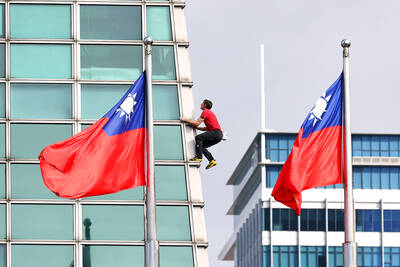
DAREDEVIL: Honnold said it had always been a dream of his to climb Taipei 101, while a Netflix producer said the skyscraper was ‘a real icon of this country’ US climber Alex Honnold yesterday took on Taiwan’s tallest building, becoming the first person to scale Taipei 101 without a rope, harness or safety net. Hundreds of spectators gathered at the base of the 101-story skyscraper to watch Honnold, 40, embark on his daredevil feat, which was also broadcast live on Netflix. Dressed in a red T-shirt and yellow custom-made climbing shoes, Honnold swiftly moved up the southeast face of the glass and steel building. At one point, he stepped onto a platform midway up to wave down at fans and onlookers who were taking photos. People watching from inside
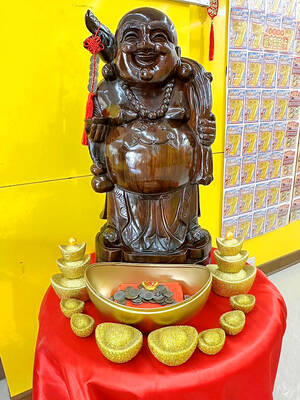
A Vietnamese migrant worker yesterday won NT$12 million (US$379,627) on a Lunar New Year scratch card in Kaohsiung as part of Taiwan Lottery Co’s (台灣彩券) “NT$12 Million Grand Fortune” (1200萬大吉利) game. The man was the first top-prize winner of the new game launched on Jan. 6 to mark the Lunar New Year. Three Vietnamese migrant workers visited a Taiwan Lottery shop on Xinyue Street in Kaohsiung’s Gangshan District (崗山), a store representative said. The player bought multiple tickets and, after winning nothing, held the final lottery ticket in one hand and rubbed the store’s statue of the Maitreya Buddha’s belly with the other,
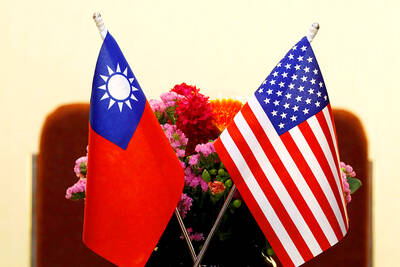
‘NATO-PLUS’: ‘Our strategic partners in the Indo-Pacific are facing increasing aggression by the Chinese Communist Party,’ US Representative Rob Wittman said The US House of Representatives on Monday released its version of the Consolidated Appropriations Act, which includes US$1.15 billion to support security cooperation with Taiwan. The omnibus act, covering US$1.2 trillion of spending, allocates US$1 billion for the Taiwan Security Cooperation Initiative, as well as US$150 million for the replacement of defense articles and reimbursement of defense services provided to Taiwan. The fund allocations were based on the US National Defense Authorization Act for fiscal 2026 that was passed by the US Congress last month and authorized up to US$1 billion to the US Defense Security Cooperation Agency in support of the

‘COMMITTED TO DETERRENCE’: Washington would stand by its allies, but it can only help as much as countries help themselves, Raymond Greene said The US is committed to deterrence in the first island chain, but it should not bear the burden alone, as “freedom is not free,” American Institute in Taiwan Director Raymond Greene said in a speech at the Institute for National Defense and Security Research’s “Strengthening Resilience: Defense as the Engine of Development” seminar in Taipei yesterday. In the speech, titled “Investing Together and a Secure and Prosperous Future,” Greene highlighted the contributions of US President Donald Trump’s administration to Taiwan’s defense efforts, including the establishment of supply chains for drones and autonomous systems, offers of security assistance and the expansion of


 RSS
RSS