

A majority of respondents found neither President Ma Ying-jeou (馬英九) nor Vice President Wu Den-yih (吳敦義) credible and do not trust the fairness of law enforcement officials, according to the results of a survey carried out by Taiwan Indicate Survey Research (TISR) which was released yesterday.
The research, conducted on Monday and Tuesday, found that only 32.7 percent of respondents said they trust Ma while 53.1 percent said they do not trust the president.
Only 24.3 percent of those polled found Wu, who has been embroiled in an alleged corruption case centered around former Legislative Yuan secretary-general Lin Yi-shih (林益世), credible, while 60.6 percent said the vice president is not trustworthy.
Leaders of the Democratic Progressive Party (DPP) outperformed the most powerful duo in the country in the credibility test, with 45.3 percent of respondents saying they trust DPP Chairman Su Tseng-chang (蘇貞昌) and 49.4 percent saying that former DPP chairperson Tsai Ing-wen (蔡英文) is credible.
A more detailed breakdown found that Ma and Wu appeared to have lost the support of many of those who consider themselves to be swing voters.
Among this group, only 25.4 percent said Ma is credible and 14.2 percent placed their trust in Wu. By comparison, 44.2 percent of swing voters said they trust Tsai and 35.9 percent found Su credible.
The survey also found that 65.4 percent of the respondents said they disagreed that law enforcement officials — including police officers, prosecutors and criminal investigators — have upheld justice and fairness in carrying out their duties. Only 24.9 percent of those polled agreed.
Comparing the survey with a pair of similar polls conducted in 2006 and 2009, public trust in the judiciary and law enforcement system has been consistently sliding, dropping from 35.8 percent in 2006 to 29.9 percent in 2009 and 24.9 percent this year, TISR general manager Tai Li-an (戴立安) said in a press release.
Asked whether the judicial system was able to uphold justice and fairness, 63.3 percent of respondents disagreed, while 24.3 percent agreed.
The survey also found Ma’s latest approval ratings still hovering around the low 20s at 22.6 percent, with Premier Sean Chen (陳冲) doing slightly better at 24.1 percent.
The poll collected 1,010 valid samples and has a margin of error of 3.1 percentage points.
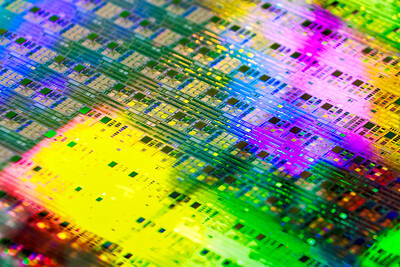
Taiwan, which accounts for more than half of the global outsourced semiconductor assembly and testing market, is well-positioned to develop copackaged optics (CPO) and manufacture precision silicon photonics chips, the Ministry of Economic Affairs said yesterday. Silicon photonics are emerging as a mainstream optical communications technology and is seen as key to overcoming bottlenecks in AI computing power. The technology is a key project under the government’s New 10 Major AI Infrastructure Projects, with industry, government, academia and research institutions working to overcome critical technological hurdles and build a self-reliant silicon photonics supply chain, the ministry said. Nvidia Corp in March invested US$4
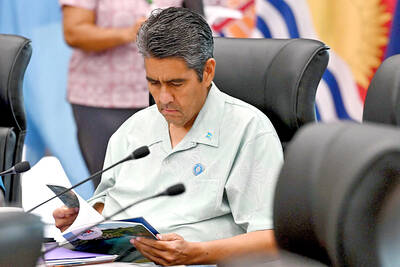
Palau’s president yesterday called for a “unified” Pacific response to a missile test by China in July, while Taiwan and its Pacific allies a day earlier at the Pacific Islands Forum (PIF) reaffirmed their commitment to peace, stability and prosperity. China gave only a handful of nations short notice before test-firing an intercontinental ballistic missile in July, sparking condemnation from several Pacific leaders. The 18-member PIF being held in Palau was expected to release a communique after press time last night, with a formal response to the test possibly included. Palau, which invited Taiwan to attend sideline events as an aid partner, urged
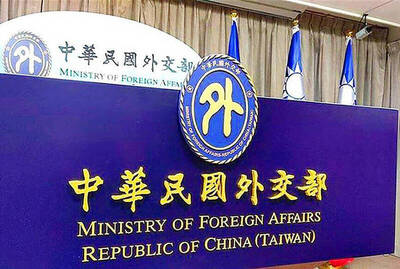
China’s continued efforts to inject geopolitical rivalry into the region and disrupt Pacific nations’ discussions of regional issues warrant greater international attention, a foreign affairs official said yesterday. Minister of Foreign Affairs Lin Chia-lung (林佳龍) last week led a delegation to diplomatic ally Palau to attend events related to the 55th Pacific Islands Forum (PIF) summit. However, the absence of some member-state leaders has been interpreted by some people as a sign of fracturing in Pacific unity. Thirteen PIF members were represented by their heads of state or government, while Fiji, New Caledonia, Vanuatu and Samoa sent ministerial-level representatives, a diplomatic official
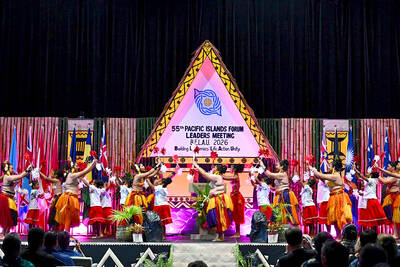
STATE DEPARTMENT: A US official said that Washington would provide more than US$150m for Pacific island nations, with Minister Lin Chia-lung welcoming the plans The US Department of State has announced partnerships with Taiwan on two Palau projects after Washington pledged more than US$150 million for Pacific island nations. Following the opening of the 55th Pacific Islands Forum (PIF) Leaders Meeting in Palau on Sunday, the department on Tuesday issued a statement titled “Promoting Pacific Prosperity: US Engagement at the Pacific Islands Forum,” which said that the US’ commitment to the security and prosperity of Pacific island nations “is steadfast and enduring, and remains a core pillar of its ‘America first’ foreign policy.” Meanwhile, US Deputy Secretary of State Christopher Landau announced at the PIF Partners


 RSS
RSS