


Former President Chen Shui-bian (陳水扁) has developed severe post-traumatic stress disorder and depression, and has attempted suicide at least three times as a result of his incarceration, a Democratic Progressive Party lawmaker yesterday cited a medical assessment report as saying.
Chen is currently serving a 17-and-a-half-year term at Taipei Prison on corruption charges.
“According to an assessment compiled by Mackay Memorial Hospital psychiatrist Chen Chiao-chicy (陳喬琪), the former president has exhibited symptoms of post-traumatic stress disorder and major depression after having been held in long-term confinement,” DPP Legislator Hsu Tain-tsair (許添財) said after a 45-minute meeting with Legislative Speaker Wang Jin-pyng (王金平) at the legislature in Taipei to discuss the former president’s medical condition.
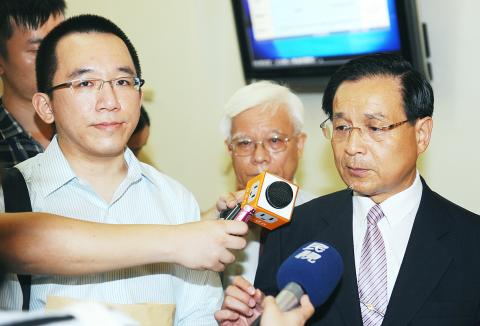
Photo: Chang Chia-ming, Taipei Times
“Because of Chen Shui-bian’s poor mental state, he has attempted suicide at least three times, including two hunger strikes and once by banging his head against the wall,” Hsu said.
The meeting was also attended by the former president’s son, Chen Chih-chung (陳致中), and a task force comprised of physicians and rights advocates — including National Taiwan University physician Ko Wen-che (柯文哲), Taipei Veterans General Hospital physician Kuo Cheng-tien (郭正典) and former Northern Taiwan Society director Janice Chen (陳昭姿) — to monitor the health of the former president.
Chen Chih-chung said that his family was worried about his father’s health and that his grandmother called him yesterday morning to ask about a follow-up medical checkup for tumors reported to have been detected in Chen Shui-bian’s prostate at Chang Gung Hospital two months ago.
Three reported tumors were found in Chen Shui-bian’s seminal vesicle earlier this year, but were later determined to be non-malignant blood clots.
Wang yesterday said that based on the medical report commissioned by Chen Shui-bian’s family, the former president’s physical state appeared to be declining, adding that the report recorded that he has suffered from hypothermia, autonomic instability, post-traumatic stress disorder and major depression.
“If these conditions are proven to be medically accurate, I will bring up the matter at an -appropriate time and occasion,” Wang said.
However, Taipei Prison yesterday dismissed Hsu’s allegations of Chen Shui-bian having attempted suicide, saying Hsu was exaggerating.
Chen Shui-bian stopped eating three times during his incarceration, but those were not suicide attempts, the prison said.
The prison said it had paid close attention to Chen Shui-bian’s health and believed his mental and physical condition were sound.
It said it had previously arranged for Chen Shui-bian to undergo medical checkups at Taoyuan General Hospital and Chang Gung Hospital’s branch in New Taipei City’s (新北市) Linkou District (林口) and that his ailments could be controlled by taking medicine and having follow-up checkups.
The prison also dismissed Ko’s allegations that Chen Shui-bian’s life was at risk and that he could die within four years if his current conditions do not improve.
Additional reporting by Rich Chang
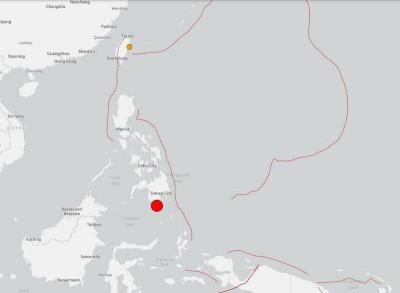
A magnitude 7.8 earthquake struck off the southern coast of Mindanao in the Philippines at 7:38am today, prompting the US Tsunami Warning System to issue an alert for neighboring countries, including Taiwan. The system issued a purple alert indicating a "tsunami threat." The potential threat zone includes Taiwan, the Philippines, Papua New Guinea, Yap and Palau. Philippine authorities were assessing the damage from the quake, with the office of civil defense seeking to verifying initial reports that 15 people had been killed and 129 injured in the region, mostly from falling debris. Arlene Hollero, disaster chief of Maasim town in the Philippines' Sarangani Province,
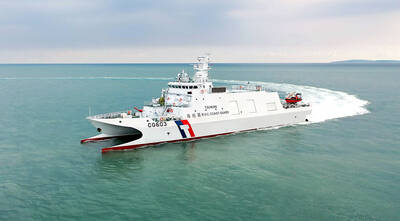
‘GRAY ZONE’ PRESSURE: Beijing’s activities are intended to create the deceitful impression that China has jurisdiction over the area around Taiwan, the CGA said Taiwan’s rights over its territorial waters and exclusive economic zone must not be violated by any country, the Mainland Affairs Council said yesterday, adding that it will not accept any unprovoked actions. The council issued the remarks in response to the China Coast Guard conducting maritime enforcement drills near eastern Taiwan and claiming to fully exercise China’s maritime administrative law enforcement authority. The Coast Guard Administration (CGA) has been closely monitoring the situation and is taking concrete steps to defend the nation’s sovereignty and secure its waters, the council said. China has no sovereign rights over the waters off eastern
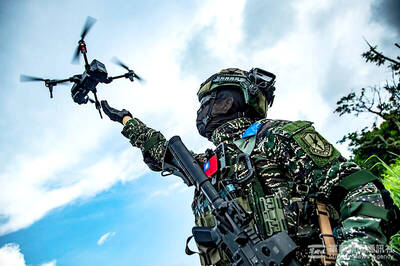
RESILIENCE: Taiwan plays a key role in semiconductors, energy, information infrastructure and advanced manufacturing, AIT Director Raymond Greene said Taiwan’s continued investment in deterrence and resilience remains vital, especially in uncrewed systems and other emerging technologies, American Institute in Taiwan (AIT) Director Raymond Greene said yesterday. Greene made the remarks at the annual National Strategic Summit on Supply Chain Resilience held by the Research Institute for Democracy, Society and Emerging Technology (DSET), a government-backed think tank. As Taiwan last year became the US’ fourth-largest trading partner and supply chain security is becoming more important, cooperation in emerging technologies continues to deepen between the two countries, he said. The US is committed to accelerating innovation, building key infrastructure, strengthening cooperation

The National Chungshan Institute of Science and Technology yesterday showcased its locally developed variants of the Vision 60 robotic patrol dog, which it plans to deploy on the nation’s outlying territories in the South China Sea. The variants were produced under the Joint Lab project — created by the institute and domestic companies — and assembled with domestically produced motors, lenses and artificial intelligence (AI) systems alongside licensed tech from the US, Missile and Rocket Systems Research Division deputy director Jen Kuo-kang (任國光) told the media event at a military base in Taipei’s Dazhi (大直) area. Taiwan has built up its strengths


 RSS
RSS