


China put its first woman into orbit yesterday, one of three astronauts to attempt a critical space docking in the latest challenge for the country’s ambitious space program.
A Long March rocket blasted off in the early evening from the remote Jiuquan Satellite Launch Center in the northwestern Gobi, carrying with it the Shenzhou 9 spacecraft and the three astronauts, including 33-year-old female fighter pilot Liu Yang (瀏陽)
This is China’s fourth manned space mission since 2003, when astronaut Yang Liwei (楊利偉) became the country’s first person in orbit, and comes as the US has curtailed manned launches over budget concerns and changing priorities.
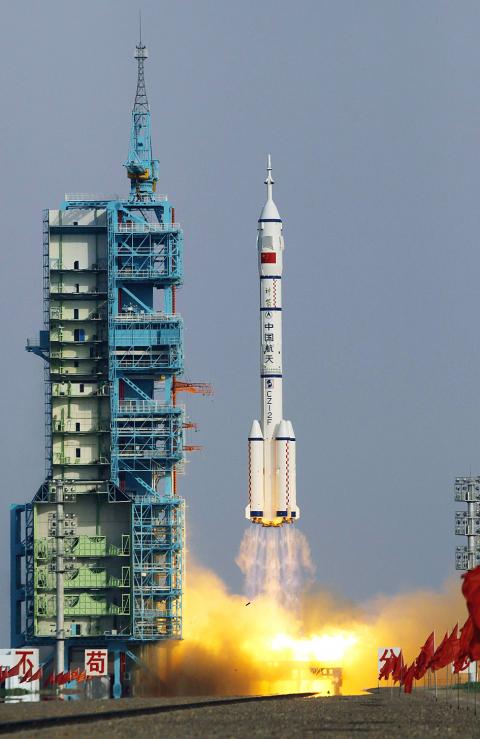
Photo: Reuters
The launch was carried live on state television and until moments before blast-off, a camera showed the three astronauts in the cabin occasionally waving. A red placard with the Chinese symbol for good fortune hung behind them.
Within days, the astronauts will try to dock with the orbiting Tiangong (Heavenly Palace) 1 module launched in September last year, as part of a 13-day mission crucial to China’s ambition to put a space station in orbit about 2020.
“I believe that we can achieve this goal because we already have the basic technological capability,” Zhou Jianping (周建平), the chief designer of China’s manned space engineering project, told reporters before the launch.
A successful manned docking mission for China would be the -latest show of the country’s growing capabilities in space, to match its expanding military and diplomatic clout.
However, Beijing is playing catch-up with the US and Russia, which, along with other countries, jointly operate the International Space Station about 390km above Earth.
Rendezvous and docking techniques such as those which China is only testing now were mastered by the US and the former Soviet Union decades ago, and the 10.5m long Tiangong 1 is a trial module, not a full-fledged space station.
Linking with the unmanned module will be an important hurdle in China’s efforts to acquire the technological and logistical skills needed to run a full space lab that can house astronauts for long stretches.
Fears of a space arms race with the US and other powers mounted after China blew up one of its own weather satellites with a ground-based missile in January 2007, though China has insisted its program is peaceful.
“China’s manned space -program has never been for military purposes. It is mainly to research how mankind can go into space, use space peacefully,” He Yu (何宇), the general commander of China’s manned spacecraft project, said before the launch.
The US will not test a new rocket to take people into space until 2017 and Russia has said manned missions are no longer a priority.
However, NASA has begun investing in US firms to provide commercial spaceflight services and is spending about US$3 billion a year on a new rocket and capsule to send astronauts to the moon, asteroids and eventually to Mars.
Chinese scientists have talked of the possibility of sending a man to the moon after 2020, the final step in a three-stage moon plan, which includes the deployment of a moon rover in 2013 and the retrieval of lunar soil and stone samples in about 2017.
China’s space program has come a long way since late leader Mao Zedong (毛澤東), founder of Communist China in 1949, lamented that the country could not even launch a potato into space.

LEVERAGE: China did not ‘need to fire a shot’ to deny Taiwan airspace over Africa when it owns ‘half the continent’s debt,’ a US official said, calling it economic warfare The EU has raised concerns about overflight rights following the delay of President William Lai’s (賴清德) planned state visit to the Kingdom of Eswatini after three African nations denied overflight clearance for his charter at the last minute. Taiwanese allies Paraguay and Saint Kitts and Nevis, as well as several US lawmakers and the Inter-Parliamentary Alliance on China (IPAC) condemned China for allegedly pressuring the countries. Lai was scheduled to fly directly to Taiwan’s only African ally from yesterday to Sunday to celebrate the 40th anniversary of King Mswati III’s accession and his 58th birthday, but Seychelles, Mauritius and Madagascar suddenly revoked
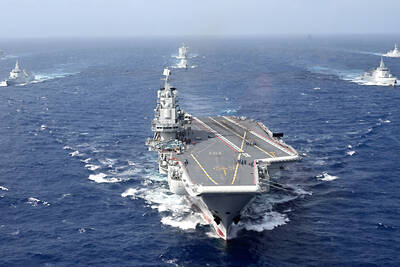
PROVOCATIVE: Chinese Deputy Ambassador to the UN Sun Lei accused Japan of sending military vessels to deliberately provoke tensions in the Taiwan Strait China denounced remarks by Japan and the EU about the South China Sea at a UN Security Council meeting on Monday, and accused Tokyo of provocative behavior in the Taiwan Strait and planning military expansion. Ayano Kunimitsu, a Japanese vice foreign minister, told the Council meeting on maritime security that Tokyo was seriously concerned about the situation in the East China and South China seas, and reiterated Japan’s opposition to any attempt to change the “status quo” by force, and obstruction of freedom of navigation and overflight. Stavros Lambrinidis, head of the EU delegation to the UN, also highlighted South China Sea
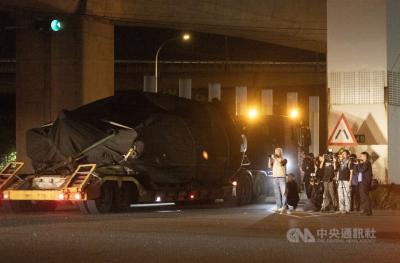
The final batch of 28 M1A2T Abrams tanks purchased from the US arrived at Taipei Port last night and were transported to the Armor Training Command in Hsinchu County’s Hukou Township (湖口), completing the military’s multi-year procurement of 108 of the tanks. Starting at 12:10am today, reporters observed more than a dozen civilian flatbed trailers departing from Taipei Port, each carrying an M1A2T tank covered with black waterproof tarps. Escorted by military vehicles, the convoy traveled via the West Coast Expressway to the Armor Training Command, with police implementing traffic control. The army operates about 1,000 tanks, including CM-11 Brave Tiger
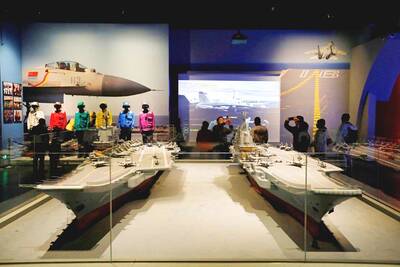
China on Wednesday teased in a video an aircraft carrier that could be its fourth, and the first using nuclear power, while making an allusion to Taiwan and vowing to further build up its islands, as it looks to boost maritime power, secure resources and bolster territorial claims. The video, issued on the eve of the 77th founding anniversary of the Chinese People’s Liberation Army Navy, featured fictional officers with names that are homophones of three commissioned aircraft carriers, the Liaoning (遼寧), Shandong (山東) and Fujian (福建). Titled Into the Deep, it showed a 19-year-old named “Hejian” (何劍) joining the group, sparking


 RSS
RSS