


China suspended three officials and apologized to a woman who was forced to undergo an abortion seven months into her pregnancy in a case that sparked uproar after graphic photos of the mother and her dead fetus were circulated online.
The moves appeared to be aimed at allaying public anger over a case that has triggered renewed criticism of China’s widely unpopular one-child limit. Designed to control the country’s exploding population, the policy has led to — often violently imposed — forced abortions and sterilizations as local authorities pursue birth quotas set by Beijing.
Feng Jianmei (馮建梅), 23, was beaten by officials and forced to abort her fetus at seven months on June 2 because her family could not afford a 40,000 yuan (US$6,300) fine for having a second child, Chinese media reported this week.
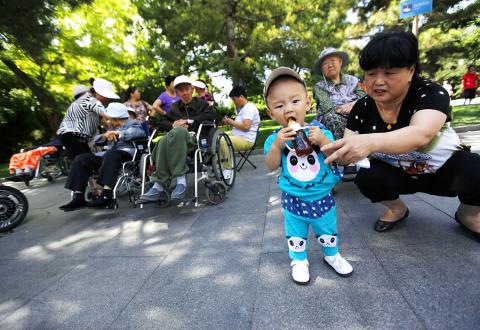
Photo: EPA
Photos of Feng lying on a hospital bed with the blood-covered fetus, reportedly stillborn after a chemical injection killed it, were posted online and went viral, prompting a public outpouring of sympathy and outrage.
The government of Ankang city, where Feng lives in northwest China’s Shaanxi Province, said a deputy mayor visited Feng and her husband in the hospital, apologized to them and said the officials responsible would be suspended amid an investigation.
“Today, I am here on behalf of the municipal government to see you and express our sincere apology to you. I hope to get your understanding,” Ankang Deputy Mayor Du Shouping (杜壽平) said, according to a statement on the city government’s Web site yesterday.
Feng and her husband could not immediately be reached yesterday. A relative who answered Feng’s cellphone said the couple were in talks with city officials.
Xinhua news agency said three officials would be relieved of their duties: two top local family planning officials and the head of the township government.
However, one expert said the officials are unlikely to be seriously punished for a problem that has existed for three decades and that is usually a result of orders carried out to meet the central government’s population quotas.
China legalized abortion in the 1950s, but it did not become common practice until the government began enforcing a one-child limit to stem population growth.
From fewer than 5 million abortions a year before 1979, the number jumped to 8.7 million in 1981, a year after the one-child policy was introduced. It peaked in 1983 at 14.4 million before coming down as China relaxed the policy to allow rural couples a second child if their first was a girl.
Xinhua said Feng was not legally entitled to a second child under China’s one-child limit because she did not have a rural household registration, but added that late-term abortions are prohibited due to the risk of causing physical injury to the mother.
“The correct way to deal with the case would have been for local officials to allow her to deliver the baby first, and then mete out punishment according to regulations,” the agency quoted an anonymous provincial family planning official as saying.
Abuses by family planning officials are often a target for popular frustration, especially amid a growing sense among better-off Chinese that the government has no right to dictate how many children people should have.
One reason that activist Chen Guangcheng (陳光誠) enjoys a wider appeal within China than many other activists is that he and his wife documented complaints about forced abortions and sterilizations in the city that oversees his village.
The couple’s efforts angered local leaders. Chen was jailed and later placed under illegal house arrest, from which he fled six weeks ago in a daring escape. He is now living in New York with his wife and two young children.

The National Chungshan Institute of Science and Technology yesterday showcased its locally developed variants of the Vision 60 robotic patrol dog, which it plans to deploy on the nation’s outlying territories in the South China Sea. The variants were produced under the Joint Lab project — created by the institute and domestic companies — and assembled with domestically produced motors, lenses and artificial intelligence (AI) systems alongside licensed tech from the US, Missile and Rocket Systems Research Division deputy director Jen Kuo-kang (任國光) told the media event at a military base in Taipei’s Dazhi (大直) area. Taiwan has built up its strengths

RIGHT DIRECTION: Taiwan’s efforts to prevent forced labor include a proposal to ‘fully prohibit’ employers from withholding workers’ documents, an official said Taiwan is to establish a mechanism to restrict imports of goods linked to forced labor, the Executive Yuan said yesterday, after the US proposed imposing additional tariffs on Taiwanese goods over labor concerns. “The Ministry of Labor and the Ministry of Economic Affairs are to establish an interministerial review procedure,” Executive Yuan spokesperson Michelle Lee (李慧芝) said at a news briefing in Taipei. “The government is to use the Foreign Trade Act [貿易法] as the legal basis to restrict imports of goods produced with forced labor” and bring its supply chain governance more in line with international standards on human rights, resilience

NOT IMMEDIATE: Taiwan has a chance to appeal the proposed 10 percent tariff before it starts, while other countries face a 12.5 percent tariff from the trade office Taiwan is among 60 economies determined by the US to have failed to impose or enforce a ban on the importation of goods produced with forced labor, according to a notice released on Tuesday by the Office of the US Trade Representative (USTR), which proposed imposing an additional 10 percent or more tariff on them. The USTR in a statement said that following an investigation, it had determined under Section 301 of the Trade Act of 1974 that the failure of the 60 economies to impose and effectively enforce a prohibition on the importation of goods produced with forced labor is
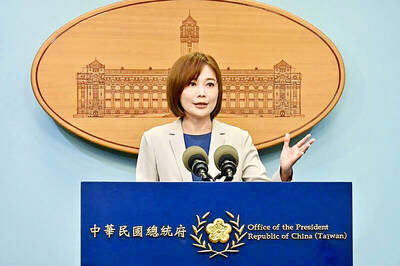
TIT-FOR-TAT: The US allegedly revoked the visa of a Chinese national working at Xinhua News Agency in the US in response to Beijing’s expulsion of Vivian Wang The Presidential Office yesterday condemned China for expelling a New York Times correspondent from Beijing following the newspaper’s interview with President William Lai (賴清德), saying the move highlighted Beijing’s suppression of press freedom and its threat to international news media. Taiwan has noted a series of recent incidents in which Beijing used similar tactics to “threaten and pressure international media outlets and journalists,” Presidential Office spokeswoman Karen Kuo (郭雅慧) said in a statement. “This concerns not only press freedom and freedom of expression, but also the safety of journalists, and Taiwan and relevant partners are paying close attention to the situation,” she


 RSS
RSS