


A district prosecutor yesterday launched a sit-in protest in front of the Supreme Court against a resolution stipulating that prosecutors have to shoulder 100 percent of the burden of proof.
Penghu District Prosecutor Wu Hsun-Lung (吳巡龍), who has a doctorate in law from Stanford Law School, launched his protest in front of the Supreme Court yesterday morning.
Wu said the Supreme Court held a criminal court meeting in January and made a resolution that in court actions, judges will only investigate evidence in favor of defendants and prosecutors have to shoulder 100 percent of the burden of proof in evidence against defendants.
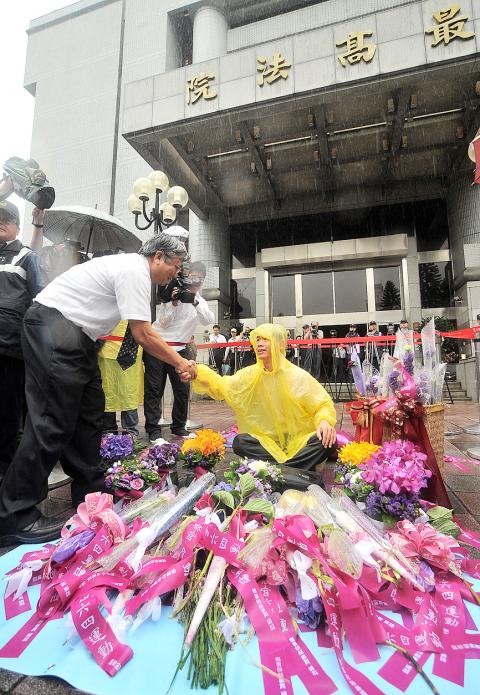
Photo: Liu Hsin-de, Taipei Times
“The Supreme Court’s resolution is not only largely in favor of defendants, it also violates the Constitution and the Code of Criminal Procedure (刑事訴訟法). I’ve never seen such a criminal procedure law anywhere else,” Wu said.
Wu said he had decided to hold a sit-in to express his view that the Supreme Court’s resolution violated the Constitution.
To avoid violating the Assembly and Parade Act (集會遊行法), some prosecutors did not join Wu’s sit-in, but one by one handed him flowers to show their support. Two major prosecutors’ associations are also supporting his protest.
Prosecutors’ Association president Shih Ching-tang (施慶堂) tried to give a letter of protest signed by 1,078 prosecutors, 27 law professors and 23 crime victims to Supreme Court Chief Judge Yang Ting-chang (楊鼎章), but Yang refused to see Shih or take the letter. Shih said the Supreme Court was arrogant and ignored prosecutors.
Meanwhile, Prosecutors’ Reform Association president Eric Chen (陳瑞仁) said: “The protest is just the beginning. Prosecutors will be holding hearings on this issue.”
In a statement in the afternoon, the Supreme Court said it regretted the prosecutors’ actions.
The court accused Wu and other prosecutors of teaching people how to avoid violating the Assembly and Parade Act by holding a one-person protest.
The Supreme Court said that the resolution was passed to consolidate the principle of presumption of innocence and that prosecutors, who shoulder the burden of proof, have equal status with defendants and judges remain neutral in courts.

ROLLER-COASTER RIDE: More than five earthquakes ranging from magnitude 4.4 to 5.5 on the Richter scale shook eastern Taiwan in rapid succession yesterday afternoon Back-to-back weather fronts are forecast to hit Taiwan this week, resulting in rain across the nation in the coming days, the Central Weather Administration said yesterday, as it also warned residents in mountainous regions to be wary of landslides and rockfalls. As the first front approached, sporadic rainfall began in central and northern parts of Taiwan yesterday, the agency said, adding that rain is forecast to intensify in those regions today, while brief showers would also affect other parts of the nation. A second weather system is forecast to arrive on Thursday, bringing additional rain to the whole nation until Sunday, it

LANDSLIDES POSSIBLE: The agency advised the public to avoid visiting mountainous regions due to more expected aftershocks and rainfall from a series of weather fronts A series of earthquakes over the past few days were likely aftershocks of the April 3 earthquake in Hualien County, with further aftershocks to be expected for up to a year, the Central Weather Administration (CWA) said yesterday. Based on the nation’s experience after the quake on Sept. 21, 1999, more aftershocks are possible over the next six months to a year, the agency said. A total of 103 earthquakes of magnitude 4 on the local magnitude scale or higher hit Hualien County from 5:08pm on Monday to 10:27am yesterday, with 27 of them exceeding magnitude 5. They included two, of magnitude

CONDITIONAL: The PRC imposes secret requirements that the funding it provides cannot be spent in states with diplomatic relations with Taiwan, Emma Reilly said China has been bribing UN officials to obtain “special benefits” and to block funding from countries that have diplomatic ties with Taiwan, a former UN employee told the British House of Commons on Tuesday. At a House of Commons Foreign Affairs Committee hearing into “international relations within the multilateral system,” former Office of the UN High Commissioner for Human Rights (OHCHR) employee Emma Reilly said in a written statement that “Beijing paid bribes to the two successive Presidents of the [UN] General Assembly” during the two-year negotiation of the Sustainable Development Goals. Another way China exercises influence within the UN Secretariat is

Taiwan’s first drag queen to compete on the internationally acclaimed RuPaul’s Drag Race, Nymphia Wind (妮妃雅), was on Friday crowned the “Next Drag Superstar.” Dressed in a sparkling banana dress, Nymphia Wind swept onto the stage for the final, and stole the show. “Taiwan this is for you,” she said right after show host RuPaul announced her as the winner. “To those who feel like they don’t belong, just remember to live fearlessly and to live their truth,” she said on stage. One of the frontrunners for the past 15 episodes, the 28-year-old breezed through to the final after weeks of showcasing her unique


 RSS
RSS