


A 22,000-tonne landing helicopter dock (LHD) under development in China has sparked alarm in defense circles in Taiwan, with some analysts saying the ship could cause a “strategic shift” in the Taiwan Strait.
The design, first unveiled by state-owned China Shipbuilding Industry Co (CSIC, 中國船舶重工集團公司) — the country’s largest shipbuilding conglomerate — at the Defense and Security 2012 exhibition in Bangkok in early March, is believed to be the Type 081 LHD that defense enthusiasts have been expecting for years.
According to Jane’s Defence Weekly, CSIC confirmed the existence of a Type 081 program in 2007, but at the time it refused to disclose further details. The design phase of the vessel was reportedly completed in 2006, with engineering design beginning soon afterwards.
The 211m long LHD will be capable of carrying an impressive eight helicopters on deck, with hangar space for four more, or for hovercraft. It will also have capacity to accommodate 1,068 marines and will be equipped with phased-array radar, four short-range air-defense launchers and anti-submarine warfare capability.
Its operational range is expected to be 7,000 nautical miles (13,000km), with an endurance of up to 30 days at sea.
The Type 081 was reportedly inspired by the Mistral-class amphibious assault ship operated by the French Navy. Some analysts have also pointed to similarities with the 18,000-tonne Hyuga-class helicopter carrier used by the Japan Maritime Self-Defense Force since 2009.
Defense analysts say CSIC is fully capable of building the LHD, especially following the experience gained by Chinese shipbuilders with three 20,000-tonne Type 071 Yuzhao-class amphibious transport docks, the last of which was launched in September, with a fourth rumored to be on the way. Despite having a similar displacement to the Type 081, the Type 071 can only accommodate two Z-8 heavy transport helicopters.
Assuming that the timeframe for construction of the Type 081 is similar to that for the Type 071, the first Type 081 could be launched as early as 2014. China’s first Type 071 was launched in December 2006, two years after the model was first unveiled.
Some reports indicate that the People’s Liberation Army Navy might be seeking to acquire as many as three Type 081s for its operations.
The Chinese government has yet to confirm whether CSIC has begun construction of the Type 081.
Given its ability to carry various types of helicopters — Z-8 and Z-9 transport and Z-10 attack helicopters, among others — a large number of marines and landing craft, analysts are saying that the Type 081 would greatly enhance the Chinese navy’s ability to launch humanitarian operations as well as project force beyond its shores, a reflection of the strategic choices made by the Chinese navy in recent years.
It would also play a key, possibly game-changing role in any amphibious assault on Taiwan or against other adversaries in the South China Sea.

DRONE CENTRAL: Taiwan aims to become Asia’s democratic hub for drones, with most exports focused on high-quality military-grade models, an official said Taiwan’s drone industry is expected to expand significantly by 2030, producing 100,000 units per month and exporting half of them, the Ministry of Economic Affairs said yesterday. Current drone production capacity is about 15,000 units per month, but the industry can quickly scale up as demand increases, Industrial Development Administration Director-General Chiou Chyou-huey (邱求慧) told a news conference in Taipei. Taiwan’s drone output grew 2.5-fold last year to NT$12.9 billion (US$408.3 million) under a government program to develop the uncrewed vehicle sector, he said. The Executive Yuan in October last year approved plans to invest NT$44.2 billion into domestic production of uncrewed aerial

A signaling system malfunction disrupted high-speed rail (HSR) services beginning at 8am today, with trains temporarily reduced to three northbound and three southbound trains per hour as authorities conduct inspections. The malfunction occurred on a section of track in Miaoli County during pre-operation checks early this morning, forcing northbound and southbound trains to use a single track, the HSR operator said. The regular schedule has been replaced with three hourly trains offering only nonreserved seating in each direction, stopping at every station, it said, adding that business class cars would still have reserved seating. Departures from terminal stations are scheduled at the top
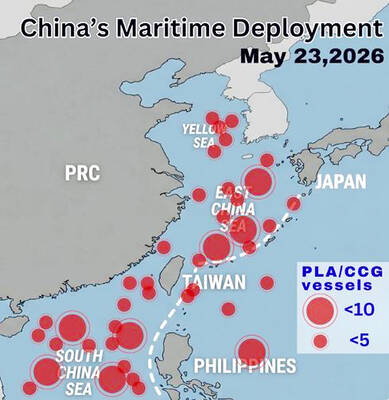
WARNING: China should stop engaging in actions that undermine regional peace and stability, as it would only build resentment among people across the Strait, the CGA said China has deployed more than 100 navy, coast guard and other vessels in waters from the Yellow Sea to the South China Sea and the western Pacific since US President Donald Trump and Chinese President Xi Jinping (習近平) met in Beijing, National Security Council Secretary-General Joseph Wu (吳釗燮) said yesterday. “In this part of the world, #China is the one & only PROBLEM wrecking the #StatusQuo & threatening regional peace & stability,” Wu wrote on X. In a separate post, he said Beijing was coercing Taiwan’s maritime domain, calling it illegal and provocative, after the Coast Guard Administration (CGA) expelled a

VERBOSE VESSELS: A CGA cutter and a China Coast Guard exchanged verbal barbs for more than a day in Taiwanese-controlled waters before the Chinese vessel left The Taiwanese and Chinese coast guards had a standoff near the strategically located Pratas Islands (Dongsha Islands, 東沙群島) in the north of the South China Sea, the Coast Guard Administration (CGA) said yesterday. The two sides engaged in intense radio exchanges over sovereignty claims during the 33-hour standoff. China Coast Guard vessel 3501 eventually left the restricted waters, 26.6 nautical miles (49.2km) west of the Pratas Islands, at 5pm yesterday, the CGA said. Lying approximately between southern Taiwan and Hong Kong, the Taiwan-controlled Pratas are seen by some security experts as vulnerable to Chinese attack due to their distance — more than


 RSS
RSS