


Members of the People First Party are set to join a mass protest in Taipei spearheaded by the Democratic Progressive Party (DPP) today.
The DPP-sponsored protest which is galvanizing support under the banner “It’s hard to survive; the President needs to explain why,” will protest against President Ma Ying-jeou’s (馬英九) poor governance and controversial government plans including a proposal to ease US beef imports containing the growth additive ractopamine, increases in fuel and electricity costs and the “one country, two areas (一國兩區)” strategy touted by Chinese Nationalist Party (KMT) officials.
The protest will proceed from three assembly points: DPP acting chairperson Chen Chu (陳菊) will lead one group from Songshan Tobacco Factory (松山菸廠), another will be led by former DPP chairperson Tsai Ing-wen (蔡英文) and will start at National Taiwan University and a third is to be led by former premier Su Tseng-chang (蘇貞昌) starting at Wanhua Rail Station.
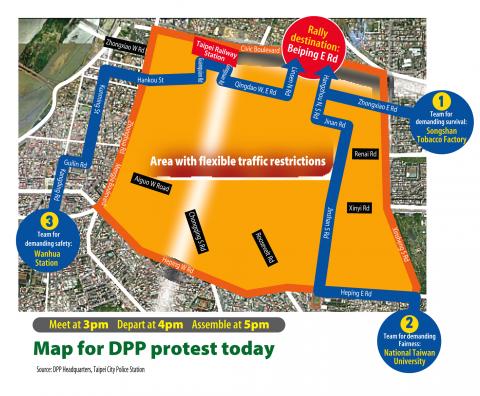
People are to meet at each of the three locations at 3pm and will begin their processions at 4pm. They plan to converge on Beiping E Road at 5pm, where a rally will be held.
Chen said yesterday that because the public is suffering, she has decided not to attend Ma’s second-term inauguration ceremony on Sunday.
The Taiwan Solidarity Union (TSU) yesterday said the party would take part in the DPP-sponsored demonstration and called for protesters to stage sit-ins through the night following the end of the DPP rally and then to attend the TSU-sponsored rally tomorrow.
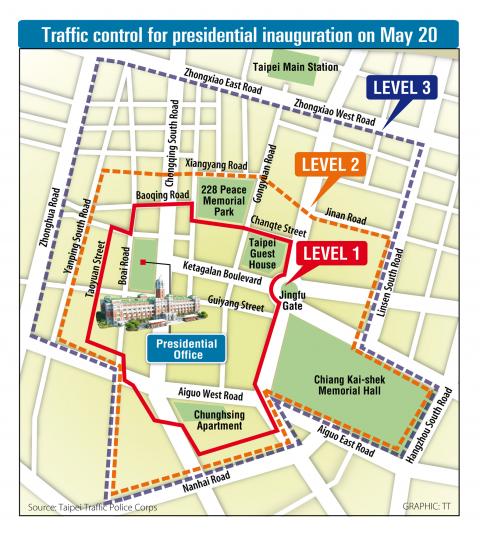
The TSU’s rally is to start at Huashan Park (華山公園) at 8am and march to an area near the Presidential Office and end at Chongqing S Road by noon.
The PFP called a press conference yesterday saying the party encouraged its cadres and members to join pan-green initiated protests against Ma.
“We will not join the protest in the name of the party because we do not support the recall of Ma and the release of former president Chen Shui-bian (陳水扁), but we encourage party members to take part in an individual capacity,” PFP caucus whip Thomas Lee (李桐豪) said.
PFP Deputy Secretary-General Liu Wen-hsiung (劉文雄) said the party supports the demonstrations, but said the support is only limited to the issues related to gasoline and electricity price increases, the government-proposed capital gains tax on securities transactions and the plan to partially lift the ban on imports of US beef containing ractopamine.
“Don’t be surprised if you see PFP Chairman James Soong (宋楚瑜) in the crowd,” Liu said.
Lee urged Ma to either “step down voluntarily” or “retreat to the back line and delegate power to Premier Sean Chen” saying that people do not hold much hope for Ma’s second term.
Ma should seriously consider the two options if he fails to revive his sinking approval ratings within two months — the lowest ever recorded for any Taiwanese president in political history, he added.
Separately, KMT Legislator Apollo Chen (陳學聖) suggested that Ma hold a press conference and apologize to the public.
“Offering an apology would be just the beginning. Only when the president is willing to stand with the people and to make adjustments to his policy and key government personnel, is he likely to see his approval ratings climb,” he said.
KMT Legislator Yang Li-huan (楊麗環) was also of the opinion that Ma has to apologize first.
“But what would be more important is what he will do next. He has to explain the rationale of his policies to the people,” she said.

The National Chungshan Institute of Science and Technology yesterday showcased its locally developed variants of the Vision 60 robotic patrol dog, which it plans to deploy on the nation’s outlying territories in the South China Sea. The variants were produced under the Joint Lab project — created by the institute and domestic companies — and assembled with domestically produced motors, lenses and artificial intelligence (AI) systems alongside licensed tech from the US, Missile and Rocket Systems Research Division deputy director Jen Kuo-kang (任國光) told the media event at a military base in Taipei’s Dazhi (大直) area. Taiwan has built up its strengths

RIGHT DIRECTION: Taiwan’s efforts to prevent forced labor include a proposal to ‘fully prohibit’ employers from withholding workers’ documents, an official said Taiwan is to establish a mechanism to restrict imports of goods linked to forced labor, the Executive Yuan said yesterday, after the US proposed imposing additional tariffs on Taiwanese goods over labor concerns. “The Ministry of Labor and the Ministry of Economic Affairs are to establish an interministerial review procedure,” Executive Yuan spokesperson Michelle Lee (李慧芝) said at a news briefing in Taipei. “The government is to use the Foreign Trade Act [貿易法] as the legal basis to restrict imports of goods produced with forced labor” and bring its supply chain governance more in line with international standards on human rights, resilience

NOT IMMEDIATE: Taiwan has a chance to appeal the proposed 10 percent tariff before it starts, while other countries face a 12.5 percent tariff from the trade office Taiwan is among 60 economies determined by the US to have failed to impose or enforce a ban on the importation of goods produced with forced labor, according to a notice released on Tuesday by the Office of the US Trade Representative (USTR), which proposed imposing an additional 10 percent or more tariff on them. The USTR in a statement said that following an investigation, it had determined under Section 301 of the Trade Act of 1974 that the failure of the 60 economies to impose and effectively enforce a prohibition on the importation of goods produced with forced labor is

TIT-FOR-TAT: The US allegedly revoked the visa of a Chinese national working at Xinhua News Agency in the US in response to Beijing’s expulsion of Vivian Wang The Presidential Office yesterday condemned China for expelling a New York Times correspondent from Beijing following the newspaper’s interview with President William Lai (賴清德), saying the move highlighted Beijing’s suppression of press freedom and its threat to international news media. Taiwan has noted a series of recent incidents in which Beijing used similar tactics to “threaten and pressure international media outlets and journalists,” Presidential Office spokeswoman Karen Kuo (郭雅慧) said in a statement. “This concerns not only press freedom and freedom of expression, but also the safety of journalists, and Taiwan and relevant partners are paying close attention to the situation,” she


 RSS
RSS