


Legislators yesterday called for a stronger military presence on Taiping Island (太平島) in the South China Sea following allegations that a Vietnamese military boat opened fire on Taiwanese coast guards stationed on the disputed island in March.
The legislature’s Foreign Affairs and National Defense Committee invited ministries to report on the current situation in the South China Sea amid growing tensions between Taiwan, China, Vietnam and the Philippines over sovereignty issues.
Quoting media reports, Democratic Progressive Party Legislator Tsai Huang-liang (蔡煌瑯) said a Vietnamese military boat had opened fire on Coast Guard Administration (CGA) personnel stationed on Taiping Island, one of the disputed Spratly Islands (南沙群島).
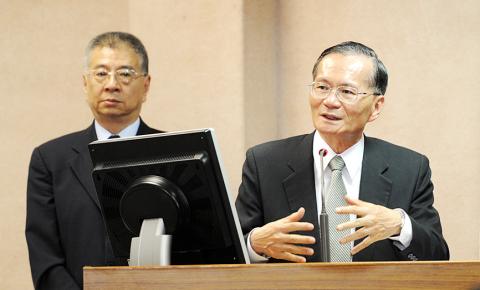
Photo: Lo Pei-der, Taipei Times
However, the CGA did not return fire, he said, but added that its officers should have fired back to protect the territory.
The marine corps should be invited back to safeguard Taiwan’s interests, he said.
CGA personnel have been stationed on Taiping since the marines pulled out in 1999, but legislators have asked the government to deploy military personnel or expand defense capabilities there.
Coast Guard Administration Minister Wang Ginn-wang (王進旺) said a Vietnamese military boat appeared to have fired a blank round toward a coast guard vessel on March 22, but the two sides did not have an engagement.
Deputy Minister of Foreign Affairs Tung Kuo-yu (董國猷) said a representative to Vietnam had expressed the government’s concern and protested with Vietnam’s Ministry of Foreign Affairs, but Hanoi denied that the incident took place.
Chinese Nationalist Party (KMT) Legislator Lin Yu-fang (林郁方) said the number of Vietnamese vessels coming within 6km of Taiping Island was increasing. There were 42 intrusions in 2010, 106 last year and 41 in the first four months of this year.
Lin, who visited the island with two other KMT lawmakers on Monday, renewed his call for the deployment of US-made missiles on the island and called for the construction of a large harbor to make the island more accessible.
He said he would freeze the budget for an unspecified defense program until the Ministry of National Defense had submitted an assessment of the situation in the South China Sea.
Deputy Minister of National Defense Andrew Yang (楊念祖) said the ministry would work with the CGA to strengthen the island’s defenses.
The ministry also said it had formed a special airborne unit capable of scrambling to the contested island within hours.
The unit has been set up under a plan named “airborne fast response and maritime support,” which was unveiled at the meeting in the legislature, officials said.
No details of the unit, such as its size, were released to the public, but media reports said that if needed, it could arrive on Taiping on board a C-130 transport plane within four hours.
The CGA said that troops stationed on Taiping would be armed with mortars with a range of 6,100m, nearly double the range of mortars currently in use.
The Chinese-language United Evening News reported on Wednesday that the US had voiced opposition to Lin’s suggestion of deploying Stinger missiles on Taiping.
American Institute in Taiwan (AIT) spokesperson Christopher Kavanagh clarified the report when he was asked to verify the comment by telephone later yesterday.
“The United States shares a number of national interests with the international community in the South China Sea. The US position remains clear. We support a collaborative diplomatic process by all claimants to resolve their disputes without coercion,” Kavanagh said.
“The United States does not take a position on competing sovereignty claims over land features in the South China Sea,” he said. “However, we call on all claimants to conform all of their claims — both land and maritime — to international law, including as reflected in the Law of the Sea Convention.”
Lin says the AIT has asked to meet him to discuss his call for the deployment of Stinger missiles on the island.
Additional reporting by Shih Hsiu-chuan and AFP
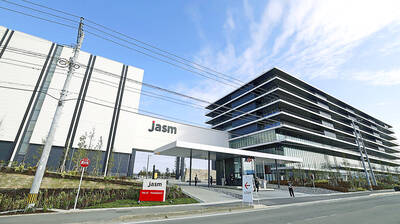
The subsidiary of Taiwan Semiconductor Manufacturing Co (TSMC, 台積電) in Kumamoto, Japan, turned a profit in the first quarter of this year, marking the first time the first fab of the unit has become profitable since mass production started at the end of 2024. According to the contract chipmaker’s financial statement released on Friday, Japan Advanced Semiconductor Manufacturing Inc (JASM), a joint venture running the fab in Kumamoto, posted NT$951 million (US$30.19 million) in profit in the January-to-March period, compared with a loss of NT$1.39 billion in the previous quarter, and a loss of NT$3.25 billion in the first quarter of
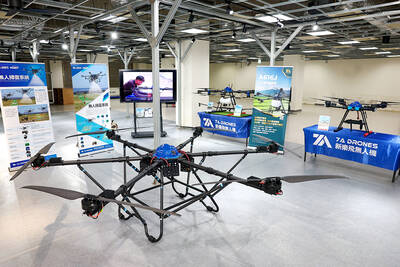
DRONE CENTRAL: Taiwan aims to become Asia’s democratic hub for drones, with most exports focused on high-quality military-grade models, an official said Taiwan’s drone industry is expected to expand significantly by 2030, producing 100,000 units per month and exporting half of them, the Ministry of Economic Affairs said yesterday. Current drone production capacity is about 15,000 units per month, but the industry can quickly scale up as demand increases, Industrial Development Administration Director-General Chiou Chyou-huey (邱求慧) told a news conference in Taipei. Taiwan’s drone output grew 2.5-fold last year to NT$12.9 billion (US$408.3 million) under a government program to develop the uncrewed vehicle sector, he said. The Executive Yuan in October last year approved plans to invest NT$44.2 billion into domestic production of uncrewed aerial
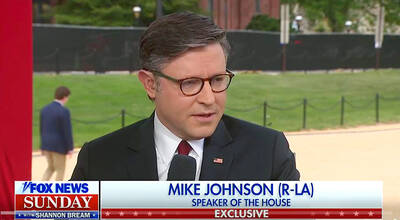
RESOLUTE BACKING: Two Republican senators are planning to introduce legislation that would impose immediate sanctions on China if it attempts to invade Taiwan US House of Representatives Speaker Mike Johnson on Sunday reaffirmed US congressional support for Taiwan, saying the US and “all freedom-loving people” have a stake in preventing China from seizing Taiwan by force. Johnson made the remarks in an interview with Fox News Sunday on US President Donald Trump’s summit with Chinese President Xi Jinping (習近平) last week. In an interview that aired on Friday on Fox News, just as Trump wrapped up a high-stakes visit to China, he said he has yet to green-light a new US$14 billion arms package to Taiwan and that it “depends on China.” “It’s a very good
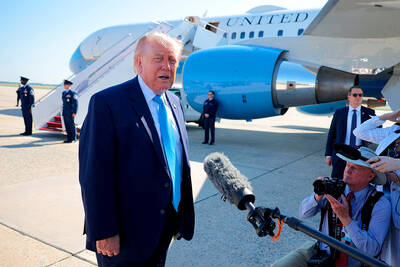
US President Donald Trump yesterday said he would speak to President William Lai (賴清德) as his administration considers whether to move ahead with a US$14 billion weapons sale to Taiwan — a potential arms deal that has drawn criticism from China. “Well, I’ll speak to him. I speak to everybody,” Trump told reporters yesterday when asked if he had any plans to call his counterpart, although he did not offer a time frame for when such a conversation could take place. Trump previously said he would speak to the person “that’s running Taiwan,” without specifying who he meant. “We have that situation very


 RSS
RSS