


The first debate of the Democratic Progressive Party (DPP) chairperson election campaign ended without an expected war of words yesterday as candidates barely mentioned crucial issues, such as China policy and party reforms.
The 150-minute televised debate between five candidates, held in Greater Kaohsiung, was the first of three debates for the May 27 vote that will elect a leader for the DPP to a two-year term.
Yesterday’s debate saw the candidates devote a surprisingly limited portion of their allotted times to China policy and party reforms, seen by most political observers as crucial factors behind the party’s loss in the January presidential election, and decide not to attack each other.
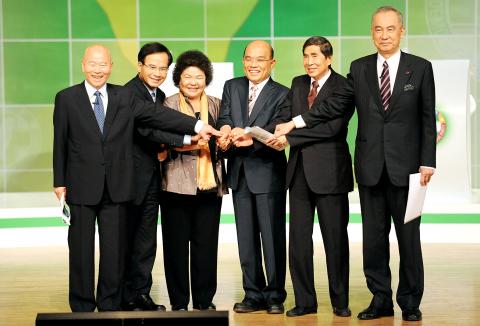
Photo: Chang Chung-yi, Taipei Times
Instead, they talked about whether the party should appeal for a presidential pardon for former president Chen Shui-bian (陳水扁) in a question raised by candidate and former DPP chairperson Hsu Hsin-liang (許信良) in the question-and-answer session, sandwiched between the opening remarks and conclusions.
Chen is serving a 17-and-a-half-year sentence for corruption and has been experiencing health problems recently.
All candidates except former premier Su Tseng-chang (蘇貞昌), widely considered as the strongest contender, supported the appeal, with Su supporting Chen’s release for medical treatment and saying that the amnesty was for the president to decide — a position that matches that of the DPP.
Relations between the party and the US became the focal point when former DPP legislator Chai Trong-rong (蔡同榮), who was known for his lobbying work in the US in the 1970s and 1980s, posed the question to his rivals, saying the absence of an endorsement by the US had hurt the party in the presidential election earlier this year.
The DPP would have to reaffirm the US as Taiwan’s most important ally, former vice premier Wu Rong-i (吳榮義) said, while Hsu said trying to change or influence US policies is a “fatal mistake” and that it would eventually backfire against Taiwan.
Su and former Tainan County commissioner Su Huan-chih (蘇煥智) said the DPP should build its connection with second and third-generation -Taiwanese--Americans to improve its outreach.
All five candidates agreed the party should establish a representative office in Washington.
The leadership hopefuls briefly touched upon the China issue. While they unanimously supported broader exchanges between the DPP and Beijing, all but Hsu, who called for “bold economic integration,” warned against increasing economic dependence on China.
However, they did not discuss what measures the party should take to initiate and maintain interaction with Beijing.
The only highlight of the debate was Su Tseng-chang’s decision not to pose a question to the others during the question-and--answer segment, which appeared to be a tactic to reduce tensions with the other candidates.
He reiterated his initiative of the “DPP 3.0 movement” and said much work has to be done to tackle the party’s three predicaments — a “blue north and green south” phenomenon, its low seat totals at the local government level and its failure to win a majority in the Legislative Yuan.
Su Tseng-chang took shots at President Ma Ying-jeou (馬英九), saying the president has performed miserably in Taiwan and abroad with his refusal to listen to the public and his passive -attitude on issues such as the South China Sea and North Korea’s missile launch.
Hsu, who has not hidden his support for former DPP chairperson Tsai Ing-wen (蔡英文) as the party’s presidential nominee in 2016 throughout his campaign, again pledged his support for Tsai.
Hsu, a two-time DPP chairperson, stressed his experience and leadership in the party’s past legislative victories in 1992 and 1997, saying that he is “not only a bold and romantic thinker, but also a leader who knows how to win.”
The other two debates will be held in Greater Taichung next Sunday and in Taipei on the following Saturday.
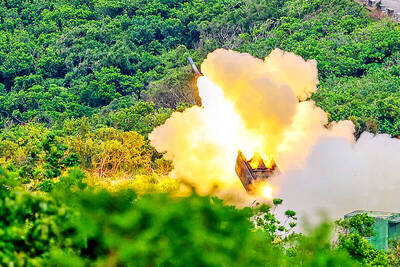
PRECISION STRIKES: The most significant reason to deploy HIMARS to outlying islands is to establish a ‘dead zone’ that the PLA would not dare enter, a source said A High Mobility Artillery Rocket System (HIMARS) would be deployed to Penghu County and Dongyin Island (東引) in Lienchiang County (Matsu) to force the Chinese military to retreat at least 100km from the coastline, a military source said yesterday. Taiwan has been procuring HIMARS and Army Tactical Missile Systems (ATACMS) from the US in batches. Once all batches have been delivered, Taiwan would possess 111 HIMARS units and 504 ATACMS, which have a range of 300km. Considering that “offense is the best defense,” the military plans to forward-deploy the systems to outlying islands such as Penghu and Dongyin so that
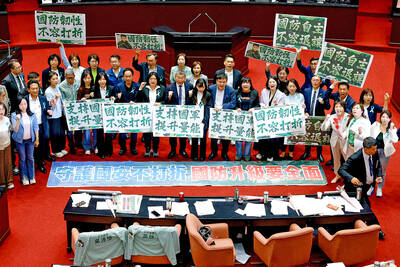
WHAT WAS ALL THAT FOR? Jaw Shaw-kong said that Cheng Li-wen had pushed for more drastic cuts and attacked him, just for the outcome to be nearly identical to his bill The legislature yesterday passed a supplementary budget bill to fund the purchase of separate packages of US military equipment, with the combined amount of spending capped at NT$780 billion (US$24.8 billion). The Chinese Nationalist Party (KMT) and Taiwan People’s Party (TPP) used their legislative majority to pass the bill, which runs until 2033 and has two main funding provisions. One was for NT$300 billion of arms sales already approved by the US for Taiwan on Dec. 17 last year, the other was for NT$480 billion for another arms package expected to be announced by Washington. The bill, which fell short of the NT$1.25
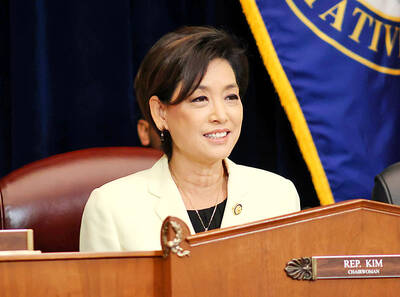
‘CLEAR MESSAGE’: The bill would set up an interagency ‘tiger team’ to review sanctions tools and other economic options to help deter any Chinese aggression toward Taiwan US Representative Young Kim has introduced a bill to deter Chinese aggression against Taiwan, calling for an interagency “tiger team” to preplan coordinated sanctions and economic measures in response to possible Chinese military or political action against Taiwan. “[Chinese President] Xi Jinping [習近平] has directed the People’s Liberation Army to be ready to invade Taiwan by 2027. China has a plan. America should have one too,” Kim said in a news release on Thursday last week. She introduced the “Deter PRC [People’s Republic of China] aggression against Taiwan act” to “ensure the US has a coordinated sanctions strategy ready should

A former television news host and six military personnel — active and retired — have been indicted on espionage charges, Kaohsiung prosecutors said yesterday. Lin Chen-you (林宸佑), a former CTi News host and YouTuber, last year allegedly made videos at the direction of a Chinese agent criticizing the Democratic Progressive Party’s recall campaign, the Ciaotou District Prosecutors’ Office told a news conference in Kaohsiung. He allegedly received 4,325 tether coins for the videos from an unidentified person surnamed Huang (黃), believed to be an agent of a hostile foreign power, they said. Lin, also known as Ma Te (馬德), has a show named


 RSS
RSS