


Washington Nationals pitcher and “Pride of Taiwan” Wang Chien-ming (王建民) on Monday night admitted he had a months-long extramarital affair while he was recovering from a shoulder injury in 2009.
“I sincerely apologize to the fans who have been supporting me,” Wang told a press conference in Viera, Florida. “I’m sorry I set a bad example and I let you down.”
Fans were shocked to hear the confession from their baseball hero, a man of few words known for his image as a family man. That positive image has also made him one of the most-wanted spokespersons for local businesses, from a laptop computer manufacturer to a blood bank.

Photo: Lu Chun-wei, Taipei Times
Haltingly reading from a statement, Wang said the relationship started after he completed surgery on his right shoulder three years ago.
“After the operation in 2009, I did not know if my career as a professional baseball player was over,” Wang said. “Because of the long rehabilitation process, I was depressed and felt helpless and hopeless every day. I lost balance between my physical and psychological life. I had an extramarital affair at a low point in my life.”
Wang said the relationship lasted about eight months and that he decided to terminate it because he could no longer live with the “strong sense of guilt.”
Even after he ended the affair, the woman continued to seek every means possible to resume the relationship and even threatened to expose the affair to the media.
“I really do not want to hurt this lady,” Wang said. “But weighing on the situation, the people I should not hurt are my family.”
Wang said he could not describe how sorry he was for the harm he had caused his wife and family as a result of a momentary weakness and that he was willing to pay the price for his action.
He said he felt even more ashamed after his wife and family chose to forgive him.
“I cannot let my family go through the suffering again,” Wang said. “I sincerely ask our friends in the media not to ask them any more questions. They are innocent and have been forced to bear such pressure.”
Asked how Wang’s spouse, Wu Chia-ling (吳嘉姈), reacted when she learned of the affair, Wang’s agent, Alan Chang (張嘉元), said she was devastated at first, but had chosen to forgive her husband to preserve their family, adding that they would work together to maintain the family and move on.
Media have identified the woman with whom Wang had an affair as a Taiwanese American known as “Cyndi.”
In an interview with the Chinese-language Next Magazine, she said she did not know Wang was a Major League Baseball pitcher, nor did she know he was married.
Asked if the Nationals knew about the affair, Wang said the team only asked him to confront the matter honestly and said would not affect his career with the team.
Wang made his major league debut for the New York Yankees in 2005 and went on to win 19 starts in both the 2006 and 2007 seasons. He was at one point the highest-paid Taiwanese player in the major leagues.
He has been with the Washington Nationals organization since 2010, but he did not make his return to the majors until last year.
He is currently on the 15-day disabled list.
Additional reporting by staff writer

The subsidiary of Taiwan Semiconductor Manufacturing Co (TSMC, 台積電) in Kumamoto, Japan, turned a profit in the first quarter of this year, marking the first time the first fab of the unit has become profitable since mass production started at the end of 2024. According to the contract chipmaker’s financial statement released on Friday, Japan Advanced Semiconductor Manufacturing Inc (JASM), a joint venture running the fab in Kumamoto, posted NT$951 million (US$30.19 million) in profit in the January-to-March period, compared with a loss of NT$1.39 billion in the previous quarter, and a loss of NT$3.25 billion in the first quarter of

DRONE CENTRAL: Taiwan aims to become Asia’s democratic hub for drones, with most exports focused on high-quality military-grade models, an official said Taiwan’s drone industry is expected to expand significantly by 2030, producing 100,000 units per month and exporting half of them, the Ministry of Economic Affairs said yesterday. Current drone production capacity is about 15,000 units per month, but the industry can quickly scale up as demand increases, Industrial Development Administration Director-General Chiou Chyou-huey (邱求慧) told a news conference in Taipei. Taiwan’s drone output grew 2.5-fold last year to NT$12.9 billion (US$408.3 million) under a government program to develop the uncrewed vehicle sector, he said. The Executive Yuan in October last year approved plans to invest NT$44.2 billion into domestic production of uncrewed aerial

RESOLUTE BACKING: Two Republican senators are planning to introduce legislation that would impose immediate sanctions on China if it attempts to invade Taiwan US House of Representatives Speaker Mike Johnson on Sunday reaffirmed US congressional support for Taiwan, saying the US and “all freedom-loving people” have a stake in preventing China from seizing Taiwan by force. Johnson made the remarks in an interview with Fox News Sunday on US President Donald Trump’s summit with Chinese President Xi Jinping (習近平) last week. In an interview that aired on Friday on Fox News, just as Trump wrapped up a high-stakes visit to China, he said he has yet to green-light a new US$14 billion arms package to Taiwan and that it “depends on China.” “It’s a very good
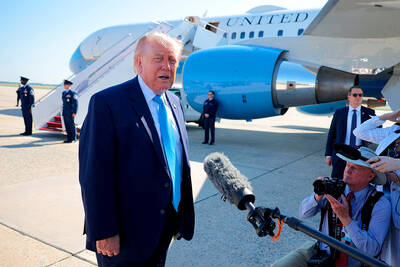
US President Donald Trump yesterday said he would speak to President William Lai (賴清德) as his administration considers whether to move ahead with a US$14 billion weapons sale to Taiwan — a potential arms deal that has drawn criticism from China. “Well, I’ll speak to him. I speak to everybody,” Trump told reporters yesterday when asked if he had any plans to call his counterpart, although he did not offer a time frame for when such a conversation could take place. Trump previously said he would speak to the person “that’s running Taiwan,” without specifying who he meant. “We have that situation very


 RSS
RSS